

[비즈한국] The universe is expanding. This is a reality of the universe that has persisted ever since it began with the Big Bang 13.8 billion years ago. But it doesn't end there. We still don't know the exact answer to how fast or how exactly the universe is expanding. More precisely, as we dig deeper into the universe, the problem only becomes more complex.
Today, astronomers estimate that the acceleration of the universe's expansion began in earnest about 7 billion years ago. To explain this accelerated expansion, it is simply assumed that the entire universe is filled with an unknown energy called dark energy.
While no one yet knows the true nature of dark energy, there has been an important premise that has been agreed upon for nearly 20 years: that the density of dark energy has remained constant from the beginning of time to the present day. Unlike dark matter and light, whose densities decrease rapidly as the universe expands and its volume increases, it was assumed that dark energy has always maintained a uniform density. It is as if the total amount of dark energy increases as the volume increases. Only then could we understand the accelerated expansion of the universe, which only continues to get faster.
However, that belief has recently been shaken. Perhaps dark energy has been gradually decreasing as time passes. It seems as if the universe, which once stepped hard on the accelerator of expansion, is slowly taking its foot off the pedal. It is true that the expansion is still accelerating because the accelerator is still being pressed, but it means that the degree of that acceleration appears to be slowly decelerating. Perhaps the ‘time’ of the universe has flowed differently according to time.
Many people mistakenly believe that dark energy is a concept that suddenly popped out of nowhere—that a new concept called the accelerated expansion of the universe and dark energy appeared for the first time due to supernova observations in 1998. However, that is a clear misunderstanding. The argument that additional energy, such as negative pressure that defies gravity, must be acting in the universe has existed long before that.
Early on, Albert Einstein felt uncomfortable with the fact that his equations pointed to a universe that should collapse under its own gravity. And to ensure the universe could hold up without collapsing, he arbitrarily added a new term that resisted gravity. When you get down to it, it was a term added based on personal preference rather than any physical basis. This is called the cosmological constant, lambda (Λ). As the name ‘constant’ suggests, it was thought that this entity resisting gravity would always have a constant value from the past to the present.
Later, as cosmological simulations using computers began to become possible in earnest, the perception that Einstein's stopgap measure was a very appropriate one took strong root. In fact, without applying Einstein's cosmological constant, lambda, the simulated universe could not withstand its own gravity and would collapse rapidly.
In 1995, just before the supernova observation results were announced, astronomer Jeremiah Ostriker published a paper in 'Nature' arguing that a lambda was absolutely necessary to implement the actual appearance of the universe by establishing a cosmological model where the cosmological constant is not zero. As such, the necessity of lambda was already strongly demanded among theoretical astrophysicists. Shortly thereafter, evidence that lambda was actually at work in the universe was captured through observations by observational astronomers of supernovae.
Even though the margin of error was very large because it was based on only about 40 supernova observations, this discovery was quickly accepted because everyone had been waiting for the existence of such a thing to be confirmed. The concept of dark energy, or lambda, did not simply “pop up” overnight without any basis. The discovery of the universe's accelerated expansion and dark energy was the answer that everyone had been waiting for from the universe for a long time.
The current standard cosmology, which talks about a universe composed of dark energy, lambda, and cold dark matter that only reacts to gravity, is called the ΛCDM (Lambda-CDM) model. Although it explains the universe very well, one must admit the fact that we still do not know the true nature of lambda. To look more properly into the secrets of this dark energy, astronomers are conducting a new observation project solely for dark energy. Even the name includes dark energy: the ‘Dark Energy Spectroscopic Instrument’ (DESI). It maps galaxies across the universe using a 4-meter telescope located at the Kitt Peak National Observatory in Arizona, USA.
Recently, the DESI team released image and spectral data for 18.7 million celestial objects observed so far. Among them, only 4 million are stars filling our Milky Way. It also includes 13 million galaxies outside our Milky Way, and even 1.6 million quasars spewing bright flashes from the edge of the universe. This is just a tiny fraction of the DESI observations that will be completed in the future. A much larger amount of data is expected to pour in.
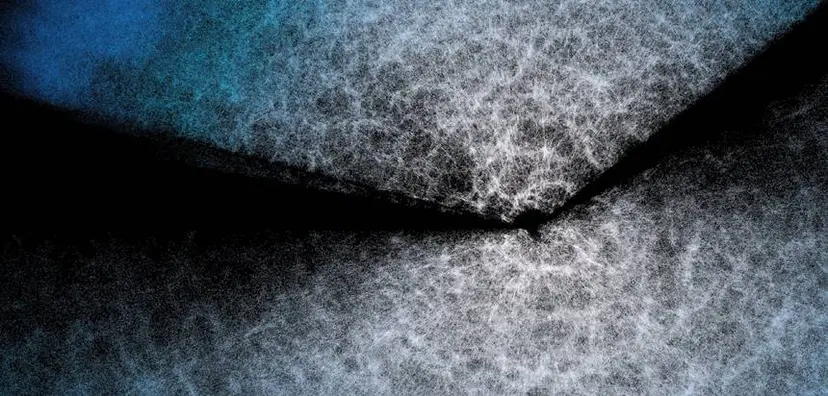
To confirm whether the universe has been pressing the accelerator with the same intensity from the past to the present, one needs to look at how the expansion rate of the universe has changed from the distant past to the present. To do this, one must accurately measure the distance to very distant galaxies. Usually, variable stars or supernovae are used, but this is not useful for large-scale observations like DESI. Variable stars are ordinary stars after all, so it is difficult to distinguish them one by one if the distance is too far. Supernovae are bright, but it is impossible to predict when or where they will explode, so it is purely a “game of luck.” Therefore, DESI uses another distance measurement tool that might seem a bit unfamiliar.
The early universe was in a high-temperature plasma state. Light and particles were all mixed together. Light could not move freely within the soup of high-density particles that densely blocked its path. Meanwhile, during this period, the universe was governed by quantum mechanics. Density fluctuations, where energy was randomly higher or lower, boiled up everywhere. High-density areas pulled in surrounding material with slightly stronger gravity, while at the same time, the temperature rose, pushing material away with light pressure. In the process of this tug-of-war between gravity and light pressure, a pressure wave similar to sound was formed and spread out in all directions. These cosmic sound waves spread out around the peaks of density fluctuations where the density was slightly higher throughout the universe.
As the universe gradually expanded, its temperature cooled, and the intensely boiling particles recombined into electrons and atoms, clearing the universe. Light squeezed through the gaps between particles and spread freely, and light pressure no longer left ripples on the particles. The sound waves of the initial density fluctuations that had spread until that very moment were imprinted intact onto the universe. The vibrations formed at this time remained as traces in the distribution of matter in the early universe, and new galaxies were created around the higher-density areas formed by these round, spreading waves.
The size of the initial vibrations is specific. Considering the scale of the universe that has expanded to the present, the vibrations should have spread to a radius of approximately 490 million light-years. Surprisingly, if you draw a map of the galaxies actually distributed in the universe today, it is statistically more common to find two galaxies separated by a distance of 490 million light-years than would be assumed if the galaxies were spread out randomly. This clearly shows that light and matter were intertwined in the beginning, and as they separated at a certain point, a specific size of imprint was left on the universe. These traces of vibrations that spread and remained like sound waves in the early universe are called Baryon Acoustic Oscillations (BAO).
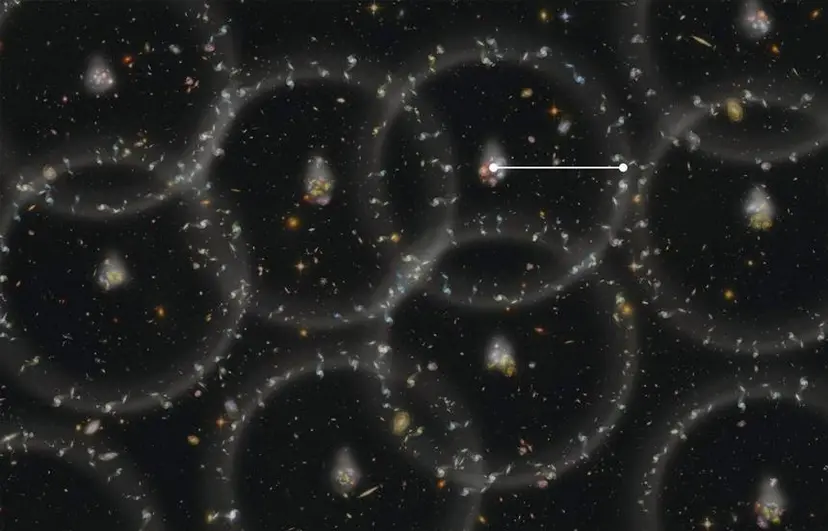
As explained earlier, BAO is specific to a precise scale. It becomes a kind of standard yardstick for which we know the exact distance. If we statistically compare the distance intervals of galaxies distributed in the distant universe, we can measure the BAO scale there. Since we already know the actual scale of BAO, comparing this allows us to know how far the galaxies are. Furthermore, comparing their distance and the speed at which they are moving away from us allows us to naturally determine the expansion rate of the universe in the distant past.
However, this alone has limitations. So, the DESI team added several constraints that reflect the evolution of the universe. For example, they applied conditions like Big Bang nucleosynthesis, which shows the ratio of elements created in the early universe. Through this, the DESI team estimated the Hubble constant, which shows the expansion rate of the universe, to be around 68.5±6. This is very close to the 67.4±0.5 estimated based on the cosmic microwave background, the residual heat of the Big Bang spread across the universe. It raises expectations that the conundrum of the "Hubble tension," which has plagued astronomers because the Hubble constants estimated by the two methods—the recession of galaxies and the cosmic microwave background—have come out so differently, might finally be resolved.
But the real problem starts after this. As more diverse constraints are applied to the DESI data, it deviates further and further from the existing ΛCDM model. Eventually, astronomers arrived at a bold attempt: applying a new model called the CPL (Chevallier–Polarski–Linder) model. Instead of a lambda that is always constant—the cosmological constant—they inserted dark energy that evolves over time. This means that the dark energy variable 'w', applied in the universe's equation of state, is not always constant at -1, but has a rate of change.
If the existing standard model is correct and dark energy is always constant, 'w' should be -1 and its rate of change, 'wₐ', should be 0. However, if we combine the DESI data with the standard candle data using the cosmic microwave background and supernovae, 'w' converges to -0.75. Statistically, this result reaches up to 4.2 sigma. This means there is only about a 0.1% chance that this result is a simple statistical coincidence. In science, it is usually said that a signal exceeding 3 sigma is a meaningful one worth paying attention to. Of course, it has not yet reached 5 sigma, which is the standard for "certain evidence" in science, but it clearly implies that a change is occurring in our universe and our view of it.
Therefore, some astronomers recently argue for the need to abandon the existing ΛCDM model, which fixes lambda as a constant, and switch to a new model. This model is called the w₀wₐ-CDM model. Here, w₀ refers to the current 'w', and wₐ refers to its rate of change. In other words, to talk about 'w' at a specific point in the past, one cannot simply assume it is the same as the current 'w'; one must multiply by the rate of change during that time to discuss how much larger or smaller 'w' was in the past.
The DESI team's new results fundamentally alter the ending of our universe. According to the existing model, which assumed that dark energy would be consistently maintained, the universe's accelerated expansion would gradually become uncontrollably faster, leading to a "Big Rip" where everything is scattered and destroyed at the atomic level. It would reach a thermal death where all light and heat vanish. However, if we see that dark energy exists but gradually decreases, as these results suggest, the acceleration of the universe's expansion could gradually approach 0, potentially leading to a "Big Freeze" where the universe slowly cools down. If the universe follows this fate, large-scale structures of the universe, such as galaxy clusters and superclusters, would survive for a longer time.
One can also imagine something more extreme. What if the universe is not just slowly taking its foot off the accelerator of expansion, but moving its foot to the brake next to it? If so, someday the expansion of the universe will stop and it will begin gravitational collapse again. And it could meet the fate of a "Big Crunch," where the universe returns to the state immediately after the Big Bang. Of course, this is a story for long after we have all disappeared, but isn't it truly fascinating that we can now talk about the unfathomable distant future not just with simple imagination, but with actual data?
Reference
https://ui.adsabs.harvard.edu/abs/2025arXiv250314738D/abstract
About the author Ji Woong-bae? He loves cats and the universe. After watching 'Galaxy Express 999' as a child, he developed a dream of making the beauty of the universe known. He is currently researching galaxy evolution through interactions at the Yonsei University Galaxy Evolution Center and the Near Cosmology Lab, and is engaged in various science communication activities, including lectures and writing. He is the author of books such as 'The Observatory of Summer Love', 'Thinking About the Universe All Day', and 'Stars, the Science of Light'.