

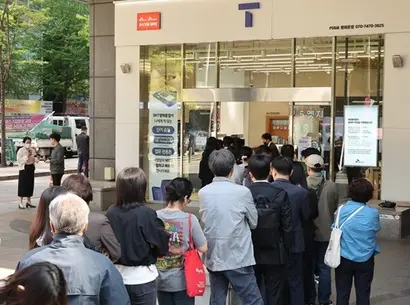
[비즈한국] SK Telecom017670 is facing growing backlash after a hacking incident led to the leak of some customer information related to USIM (Subscriber Identity Module) cards. Starting the 28th, SK Telecom began offering free USIM replacements for all subscribers. However, many customers are returning home empty-handed despite lining up at branches due to a shortage of USIM stock, and the company website is inaccessible due to a surge in traffic from users waiting in the queue. There is even talk among subscribers of organizing collective action.
Kim A-ram, an analyst at Shinhan Securities, stated, "Although the company has promised free USIM replacements for all customers and 100% compensation in the event of damages following the subscription of their USIM protection service, concerns regarding financial fraud and the creation of 'burner phones' continue to be highlighted."
This anxiety is also impacting SK Telecom’s stock price. Opening at 55,500 won, down 3.98%, the stock saw its decline deepen to over 7% on the same day. This is due to concerns that the financial burden of replacing USIMs for the entire user base (25 million people) will increase. Furthermore, as the initial response has failed to meet consumer expectations, signs of customers moving to other mobile carriers are being detected.
Analyst Kim A-ram noted, "Assuming all customers replace their USIMs, the financial burden would be around 170 billion won. While this is unlikely to lead to a cut in shareholder returns—a key factor for the stock price—it is essential for the number one telecommunications provider to secure its reliability."
According to Yuanta Securities, SK Telecom is projected to reach 17.8 trillion won in consolidated revenue and 2 trillion won in operating profit this year. If we assume the response costs for this incident amount to 170 billion won, the impact on revenue is negligible, but it represents an 8–9% reduction in operating profit, a level that is difficult to ignore.
In particular, because SK Telecom has maintained market-leading levels of shareholder returns, any reduction in earnings will inevitably put indirect pressure on dividends. Even if the company is unlikely to cut dividends solely due to these costs, investors have come to expect consistent dividend income, meaning the market is bound to react sensitively, and there is a possibility that the stock price will be affected for the time being. Furthermore, given the severity of the inconvenience faced by many subscribers and the fact that restoring trust and addressing damages should be the priority, it is necessary to approach investment cautiously for the moment.
That said, the brokerage industry expects SK Telecom's first-quarter performance for this year to be solid. Observers believe that due to the cost-cutting effects from large-scale voluntary retirements last year, stable wireless revenue based on 5G, and the AI business, the company will continue its earnings growth not only in the first quarter but throughout the year. As SK Telecom continues to show business growth in 5G and AI, its fundamentals remain positive, but for now, additional risk factors such as subscriber churn and damage compensation issues must be considered.
Similar incidents occurring overseas are making cybersecurity investment a global trend. According to The Wall Street Journal, the U.S. government confirmed at the end of last year that the Chinese hacker group 'Salt Typhoon' had breached the networks of nine U.S. telecom carriers. Salt Typhoon reportedly carried out large-scale hacking operations targeting U.S. political figures, including President Trump and Vice President Vance. Following this, the U.S. Congress passed a bipartisan cybersecurity enhancement bill, requiring both government and private enterprises to significantly increase investments in cybersecurity.
Ultimately, investor interest in related companies is rising due to increased U.S. government spending, IPOs of cybersecurity firms, M&A activity by big tech, and growing cybersecurity spending worldwide.
Domestically, the SK Telecom hacking incident has also led to a significant surge in interest in USIM-related and cybersecurity-related stocks. On this day, USIM suppliers Ubivelox089850 and Xcure091440 hit the daily upper limit, while Hansol Inticube070590, Kona I052400, Sands Lab, KSign, and Dream Security also saw gains. However, even if security-related stocks have short-term momentum, it remains to be seen whether this will translate into actual earnings improvement.