

[비즈한국] The Korea Art Support Project, which began as an initiative solely to support artists, has continued for 10 years. Staying true to our original intent, we have supported over 230 artists. This was a unique undertaking that no other media outlet, cultural organization, or state agency in Korea had attempted. We take pride in the fact that this decade of persistence has become a value etched into the 21st-century Korean art scene. As such, the 10-year history of the Korea Art Support Project is recognized as a vantage point for observing the flow of contemporary Korean art. Now, in Season 11, we intend to pave yet another path for Korean art.
When analyzing a painting, various elements are organically connected and woven in a highly complex manner. The more valuable a painting is, the higher its density of composition.
The most fundamental elements are content and form. The relationship between the two is like that of "water and a vessel." Form that suits the content is a prerequisite for a good painting. If content and form align, the result is beautiful; otherwise, it fails to reach the level of art. What if you were to pour wine into a gourd to drink it? While the taste itself would remain the same, it would be difficult to truly appreciate it as intended. Wine is best enjoyed in a wine glass. If wine is the content, the wine glass is the form.
Content is the artist's thought. A perspective on the world is shaped based on the environment one has lived in and the experiences one has gathered. This develops into the artist's thoughts, becoming the content of the painting. Form is the hardware that holds the content, consisting of techniques, materials, texture, and color.
We experience and appreciate a painting by observing the result of its form. This is why form is critical in painting and serves as a standard for judging an artist's individuality. The most important aspect of form is composition. What artists spend their entire lives trying to find in their painting is the creation of their own unique composition. Composition acts as the skeleton that creates the basic framework for all art.
Music composition is an art that demonstrates the essence of "composition." Using notes—which are abstract by nature—composers create concrete images through composition. The skill of arranging and combining notes is composition, and it is through this that people are moved.
Cinema is an art form where complex compositions weave together to deliver universal emotional impact. Having established itself as the most influential art form of our time, film is a genre where the beauty of composition shines. In film, it is called editing, where video and sound are pieced together like Lego blocks to convey the message the director intends.
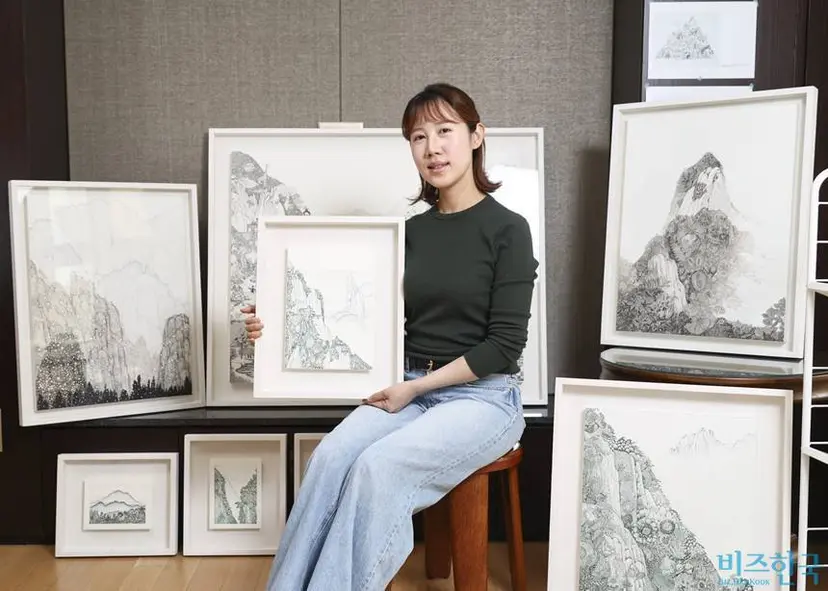
The most striking aspect of artist Lee Mi-hee's paintings is also the power of composition. Based on experiences gained through travel, she weaves her own stories. These stories are not grand; they are about the world as seen from her own perspective, the environment in which she has lived, and the experiences she has gained while rubbing shoulders with the world.
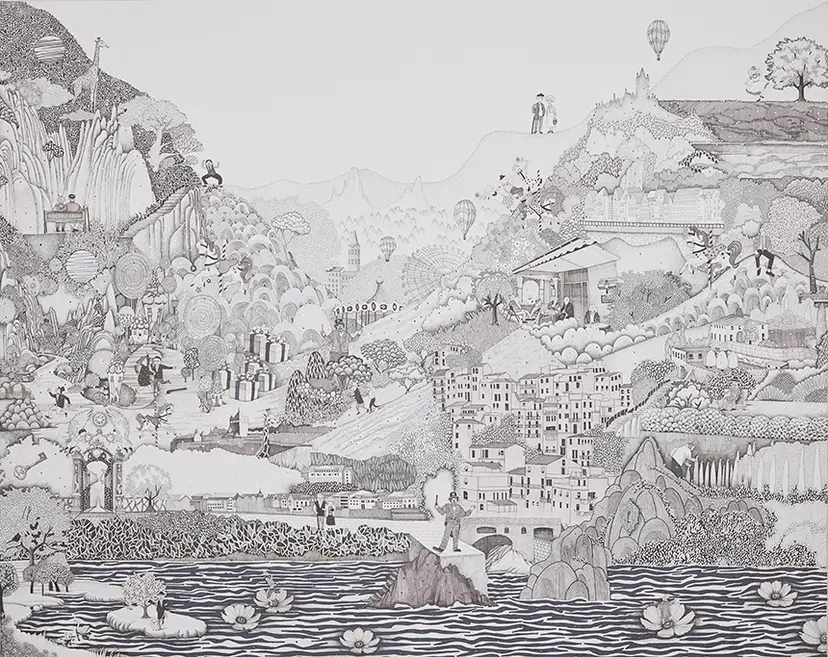
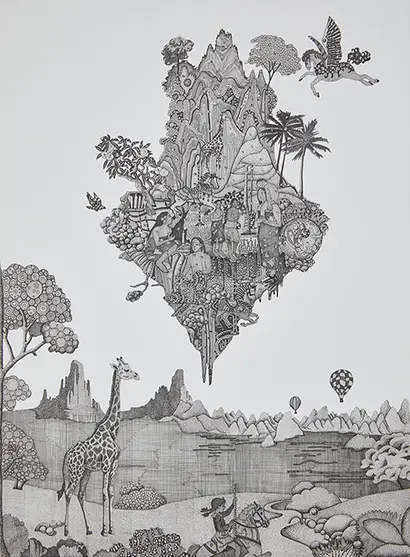
To convey this content persuasively, she has created her own unique form. She uses a drawing pen to render subjects in delicate detail, connecting various situations to present landscapes that evoke the atmosphere of traditional painting. It looks as if a section of a landscape painting has been captured in monochromatic tones.
However, the elements that form these landscapes are diverse. Trees and grass are visible, as are rocks, the sea, houses, cars, and even food. People of all ages and occupations also appear. All of these are subjects Lee Mi-hee has encountered throughout her life. Her ability to organize all of this into a single landscape is exceptional. That is why one finds themselves meticulously examining Lee Mi-hee's paintings.