

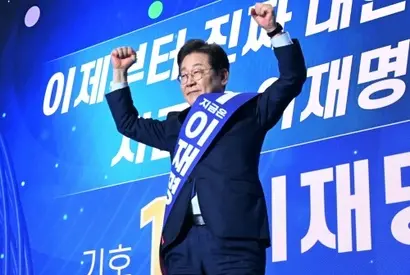
[비즈한국] The result was unprecedented and overwhelming. With the conclusion of the primaries in the Seoul metropolitan area, Gangwon, and Jeju on the 27th, Lee Jae-myung, the Democratic Party's presidential primary candidate, secured the nomination for the 21st presidential election with a final cumulative vote share of 89.77%. Following his victories in the Chungcheong, Yeongnam, and Honam regions, he maintained a vote share well over the majority in the capital region as well. With this, Lee secured his ticket to the main election without the need for a runoff, and the Democratic Party officially declared him its final candidate for the 21st presidential election.
Candidate Lee Jae-myung has enjoyed steadfast support throughout the nationwide tour of primaries. After recording a high vote share of 88.69% in the Honam region—considered a key battleground following the Chungcheong and Yeongnam regions—he solidified the "inevitability" of his candidacy by garnering 91.66% support in the capital region. He secured balanced votes from both party members with voting rights and delegates, and by gaining overwhelming support in the Seoul, Gangwon, and Jeju areas, he cemented his dominant position.
In this primary, the Democratic Party elected its final candidate by combining 50% of the party member vote with 50% of the public opinion poll. Lee received consistent support across all regions and demographics, uniting the party's base. Standing at the starting line for the main election, Lee vowed to achieve victory, stating, "Overcome internal turmoil and restore democracy. Recover people's livelihoods and revive the economy. Unifying the people and advancing into the world is the supreme command given by the 2.5 million party members and the citizens who support the Democratic Party."
While the debate between the ruling and opposition parties continues to intensify regarding the declaration of martial law and the end of internal turmoil during the era of former President Yoon Suk-yeol, both sides share a consensus on the need to respond to the worsening global trade environment—caused by high-tariff policies from U.S. President Trump—and the domestic economic downturn. Beyond political responsibility, there is no disagreement that policy capability to effectively overcome the economic crisis will be the most important task for the next administration.
In this context, it is worth focusing on the economic pledges of leading presidential candidate Lee Jae-myung. The core message permeating his economic platform is 'balanced regional development and a great economic transformation led by future industries.' He has presented a consistent strategy to boost regional competitiveness by maximizing the unique industrial and cultural characteristics of each region, including the Seoul metropolitan area, Chungcheong, Gangwon, Honam, Busan-Ulsan-Gyeongnam (Bu-Ul-Gyeong), and Jeju. His plan is to resolve the over-concentration in the capital region and foster each region into a 'global hub' that directly connects with the world market. This approach goes beyond mere regional support and reflects his determination to reorganize the entire Republic of Korea into a multi-polar economic structure.
Another pillar is the 'cultivation of cutting-edge industries as future growth engines.' Lee emphasized that he would shift the paradigm of the Korean economy from a 'follower' to a 'leader' by actively fostering high-value-added industries such as semiconductors, bio, renewable energy, AI, defense, and aerospace. In particular, he focused on securing new growth engines through industrial convergence, such as an 'Energy Highway,' 'RE100 Industrial Complexes,' and 'Smart Agriculture.' This presents a long-term vision that encompasses global trends like carbon neutrality, food sovereignty, and energy security, moving beyond simple industrial promotion.
Lee's economic vision aims for "the recovery and growth of the Republic of Korea, and a leap forward into a true leading nation." His policy ideas—building infrastructure that densely connects the entire country, creating an industrial base with global competitiveness, and simultaneously easing inequality while promoting region-led growth—are aligned with the direction of building an economic constitution that is resilient to external shocks and sustainable internally. Lee has infused his consistent philosophy—"The Republic of Korea thrives only when its regions thrive, and the country becomes strong only when its future industries are strong"—into his overall economic policy.
Regional Balanced Development Strategy: "Multi-polar Growth System for Global Competitiveness"
Democratic Party presidential candidate Lee Jae-myung has presented a 'Great Transformation of the Balanced Regional Economy' strategy to turn the entire country into a hub for future growth as a solution to overcome the structural limitations of the Korean economy. His plan is to connect the capital and the provinces in a multi-polar way, directly linking the unique industries and cultures of each region to the world market. Lee has proposed building a regional economic ecosystem with self-sustaining competitiveness, going beyond simple fiscal injection.
For the capital region, the key is strengthening global competitiveness. He presented a roadmap to foster Seoul as a global financial and business hub on par with New York and London; Incheon as an international gateway for the bio and logistics industries; and Gyeonggi as the world center for semiconductors and high-tech industries. He also actively promised the expansion of transportation infrastructure, including connecting the Yeouido financial hub to the Yongsan International Business District, creating a semiconductor mega-cluster, and completing GTX-A, B, and C lines while pursuing new GTX-D, E, F, and GTX Plus lines.
The Chungcheong region will be reorganized to function as an 'administrative and scientific capital area.' He plans to establish the National Assembly's Sejong branch and the presidential office in Sejong to complete it as a full-fledged administrative capital, while elevating Daejeon into a global scientific capital centered on AI and the space industry. North Chungcheong is slated to become a center for bio-health, secondary batteries, and semiconductors, while South Chungcheong will be fostered as a hub for the display industry. Large-scale transportation projects, such as the Central Region East-West Cross-Island Railway and the Seoul-Metropolitan Inland Line, will also be pursued simultaneously.
Bu-Ul-Gyeong is set on becoming a global maritime economic zone. Busan will be turned into a global logistics hub through the relocation of the Ministry of Oceans and Fisheries, the creation of a shipping and shipbuilding cluster, the new Gadeokdo airport, and the opening of Arctic routes. Ulsan will focus on eco-friendly future vehicles and the advancement of the petrochemical industry, while South Gyeongsang will be nurtured as a global center for the aerospace and defense industries. The plan also includes building a Bu-Ul-Gyeong metropolitan transport network, the early opening of the Bujeon-Masan double-track railway, and lowering tolls for the Geoga and Machang bridges to realize a 30-minute living sphere.
The Honam region is to be restructured into an 'AI Energy Megacity.' Gwangju will be fostered as an AI-centric city by expanding AI data centers and computing centers, while Jeonju will become a specialized financial city for asset management. Yeosu and Gwangyang will shift their industrial structures toward eco-friendly chemical industries and hydrogen-reduction steelmaking technologies, while Saemangeum will be home to a secondary battery specialized complex and an RE100 industrial park. Expansion of seawater circulation in Saemangeum, the construction of an offshore wind power cluster, and regional income generation through "sun and wind pensions" will also be promoted.
The Gangwon State will be transformed into a center for peace and new energy industries. It will lead the East Sea economic zone through the cultivation of floating offshore wind power and hydrogen energy, while Chuncheon, Wonju, and Gangneung will be nurtured as hubs for cutting-edge medical and digital industries. Connectivity with the capital region will be strengthened through the construction of GTX-B (extension to Chuncheon), GTX-D (extension to Wonju), the Gangwon Inland Line, and the East-West Peace Expressway. Border areas will be developed into peace-economy special zones to create a foundation for inter-Korean exchange.
Jeju will focus on building a leading model for carbon neutrality. It aims to complete a clean energy system based on offshore wind, solar, and green hydrogen, and accelerate the shift to eco-friendly mobility with the goal of 100% electric vehicle adoption. The designation of a distributed energy special zone, the expansion of sun and wind pensions, and zero-carbon housing and de-plasticization innovation policies will also be pursued. Furthermore, he presented a plan to leap forward as a digital tourism city by expanding international MICE (Meetings, Incentives, Conferences, Exhibitions) infrastructure and promoting long-stay tourism.
Candidate Lee Jae-myung's regional economic pledges are evaluated as an attempt to establish the entire nation as an equal subject of growth, moving beyond the model of concentration in the capital region during the high-growth era. His economic blueprint to transform the Republic of Korea from a 'follower' into a 'leader' reflects a determination to change the very structure of the economy, rather than simply providing support.
Declaring an 'Industrial Transformation' to Change the Economic Constitution
Democratic Party candidate Lee Jae-myung has proposed an 'Industrial Transformation' to fundamentally change the constitution of the Korean economy. He aims for a multi-dimensional structural reorganization that encompasses cutting-edge technology, energy transition, food security, and cultural soft power, rather than just fostering one or two industries. Lee emphasizes that as the world undergoes rapid shifts, the Republic of Korea must rise not as a 'follower' but as a 'leader.'
The starting point of the industrial transformation is semiconductors and artificial intelligence (AI). Lee plans to create a semiconductor mega-cluster and a global AI convergence research hub centered on the capital and Chungcheong regions, creating a "super-gap" ecosystem where data, semiconductors, and software are connected. This is expected to be the first gateway to transitioning from simple manufacturing to an intelligent industrial structure.
Energy and climate crisis response are also key pillars of the industrial transformation. Lee stated that he would spread a renewable energy-based manufacturing ecosystem nationwide through the construction of an 'Energy Highway' and RE100 industrial complexes. From the West Sea offshore wind grid to a U-shaped maritime power grid on the Korean Peninsula, the strategy is to simultaneously pursue balanced regional development and green growth through large-scale infrastructure innovation.
The defense industry will also break away from the framework of traditional manufacturing and be reorganized around cutting-edge technology. Lee presented a blueprint to elevate the Republic of Korea into one of the world's top four defense powers by fostering K-Defense startups, expanding military service exceptions, and widening global defense cooperation. This is expected to be a representative case of converting the manufacturing base into an export industry by fusing it with high-end R&D.
The bio-health industry has been set as an essential strategy to respond to future demographic changes. With a goal of concentrating the vaccine, immune, and anti-cancer industries around Osong, Songdo, and Hwasun, the plan is to simultaneously strengthen production and research capabilities in line with global bio-market trends. In addition, the establishment of a bio-data platform and plans for nurturing specialized talent will be pursued to aim for a sustainable healthcare foundation.
Agriculture is being restructured as a future industry that simultaneously solves climate crisis and food security. Smart farms, agro-photovoltaics, and eco-friendly agricultural technologies are placed at the center of agricultural innovation, and the sustainability of rural areas will be supported through the expansion of retirement pensions for farmers and public benefit direct payment systems. Lee's will to redefine agriculture as a strategic industry rather than just a survival industry is evident.
The cultural content industry has been set as a vanguard for strengthening South Korea's soft power. K-Content, K-Food, and K-Webtoons are focused on increasing global market share through systematic policy finance and R&D support. In particular, the expansion of content production infrastructure and stricter crackdowns on illegal distribution are intended to elevate the cultural industry into a key national growth engine, going beyond the spread of the Korean Wave.
The financial market is also taking its place as a pillar of the industrial transformation. Lee promised to strengthen fairness in the stock market, resolve the "Korea Discount," and improve the foreign investment environment, setting a goal for the KOSPI 5,000 era. This reflects the recognition that investment in innovative companies and the creation of a sound capital market are essential conditions for building a financial ecosystem that supports the industrial transformation.
Must be Accompanied by 'Delicate Policy Capability' for Execution and Sustainability
Candidate Lee Jae-myung's economic pledges contain a determination to face the challenges of regional imbalance and industrial transition that the Republic of Korea is currently confronting. The idea of growing the entire nation in a balanced manner beyond the concentration in the capital region and making future high-tech industries a new axis of national competitiveness has clear significance in its direction. The approach of respecting regional uniqueness and directly connecting to the global market can be evaluated as an attempt that transcends past symptomatic regional policies.
However, the tasks that the Korean economy must resolve remain large and heavy. Industrial reorganization and infrastructure expansion are not short-term prescriptions that will resolve structural problems that have been entrenched for decades in one go. It is pointed out that to translate such a grand design into reality, sophistication is more necessary than speed, and delicate policy capability that carefully coordinates the diversity and conflict factors of each region is essential. Above all, it must be accompanied by a cool-headed verification of feasibility and sustainability, rather than hopeful slogans.
The Korean economy is in a desperate crisis situation where nothing is easy, both internally and externally. For the vision presented by Candidate Lee Jae-myung to lead to true change, constant communication, flexible coordination, and consistency in action are required. Since keeping promises is harder than making them, firm and cautious steps are needed on the path toward his campaign slogan, "A Real Republic of Korea."