

[비즈한국] The Korea Aerospace Administration (KASA)'s attempt to convert the next-generation launch vehicle project into a reusable launch vehicle program with a 2 trillion won budget has stalled at the very first step—the specific evaluation—sparking concerns among participating companies.
While KASA maintains that it will review procedures such as the Ministry of Economy and Finance's adequacy re-examination for restructuring the preliminary feasibility study based on the results of the specific evaluation, delays to the project appear inevitable. Consequently, the start of design and component manufacturing by the prime contractor, Hanwha Aerospace012450, and its partner firms is expected to be delayed, raising concerns about the burden on companies left without work.
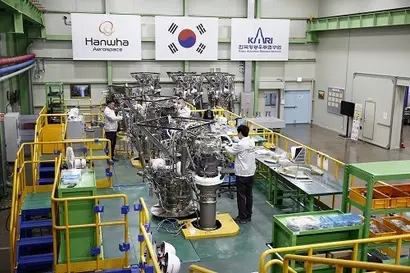
According to the Ministry of Science and ICT on the 27th, the 3rd General Committee on National Research and Development Project Evaluation for 2025, held on the 24th, discussed whether the next-generation launch vehicle development project should be subject to specific evaluation and ultimately decided not to select it.
In February, KASA announced plans to develop the next-generation launch vehicle into a reusable format and undergo a specific evaluation by the Ministry of Science and ICT's Science and Technology Innovation Office, a procedural step for restructuring R&D projects. A specific evaluation is possible when there are plan changes due to external environmental shifts that could not have been anticipated during the preliminary feasibility study, or when the project budget is increased by 15% or less.
It is reported that KASA proposed two options for the project modification: Option 1, developing a methane engine-based launch vehicle to be made reusable later, and Option 2, adding two 100-ton engines to the existing kerosene-based next-generation launch vehicle design.
However, after expert reviews, the General Committee concluded that neither Option 1 nor Option 2 qualified for the specific evaluation.
For Option 1, KASA proposed a 13% budget increase, but it was noted that experts expressed the opinion that the actual increase would likely exceed 15%. Regarding Option 2, which involves increasing the number of engines, it was suggested that because it only requires a partial budget increase, it could be handled during the budget deliberation process without the need for a specific evaluation.
While KASA’s position was that the project could be modified through a specific evaluation alone, it now appears that developing a reusable launch vehicle will require passing an adequacy re-examination or planning the project from scratch, making a blow to the original development schedule inevitable.
KASA intends to pursue follow-up administrative procedures to move forward with the reusable launch vehicle development. They are preparing a project planning report with the goal of submitting it by early May, effectively aiming for a new preliminary feasibility study. The contract fees for the system integration of the next-generation launch vehicle have barely been executed this year. These system integration fees account for approximately 950.5 billion won, about half of the total 2 trillion won project budget.
With the development schedule delayed, KASA will be unable to execute manufacturing contract payments promptly. It is predicted that Hanwha Aerospace's suppliers will face delays in receiving project funds. An industry official expressed concern, stating, "Large corporations might be able to hold out, but the harder it is for component manufacturers to receive timely payments, the more difficult their situation becomes."