

[비즈한국] As Slovakia considers Korea Aerospace Industries (KAI)047810's FA-50 for its advanced trainer jet replacement program to train pilots, the potential acquisition of the Czech L-39 Skyfox has also been raised, intensifying the competition. While the L-39 Skyfox is a trainer one tier below KAI's T-50 or FA-50, it has emerged as a strong contender due to aggressive marketing by the Czech president and the advantage of local production in Europe.
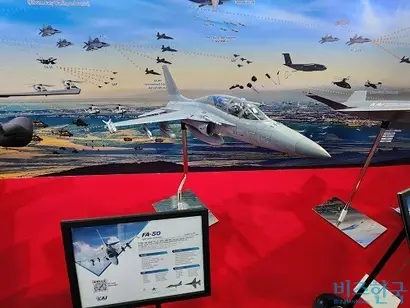
According to Slovakian media on the 25th, the Slovakian Ministry of Defense is considering a plan to introduce 12 Czech-developed L-39 Skyfox units at approximately 10 million euros (16.3 billion won) per aircraft. Slovakia has been operating L-39 advanced trainers, but because these are aging airframes developed during the Cold War, the country is pushing for a project to replace them.
Slovakia signed a contract with U.S.-based Lockheed Martin in 2018 to purchase 14 F-16V aircraft for 1.8 billion dollars (approximately 2.58 trillion won). However, the delivery schedule was delayed by more than two years due to the COVID-19 pandemic and semiconductor chip shortages. As a result, actual delivery only began last year, and as the country transitions from Russian-made fighters to American ones, a change in the pilot training system has become inevitable. Consequently, the need to replace advanced trainer jets has resurfaced.
The Czech L-39 Skyfox is a multi-purpose trainer equipped with advanced avionics, allowing it to perform not only training but also light combat missions. Although it has the drawback of being a subsonic jet—an upgrade of the existing L-39 Albatros—it is highly regarded for its cost-effectiveness and practicality. In particular, it is equipped with an advanced cockpit and Virtual Training System (VTS) based on technologies used in 4th and 5th-generation fighters such as the F-16, F-35, and Gripen, enabling training that is similar to real-world combat.
Czech President Petr Pavel recently experienced the L-39 Skyfox himself, experiencing 4G acceleration, and has been promoting its excellence. He emphasized, "This is an example that proves the international competitiveness of the Czech aviation industry, and we must promptly build cooperation with allies and partner countries."
The possibility of exporting the FA-50 to Slovakia was first mentioned back in 2021. At that time, KAI signed a Memorandum of Understanding (MOU) for industrial cooperation with the Slovakian state-owned defense company LOTN for the export of the FA-50. A positive atmosphere had formed, with high-ranking officials from the Slovakian Ministry of Defense discussing the introduction of the FA-50 in detail at the IDEX 2025 defense exhibition held in the United Arab Emirates this past February.
However, with recent reports regarding the review of the L-39 Skyfox, the FA-50 now faces its most formidable competitor. Recently, Slovakian Defense Minister Robert Kaliňák visited the headquarters of Aero Vodochody in the Czech Republic to express interest in the Skyfox and mentioned strengthening Czech-Slovak defense cooperation.
Nevertheless, the fact that neighboring Poland has introduced 48 FA-50s is an advantage for KAI, as Poland can be utilized as a hub for maintenance, repair, and overhaul (MRO). In the past, when attempting to export the T-50 to Israel, Korea lost out to Italy's M-346, which held an advantage in logistics support due to its proximity to the Mediterranean; the current situation is the exact opposite.
The FA-50 is evaluated as effective for F-16 and F-35 operational training because its flight control systems and cockpit configuration are similar to those of the F-16. In fact, the Polish Air Force assessed that the FA-50's similarity to the F-16 played a positive role in their selection of the aircraft.
An industry insider emphasized, "The FA-50 is also a platform that can perform both training and light attack missions, and we must lead the project through organic cooperation between the government and companies, just as the Czech Republic is doing."