

[비즈한국] Naver Cloud035420 is releasing three lightweight models of its HyperCLOVA X as open source. This move opens the door for domestic and international companies and business operators to utilize the technology commercially. The initiative aims to revitalize the domestic artificial intelligence (AI) ecosystem by removing cost and licensing barriers. It is seen as the first step in Naver's "Sovereign AI" strategy.
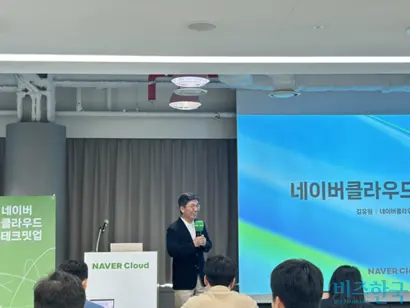
Kim Yu-won, CEO of Naver Cloud, emphasized at a press conference, "AI is not a sprint, but a marathon," adding, "Naver is moving forward while ensuring this technology creates value for society." This is interpreted to mean that rather than focusing on "fast and flashy performance," the company is justifying its business by evaluating whether its technology can solve problems Korea faces, such as national security, cybersecurity, and public welfare. CEO Kim asserted, "It is 'utter nonsense' to call something Sovereign AI just by attaching a local brand name to foreign technology."
First Domestic Case of Open Sourcing for Commercial Use
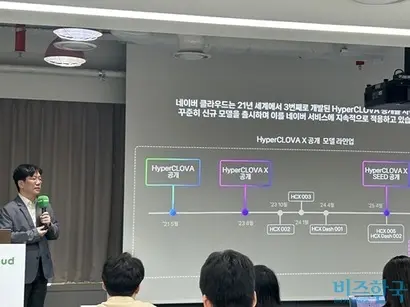
Three lightweight versions of HyperCLOVA X, branded as "HyperCLOVA X SEED," will be released on the 24th as open source without restrictions on commercial use. HyperCLOVA X is a large-scale generative AI based on Naver’s proprietary technology, and these three versions have been lightweighted to ensure stability and efficiency. The HyperCLOVA X SEED lineup consists of models based on parameter sizes: 3B (Billion), 1.5B, and 0.5B.
The 3B model possesses the ability to understand images and videos, retaining the characteristics of HyperCLOVA X specialized for the Korean language and culture. The 1.5B model is equipped with instruction-following capabilities, considered a fundamental skill for language models. It can perform basic translation tasks and follow commands like "speak in a specific tone," making it applicable to various chatbot services and business applications. The ultra-compact 0.5B model allows for the implementation of conversational services on mobile devices, smart homes, and wearables.
This decision to go open source is effectively the first of its kind in the domestic industry, as it has lifted the gate on commercial usage. While open source generally refers to releasing source code to the public for any purpose, the "EXAONE" model previously open-sourced by LG AI Research003550 requires permission for commercial use and has restrictions, being limited to internal LG Group use and research purposes.
The strategy of releasing lightweight AI models as open source is a highly advantageous option in terms of costs. While large-scale models require high-performance GPUs and enormous maintenance costs, these models offer a strategic, cost-efficient alternative.
Currently, HyperCLOVA X is being used in approximately 300 projects within Naver and its affiliates. About 40% of these projects use lightweight models of 3B or smaller. Sung Nak-ho, Naver Cloud's Head of Hyperscale AI, explained, "Everyone knows that models get better as they get bigger, but the cost burden is significant when applying them to actual services. Models that can convert existing services to be lighter are the most effective and necessary in the field. We have secured a production process that costs only 1/10th to 1/20th of conventional methods, a result made possible by our continued advancement of our flagship model (HyperCLOVA X)."
“Can You Call It Sovereign Just by Sticking a Korean Label on Foreign Tech?”
CEO Kim emphasized "sovereign" throughout the press conference. He argued that in a future where AI becomes the fundamental infrastructure for running a society, it is essential to have AI capabilities based on domestic infrastructure and proprietary technology. Citing the case of Ukraine, he expressed concern that if cloud and AI are subject to geopolitical uncertainties in the absence of Sovereign AI, the ripple effects would be severe. Since the war, Ukraine's communication networks have struggled to operate normally, with U.S. satellite support acting as critical infrastructure.
However, Naver's social responsibility or "goodwill" alone does not fully explain why the company is opening up its proprietary technology and capital investment to all other companies and operators. It is interpreted as a strategy to increase industry penetration, achieve indirect R&D effects, and secure technological leadership once the technology reaches a certain level. Companies like Meta (Llama) in the U.S. and Mistral in France also shifted their strategies to open source amid competition with Google, OpenAI, and China's DeepSeek.
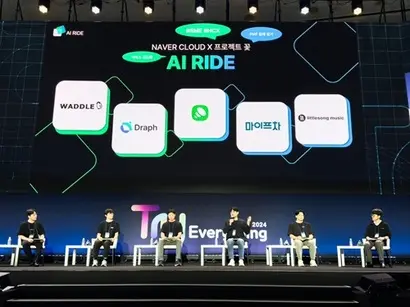
CEO Kim added, "This is fundamentally a decision to revitalize the domestic AI ecosystem. Open source can serve as a stepping stone for many startups to emerge, which leads to a virtuous cycle where the government implements promotion policies. Naver, too, can gain strength from this."
He also expressed candid criticism of KT030200, which is actively promoting its own Sovereign AI. KT is planning to build Sovereign AI in collaboration with Microsoft, intending to form a strategic partnership in AI and cloud to co-develop a Korean-style AI. When asked about this, CEO Kim said, "It is utter nonsense to call it 'sovereign' just because you bring in foreign technology and attach a Korean label to it."
Even if Naver’s Sovereign AI vision proceeds sequentially, sustainability remains a challenge. Whether it can consistently maintain an edge in global competition using local capital and data is key. It also remains to be seen how it will derive marketability within a narrow ecosystem.
Naver plans to solidify its role in Sovereign AI domestically while seeking new growth engines in countries across Southeast Asia and the Middle East that are concerned about data sovereignty amid the rivalry between the U.S. and China. CEO Kim stated, "We are striving to find business opportunities in regions that have a very strong will for sovereignty but currently lack a strong technological foundation."