

[비즈한국] A fairness controversy has erupted over the performance evaluation methods for the multi-purpose unmanned vehicle project. This is because the Defense Acquisition Program Administration (DAPA), which oversees the project, suddenly notified participants that it would not reflect the results of "maximum performance verification"—which objectively compares and evaluates vehicles under identical environments and conditions—in its assessment. There are concerns within the industry that the multi-purpose unmanned vehicle project could be delayed, much like the KDDX project, which is currently adrift due to DAPA's failure to provide clear criteria. Experts have pointed out that the fairness issue can only be resolved by evaluating actual equipment using clear assessment standards under the same environment and conditions.
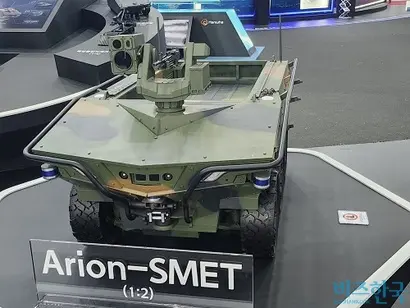
The multi-purpose unmanned vehicle project is scheduled to run until 2026 as part of the Rapid Acquisition Demonstration project. The multi-purpose unmanned vehicle serves as a platform to perform various operations such as surveillance, reconnaissance, combat, and material transport in place of soldiers, and is the first unmanned system to be fielded by the Army. The initial mass production scale is worth 50 billion KRW, with Hyundai Rotem064350's 'Sherpa' and Hanwha Aerospace's 'Arion-SMET' engaged in fierce competition.
Through testing and evaluation conducted by the Army Test & Evaluation Group from late September of last year to February of this year, both pieces of equipment were evaluated as meeting the Required Operational Capability (ROC). In addition to the Army's tests, the process involves DAPA directly verifying the maximum performance.
While DAPA had previously maintained that it would "test maximum performance," it did not provide vendors with details in the Request for Proposal (RFP) on how this maximum performance would be verified and reflected in the evaluation. DAPA focused the selection criteria for this project on "performance" rather than "price." Both companies, Hyundai Rotem and Hanwha Aerospace, submitted performance data for their unmanned vehicles issued by accredited certification bodies of their own choosing along with their proposals. The performance tests of the two companies were conducted under different environments and conditions. Although DAPA did not provide specific standards for actual equipment evaluation, it was expected that six items, including speed and payload, would be verified through an "actual equipment evaluation" following the proposal assessment.
However, DAPA suddenly announced at the end of last month that it would conduct both documentation and actual equipment evaluations based on the internal performance test reports submitted by each company with their proposals. This ignited the controversy over fairness.
This is the first procurement project where the maximum performance is verified and reflected in the model selection process while the bidding companies already possess the actual equipment. According to Article 27 of the Enforcement Decree of the Defense Acquisition Program Act and Article 73 of the Directive on Defense Capability Development, DAPA's principle for conducting procurement test evaluations is to perform an "evaluation based on the actual object" if prototypes exist. Opinions have been raised that for a reliable comparative evaluation of maximum performance, it is appropriate to use test results conducted under identical test conditions (test tracks, environment, methods, etc.) to perform the comparison. Industry sources have pointed out that both companies' equipment must be evaluated under the same environment and conditions with clear criteria to determine superiority.
DAPA stated that it would proceed with the actual equipment evaluation, but would only reflect the results if they turn out to be inferior to the contents contained in the original proposals. For instance, if a vehicle was recorded in the proposal as having a maximum speed of 40 km/h, but a test shows 60 km/h, the higher figure would not be recognized.
It is reported that after two meetings with the companies in March, DAPA sent an official document containing a clause stating that the companies "accept the maximum performance criteria and methods, and will not raise objections in any form, such as complaints or lawsuits, in the future." This effectively means that for follow-up negotiations to proceed, companies must agree not to raise any objections even if there are problems with DAPA's maximum performance verification process; thus, companies have no choice but to accept DAPA's demands even at the risk of disadvantage.
Concerns are also being raised that the certification bodies that verified the internal test performance for the proposals are private institutions rather than state-accredited ones, and because evaluation methods differ by company, this will lead to controversy over the fairness and equity of the assessment.
Since the participating companies each possess prototypes, actual equipment evaluation is essential. The two participating companies are currently divided in opinion, with some favoring an evaluation based solely on proposals and others favoring an actual verification of maximum performance.
Within the industry, there are concerns that the multi-purpose unmanned vehicle project will be delayed, much like the KDDX project, which has been unable to select a contractor due to DAPA's failure to provide clear standards. An industry official remarked, "This is a problem triggered by DAPA failing to clearly present evaluation methods and criteria. Like the KDDX issue, if one side loses, it could escalate into a dispute between companies over equity. Fortunately, unlike KDDX, both companies are pushing for overseas exports, which may mitigate the damage. DAPA must review its standards, methods, and procedures to ensure a fair evaluation."