

[비즈한국] One-third of our citizens will suffer from a mental disorder at some point in their lives. However, the number of people who cross the threshold for "psychiatric treatment" remains extremely small. This is because people are still not free from the negative perceptions surrounding mental disorders. We asked psychiatrists and pharmaceutical companies about what fears cause people to hesitate to seek treatment and whether such prejudices are actually true.

A Disease of the Few? “One-Third of the Population Experiences It”
The rate of people experiencing mental disorders is higher than one might think. According to mental health statistics from the National Mental Health Portal, the "lifetime prevalence of mental disorders"—which refers to the percentage of people who have experienced a mental disorder such as alcohol use disorder, nicotine use disorder, depressive disorder, or anxiety disorder at least once in their life—reaches 27.7%. This means that roughly one-third of our citizens suffer from a mental disorder at some point in their lives. Even if we narrow the scope to "depressive disorder," the "prevalence of depression," which measures the number of adult respondents who have felt sad or hopeless to the extent that it hindered their daily life for more than two consecutive weeks in the past year, is 11.3%. This is higher than the OECD average of 10.7%.
However, not many people actively seek treatment for these issues. The "utilization rate of mental health services," which involves consulting with mental health professionals, remains in the single digits at 4.5%. This drops further to 3.7% when limited specifically to psychiatrists. Given that the lifetime prevalence of mental disorders is 27.7%, this means only about 13% of those suffering from mental disorders seek help from a psychiatrist.
Disadvantages in Hiring and Promotion? “Medical Records Are Private”
The reason patients find it difficult to consult with specialists is due to various misunderstandings regarding "medical records." People fear that their workplace might access their medical records, leading to disadvantages in their social life, such as in hiring or promotions. However, this is not true. Article 21 of the Medical Service Act explicitly states that medical personnel, heads of medical institutions, and employees of medical institutions must not allow anyone other than the patient to view records concerning the patient or provide copies, effectively ensuring no one else can check the contents. A medical record cannot be viewed by anyone other than the patient themselves.
Some also fear that their National Health Insurance Service data will be disclosed. Psychiatric treatment is covered by health insurance just like treatment for other departments, and in these cases, data remains with the National Health Insurance Service. However, even these records are rarely requested for disclosure except in special cases such as investigations or trials. Psychiatrist 'A' explained, "Some organizations ask prospective employees to submit their 'Health Insurance Benefit Details for Identity Verification,' but they cannot reject a candidate simply because they have a history of treatment. There must be an expert opinion stating that the individual has a mental illness 'to the extent that they cannot perform their duties.'"
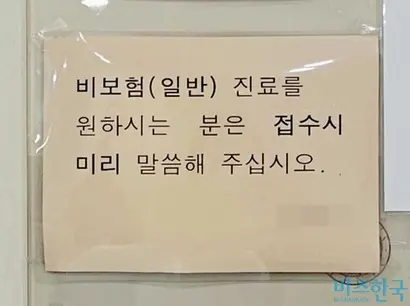
Nevertheless, many patients choose "non-insured" treatment due to anxiety. Without health insurance coverage, patients must bear a significant cost, averaging between 70,000 and 100,000 won including medication, but they are willing to bear this to avoid leaving a "record." As a result, one can often find notices in psychiatric clinics stating, "Please inform us if you desire non-insured (general) treatment." Psychiatrist 'A' said, "I inform them that there are no problems other than the potential difficulty of signing up for insurance for a certain period, but for an anxious patient, this can be difficult to accept. I understand the patient's position and inform them that they can switch to health insurance treatment until the end of the month when the record is finalized."
Why Are They Prescription Drugs? “Reactions Vary and Side Effects Are a Concern”
Some patients look for "over-the-counter" antidepressants before visiting a psychiatrist, but only about two such products are sold on the market. The number of pharmacies selling them is also small, leading to the sharing of "lists of pharmacies where purchase is possible" on the internet. According to the Korea Pharmaceutical Information Center, Yuyu Pharma's 000220 "Neuromin Tablet" and Dongkook Pharmaceutical's 086450 "Mindtrol Tablet" are sold as central nervous system agents and remedies for lethargy, respectively. They work by alleviating anxiety and lethargy, and relieving mild, temporary depressive symptoms. Both products contain extracts from the "St. John's Wort" plant and produce antidepressant effects by regulating the levels of neurotransmitters in the body.
Why are most antidepressants released as prescription drugs? The pharmaceutical industry cites the nature of mental illness and the side effects of antidepressants as the reasons. 'B', an official from a pharmaceutical company that manufactures prescription antidepressants, said, "Neurological and psychiatric illnesses are difficult to treat with over-the-counter drugs. Even if a patient's condition seems similar, the effectiveness varies depending on the patient and the ingredients. The reason various dosages are available is because there are many circumstances to consider for each patient, such as starting with a low dose and gradually increasing it."
'B' added, "Antidepressants are used not only for depression but also for pain-related diseases and IBS (Irritable Bowel Syndrome). Since they regulate signals in the nervous system, taking them as over-the-counter medication could cause serious side effects, such as urinary retention, and patients might not be able to identify whether it is a side effect on their own. Therefore, they are usually released as prescription drugs."