

[비즈한국] The Korea Development Bank (KDB) and the Korea Ocean Business Corporation (KOBC) have increased their stakes in HMM011200 by converting convertible bonds (CB) into shares. Some suggest that this increase in equity may have a negative impact on the privatization of HMM. If the number of shares held increases without a change in the stock price, the total value of the shares held rises accordingly. This leads to a higher sale price, which can be a burden for potential buyers.
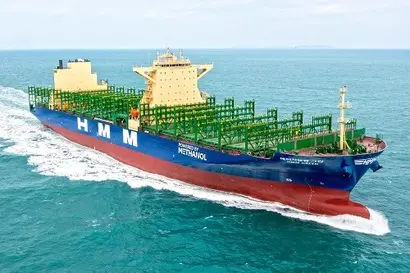
KDB and KOBC recently converted 720 billion won worth of HMM CB into stocks. CBs are bonds that can be converted into shares at the owner's request after a certain period. As a result, KDB's stake in HMM increased from 33.73% to 36.02%, and KOBC's stake rose from 33.32% to 35.67%.
Analysts suggest that this CB conversion could complicate HMM's privatization. As the number of shares held by KDB and KOBC increases, the total value of the shares—and thus the sale price—rises. Based on HMM's recent stock price of approximately 19,000 won, the total value of HMM shares held by KDB and KOBC increases from 11.225 trillion won to 13.961 trillion won, potentially burdening prospective buyers.
HMM's excellent financial structure could also be a burden for buyers. As of the end of last year, HMM's debt-to-equity ratio was only 21.51%. For an ordinary company, this would be cited as a model case of financial management. Paradoxically, because the financial structure is so sound, it is difficult for buyers to demand a lower sale price.
KDB and KOBC previously attempted to sell HMM in 2023. Although Harim Group was selected as the preferred bidder and negotiations reached the final stages, the deal ultimately failed due to disagreements over terms. In February of last year, Harim Group stated, "It was not easy to negotiate because there was a difference in positions with the sellers, which consisted of a bank and a public enterprise."
HMM's stock price has not changed significantly since mid-2023. Unless the stock price drops, KDB and KOBC have no justification for lowering the sale price of HMM. Selling at a price significantly lower than the market price would invite criticism regarding the waste of public funds and could even lead to allegations of breach of trust. However, KDB and KOBC cannot abandon the privatization of HMM either. Having already injected a significant amount of capital into HMM, they must complete the sale to recover public funds.
Ahn Byung-gil, President of KOBC, said at a press conference in March, "It is absolutely not true that we are passive about the sale of HMM; we want to end creditor management as soon as possible. While HMM is a private company, we believe it needs a good owner to secure international competitiveness."
Some point out that KDB and KOBC were hasty in proceeding with the CB conversion, but it was an unavoidable situation. KDB and KOBC converted the CBs at 5,000 won per share according to the original contract. Currently, HMM's stock price exceeds 10,000 won. Failing to exercise the conversion rights when they are available at a price lower than the market value could potentially constitute a breach of trust.
The securities industry expects HMM to reduce the stakes held by KDB and KOBC through share buybacks. Early this year, HMM announced plans to purchase and cancel 2 trillion won worth of its own shares within the year. If HMM buys back the shares held by KDB as treasury stock, KDB's stake in HMM will decrease accordingly. However, some analysts argue that since buying and canceling treasury shares typically drives up the stock price, the total value may remain unchanged.
HMM has recently been focusing on enhancing corporate value. In January, the company announced, "We will expand shareholder returns to at least the smaller amount between a 30% dividend payout ratio and a 5% dividend yield by 2030," adding, "The expected amount of shareholder returns within the next year, including the 2024 year-end dividend, is over 2.5 trillion won." Dividend yield indicates the percentage of a dividend relative to the stock price. While higher corporate value leads to a higher stock price, it can also act as a hurdle for privatization.
Another variable is the future trend of HMM's stock price. The securities industry has a negative outlook on HMM's performance this year. iM Securities and Daishin Securities project HMM's operating profit for this year to be 188.3 billion won and 136.4 billion won, respectively—a significant drop from last year's operating profit of 351.3 billion won. Daishin Securities even forecast HMM's 2026 operating profit to be 54.1 billion won.
Deteriorating performance could lead to a decline in stock price. If the stock price rises, the sale price rises; if the stock price falls, the sale price falls, making the privatization process relatively easier. However, if HMM's performance worsens significantly, the necessity for a buyer to acquire HMM may decrease.
Bae Se-ho, a researcher at iM Securities, noted, "Due to the increasing trend of container ship capacity and U.S. reciprocal tariff policies, a decrease in global container cargo volume and a decline in freight rates are expected. HMM's operating profit shows a high correlation with the Shanghai Containerized Freight Index (SCFI), so a decrease in operating profit is expected following the decline in container freight rates."
Nevertheless, some companies such as Dongwon Group and Harim Group are reportedly still interested in HMM. Kim Hong-kuk, Chairman of Harim Group, met with reporters last October at the 'Yonggari Disappeared' pop-up store in Seongsu-dong, Seongdong-gu, Seoul, and said, "If (HMM) is put up for sale again, we will review it then."
The term of KDB Chairman Kang Seog-hoon ends in June. Considering the schedule for appointing the next chairman, the sale of HMM is not expected to be discussed until at least July. However, because the environment surrounding the HMM sale is unfavorable, the privatization process is expected to remain difficult even under the next administration. A KOBC official stated, "Nothing has been decided yet, so it is difficult to express a specific position."