

[비즈한국] Black holes are fascinating entities that capture the imagination of everyone who loves space. However, I personally feel that, despite their fame, the name "black hole" is somewhat of a misnomer. Literally translated, it means a "dark hole." But in reality, black holes aren't "black." In the first place, black holes have no color. This is because they do not emit light themselves. The name "black" was attached to them because their gravity is so intense that not even light can escape, meant to represent a deep, profound abyss carved into space-time. I often think it might have been more appropriate to use a word like "dark," which signifies darkness or the absence of light.
That is not the only perplexing thing. While it is true that black holes do not shine due to their overwhelming gravity, it is not strictly true to say they emit no light at all. To be precise, while the black hole itself is dark, the surrounding material captured by its gravity heats up to intense temperatures and can emit light. Furthermore, particles accelerated by the strong magnetic fields around the black hole also emit mysterious radiation. This light is so intense that it emits high-energy rays, such as X-rays and gamma rays, which far exceed the spectrum of visible light. Despite being named a "black hole" for its supposed inability to emit light, it is, in fact, one of the most intense light-emitting entities in the universe. I find the name itself to be quite contradictory and mysterious.
Recently, the James Webb Space Telescope captured some very intriguing light coming from Sagittarius A*, the supermassive black hole at the center of our galaxy. Not only did the black hole emit high-energy light, but that light also flickered! Astronomers call this phenomenon a "black hole’s flickering."
First, we must understand how the most intense, high-energy light in the universe can coexist with the deepest darkness. The main mechanism occurs in the accretion disk that surrounds the black hole. If there is a tasty meal nearby, such as a gas cloud or a star, it is gradually pulled into the vicinity of the black hole by its powerful gravity. As it gets closer to the black hole, its speed increases. As long as it has not yet crossed the event horizon, the material orbiting at sufficiently high speeds can withstand the black hole's gravity and maintain its orbit. During this process, these fast-moving particles collide with each other, generating friction and heat. They are heated to temperatures far exceeding the surface temperature of ordinary stars like the Sun. This is why X-rays are observed in accretion disks. We have previously discovered something terrifying at the center of our galaxy, in the direction of Sagittarius, that is voraciously devouring surrounding matter through X-ray observations.
Because the accretion disk emits distinct X-rays and rotates at high speeds, we can relatively easily determine the existence and mass of a black hole. This is due to the Doppler effect, where the light waves observed change as the disk rotates, with some parts moving toward our line of sight and others moving away. By utilizing this, we can calculate how fast the accretion disk caught in the black hole's gravity is rotating and how massive the central black hole holding the disk is.
However, the light emitted from a black hole is not limited to X-rays from the accretion disk. For a supermassive black hole at the center of a galaxy with plenty of "prey" nearby, one can find very diverse and complex structures as you move further away from the black hole. Outside the accretion disk, a dense, donut-shaped cloud of dust surrounds it. This dust torus absorbs some of the X-rays and heats up to a lukewarm temperature. Afterward, the dust torus re-emits that energy in the infrared range, where the energy is lower. This makes the observed total spectrum of a black hole even richer.
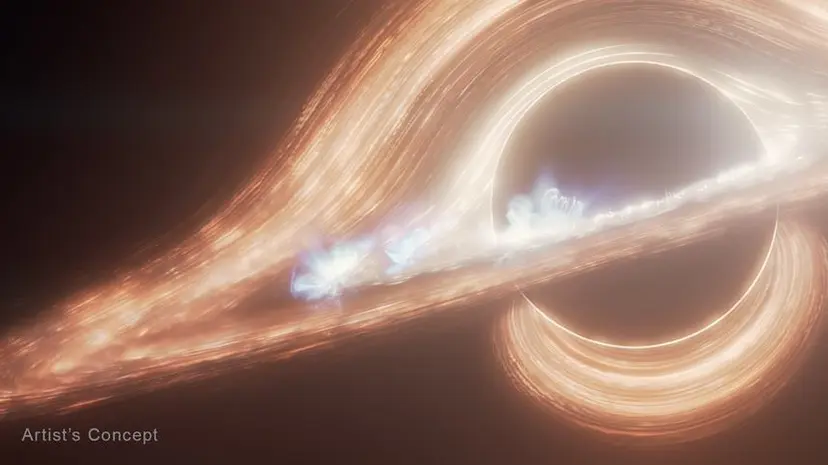
The factors determining how much the dust torus obscures X-rays, and how much lukewarm light from the dust torus is observed in its place, are quite simple: the inclination, or how steeply the disk and torus appear tilted when viewed from our vantage point. If we view the dust torus almost edge-on, the central accretion disk and its X-rays appear significantly obscured. Conversely, if we look down at the disk from almost directly above, we can see the powerful X-rays almost unobstructed.
There was a time when supermassive black holes with different spectral shapes at the centers of galaxies were assumed to be entirely separate, distinct types of black holes. However, we now understand this is simply a matter of the viewing angle, and we view these diverse galactic center black holes through a single, unified framework.
Finally, there is another interesting light emitted from black holes. A rapidly rotating black hole forms a very powerful magnetic field along its axis of rotation. Due to the high temperatures in the surrounding accretion disk, ionized particles spiral along the magnetic field and are accelerated to speeds nearly approaching the speed of light. When particles are accelerated, they emit light. This light is observed across a wide range of wavelengths, from X-rays to infrared, a phenomenon known as synchrotron radiation.
The James Webb Space Telescope primarily views the universe in infrared. Among the various types of light emitted by black holes, it only looks at infrared. From 2023 to 2024, astronomers observed the brightness of the light leaking from the Sagittarius A* black hole in our galaxy at two infrared wavelengths: 2.1μm and 4.8μm. The total cumulative observation time amounts to about 48 hours. To fairly compare the black hole's fluctuating brightness, two stars visible in the same field of view were used as reference stars. By using these two stars, whose brightness remained nearly constant throughout the observation period, the intensity of the light around the black hole captured at any given moment could be standardized.
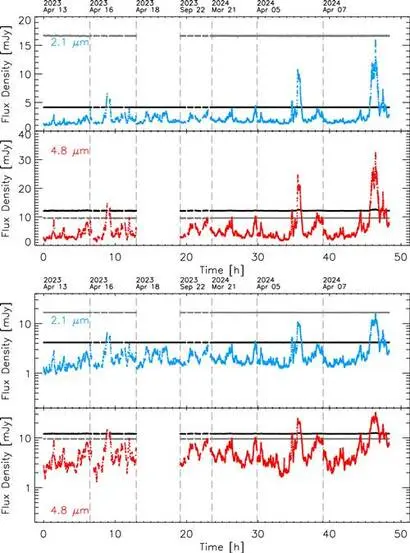
The graph above shows interesting results. The blue line represents changes observed at a wavelength of 2.1μm, corresponding to higher energy, while the red line represents changes at 4.8μm, corresponding to lower energy. The black line is the constant brightness change pattern of the reference stars observed simultaneously. Comparing this with the brightness pattern of the reference stars, we can be certain that these fluctuating brightness changes were real events occurring around the Sagittarius A* black hole. Along with generally small fluctuating patterns, phenomena like flares, where brightness suddenly increases significantly and then decreases, can also be observed.
Astronomers took this a step further. Comparing the blue and red lines reveals an interesting pattern across all data: the blue line always peaks first, followed by the red line after a slight time delay. In other words, higher-energy, shorter-wavelength light flashes first, followed about 30 to 40 seconds later by longer-wavelength light.
Astronomers explain the fluctuations in brightness, large and small, observed at these two infrared wavelengths in two main ways. One is the fluctuations occurring within the accretion disk itself. The density of the accretion disk, where the "prey" swallowed by the black hole is spread, is never uniform. Some parts may have higher density and higher temperatures. As this jagged, density-varying accretion disk rotates rapidly and emits light, it can cause fluctuations where the intensity of light changes moment by moment on a relatively small scale.
Additionally, the strong magnetic field formed around the black hole can cause more intense flares. This is similar to how flares erupt from the Sun. As bundles of magnetic fields formed around the black hole reconnect and connect with each other, massive amounts of particles can be ejected outward in an instant. This process is an incredibly powerful explosive phenomenon. Therefore, there is not a large difference in brightness according to wavelength. It is witnessed as a very bright flash at both 2.1μm and 4.8μm. Astronomers estimated that the fact that there was almost no difference in brightness at the peak moments in both wavelengths, particularly when sudden flares were captured, fits well with this hypothesis.
As such, black holes are actually very violently fluctuating entities. At first glance, you might think of a black hole as a boring entity that always sits quietly and silently in the dark, but the reality is the exact opposite. Black holes are among the most chaotic entities in the universe, even spitting out blinding flashes like solar flares. To better understand the ever-fluctuating appearance of a black hole, there is a need to monitor it without taking our eyes off it for a longer period. Thus, the astronomers who led this study boldly requested more time with the James Webb. It is an observation where, for 24 hours straight—all day long—the eyes of the James Webb will restlessly watch only the Sagittarius A* black hole. If this observation finishes successfully, we will be able to grasp what is happening around the black hole all day long without any gaps in the middle of the graph.
The day is not far off when the "heaviest" observational reality show in the universe, peeking into the every move of our galaxy's central black hole, becomes a reality.
Reference
https://iopscience.iop.org/article/10.3847/2041-8213/ada88b
https://www.stsci.edu/jwst/phase2-public/3559.pdf
Who is the author, Woong-bae Ji? He loves cats and space. After watching "Galaxy Express 999" as a child, he dreamed of sharing the beauty of the universe. Currently, he researches galaxy evolution through interactions at the Center for Galaxy Evolution Research and the Near-Field Cosmology Laboratory at Yonsei University. He is also active in science communication, including lectures and writing. He is the author of books such as "The Observatory That Flirts," "Thinking About Space All Day," and "Stars, the Science of Light."