

[비즈한국] Looking purely at the statistics this year, South Korea's job market appears to be enjoying a tailwind. While the number of employed people saw a decline last December, it has shown three consecutive months of growth from January to March. Despite the martial law declaration by former President Yoon Suk-yeol and the tariff war initiated by U.S. President Donald Trump, the Korean labor market seems to be unaffected and even shows signs of improvement.
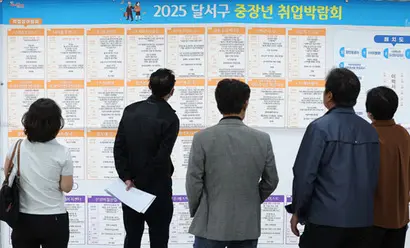
However, when looking beneath the surface, the reality is worsening, contrary to the statistics: employment is falling in all age groups except for those in their 60s, and the number of jobs in the manufacturing sector—the backbone of the Korean economy—is plummeting. Furthermore, government agencies and the Bank of Korea are continuously lowering their employment forecasts for this year, leading to concerns that a "frozen period" could arrive for the labor market as we move into the second half of the year.
According to Statistics Korea on the 18th, the number of employed people aged 15 and over in March was 28.589 million, an increase of 193,000 compared to the same month last year. While the number of employed persons fell by 52,000 in December last year due to the temporary end of government job programs, it increased by 135,000 in January, 136,000 in February, and nearly 200,000 in March. The number of employed people has been steadily increasing this year. Even on a quarterly basis, the number of employed people in the first quarter of this year grew by 155,000, marking the highest increase since the first quarter of last year (293,000).
However, when quality rather than quantity is considered, the situation is not so bright. This is because most of the 155,000 increase in the first quarter is attributed to job seekers aged 60 and older. Employment among the youth (aged 15-29) dropped by 220,000 in the first quarter, the largest decline since the fourth quarter of 2020 (-265,000), when the economy was at its worst due to the COVID-19 pandemic. In contrast, employment for those aged 60 and older surged by 349,000 in the first quarter.
As a result, the number of employed people aged 60 and older reached 6.412 million, accounting for 22.7% of all employed persons (28.215 million). Meanwhile, employment in the manufacturing sector, which is considered a pillar of quality jobs and supports the Korean labor market, is falling sharply. In the first quarter of this year, the number of manufacturing workers stood at 4.394 million, down 81,000 from the same period last year. After a decline of 32,000 in the third quarter of last year and 75,000 in the fourth quarter, the rate of decline is accelerating. Moreover, the first-quarter drop in manufacturing employment is the largest since the fourth quarter of 2020 (-107,000). With domestic demand frozen in the wake of the Yoon administration's martial law crisis and the added impact of President Trump's tariffs, the job market is expected to become even more severe.
In fact, government agencies and the Bank of Korea are continuously downgrading their employment forecasts for this year. The impact on the youth demographic, who are expected to face a serious situation as the labor market—which appeared favorable in the first quarter statistics—worsens in the second half, appears even more severe. In its economic outlook released in February, the Korea Development Institute (KDI), a state-run research agency, lowered its annual growth forecast from 2.0% in November to 1.6%, citing that "downside risks are expanding due to rising uncertainty surrounding U.S. trade policy." The forecast for the increase in the number of employed people was also lowered by 40,000, from 140,000 to 100,000, in just three months.
The National Assembly Budget Office also lowered its 2025 employment growth forecast from 115,000 in October last year to 92,000 in March, a cut of 23,000, citing expected declines in corporate earnings due to persistent uncertainty in U.S. trade policy.
The Bank of Korea's employment outlook is also worsening over time. In its economic outlook released last August, the BOK projected an increase of 160,000 jobs for this year, but lowered this estimate by 30,000 to 130,000 in November. Then, in February of this year, it again lowered the projection to 100,000, stating that "employment sluggishness is expected to deepen due to persistent weakness in manufacturing employment, a contraction in construction investment, and delays in the recovery of domestic demand." As the fallout from President Trump's tariff policies has only recently begun in earnest, the Bank of Korea's new economic forecast, due in May, is expected to present an even bleaker outlook for employment.