

[비즈한국] Once again, a construction worker who went to a worksite today did not return home. The construction industry accounts for the highest number of fatal accidents among all industries in South Korea. Our society enacted the Serious Accidents Punishment Act (SAPA), which came into full effect in January 2022, to prevent tragic accidents where workers lose their lives due to a failure to fulfill safety and health obligations. However, the number of workers losing their lives at construction sites each year remains in the triple digits. What efforts must our society make to reduce fatalities at construction sites?
As confirmed by Bizhankook, Regional Architectural Safety Centers, which are tasked with inspecting construction site safety and preventing shoddy construction, have been operating in name only eight years after their introduction. Out of 140 local governments required to establish these centers, 13 have not even installed one, and about half fail to employ the essential professional staff mandated by law. There is a growing call to strengthen the substance of these centers, which are intended to supplement the expertise of administrative agencies to prevent safety accidents at construction sites.
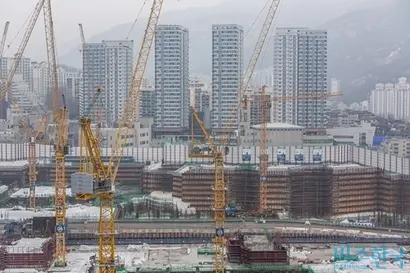
The Regional Architectural Safety Center is a specialized agency under local governments that monitors regional architectural safety. Architectural professionals perform technical reviews related to local permits and supervise safety management at construction sites. The National Assembly amended the Building Act in 2017 to introduce these centers to bridge the safety management gap caused by a lack of expertise in administrative agencies. Metropolitan governments, basic local governments with populations of over 500,000, and those where the area of building permits or the ratio of aging buildings is within the top 30% are required to establish a center in their jurisdiction.
According to data obtained by Bizhankook through information disclosure requests to the Ministry of Land, Infrastructure and Transport and 17 metropolitan governments, as of February this year, 13 (9%) out of 140 local governments mandated to install these centers had not done so. The local governments without centers include Buyeo-gun (Chungnam), Naju-si, Boseong-gun, Jangheung-gun, and Jindo-gun (Jeonnam), Gyeongju-si, Uiseong-gun, Yecheon-gun, Bonghwa-gun, and Uljin-gun (Gyeongbuk), and Goseong-gun, Namhae-gun, and Geochang-gun (Gyeongnam).
Are the centers established by local governments operating properly? Under the building laws, each center must employ at least one architect and one architectural structural engineer or architectural construction engineer as professional staff. In essence, at least two experts are required to oversee regional architectural safety. If a center cannot even meet this requirement, it can be considered effectively non-functional.
Half of the current Regional Architectural Safety Centers are practically in name only. Out of 127 centers established as required by law, 61 (48%) fail to meet the essential professional staffing requirements. Thirty-four centers have not hired a single professional, and 27 have hired only one. Combining the 13 centers that were never installed with the 61 that lack required staff, 74 out of 140 mandated local governments (53%)—more than half—fail to maintain the essential professional staffing levels for their centers.
The reasons cited for the centers' failure to staff essential professionals include a shortage of human resources and poor working conditions. It is argued that because the pool of domestic experts is small and compensation at these centers is typically lower than in the private sector, it is difficult to fill statutory positions. According to statistics from the Ministry of Land, Infrastructure and Transport and the Human Resources Development Service of Korea, there were 19,738 architects, 1,329 architectural structural engineers, and 10,116 architectural construction engineers in the country last year. It is reported that these professionals currently receive compensation equivalent to a Grade 6 fixed-term public servant.
An official from one metropolitan government said, "Basic local governments consistently post job openings for experts, but it's hard to find applicants. The local expert pool is small, and we are struggling to recruit because the pay doesn't match the private sector." Another metropolitan government official added, "Many basic local governments fail to meet the mandatory staffing requirements due to a lack of a talent pool. While it is possible to hire architects to some extent, it is very difficult to find other specialists like structural engineers. We believe low compensation is also a cause."
Before supporting the acquisition of essential personnel, the government is moving to relax regulations. An official from the Architecture Safety Division of the Ministry of Land, Infrastructure and Transport stated, "Because issues like professional compensation are difficult to solve in the short term, we are pushing for institutional improvements to reduce the mandatory staffing requirement from two to one for local governments that cannot meet the standard due to labor shortages. We are pursuing these changes as a policy measure to first resolve the illegal status and then allow for the recruitment of recommended personnel in the future."
Shin Young-chul, head of the National Policy Project Watchdog at the Citizens' Coalition for Economic Justice (CCEJ), pointed out, "Negligent management by local governments, which hold licensing authority, plays a significant role in safety accidents and construction quality issues at sites. The process requires a thorough examination of risks and safety management plans during the permitting phase, as well as on-site inspections, but in reality, it often ends up being a formality due to a lack of expertise. It is a major problem that Regional Architectural Safety Centers, designed to supplement administrative expertise and monitor regional safety, are operating in name only."