

[비즈한국] Domestic defense companies are competing fiercely to secure a leading position in the field of Unmanned Surface Vessels (USVs), which are poised to become game-changers in future warfare. The ROK Navy has designated its future integrated manned-unmanned combat system as 'Navy Sea Ghost' and is planning the introduction of related equipment. While Hanwha Systems272210 and LIG Nex1079550, which have been progressing from conceptual design to system development, have established a duopoly in the USV sector, the landscape is expected to turn into a three-way race as HD Hyundai Heavy Industries329180 recently signed agreements with U.S. firms and began development.
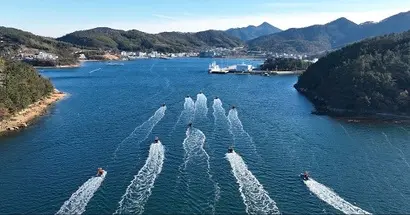
Hanwha, Concentrating the Capabilities of its Three Defense Affiliates
A USV is a vessel operated on the water surface without a crew. It is utilized for reconnaissance or combat purposes, such as surveillance, mine detection and neutralization, and attacks. According to the research firm GlobalData, the USV market is projected to expand from $894 million (approx. 1.2 trillion KRW) in 2023 to $3.1 billion (approx. 4.46 trillion KRW) by 2033.
Hanwha Systems made its first foray into the combat unmanned naval power market by developing its own Naval Combat Management System (CMS). The company is focusing its efforts not only on reconnaissance USVs but also on unmanned combat surface vessels. The CMS, which acts as the 'brain' of a warship, plays the role of detecting and analyzing various incoming threats via onboard sensors and then transmitting commands to armament systems, such as naval guns, to neutralize the threats.
Over the years, Hanwha Systems has participated in USV-related development projects, building a lineup of marine unmanned systems ranging from small to large sizes. The company has developed various systems, including the 'Haeryeong,' a 12-meter-class search and reconnaissance USV capable of coastal search-and-rescue and surveillance missions; an autonomous underwater vehicle for docking capable of underwater docking; and an anti-submarine reconnaissance unmanned underwater vehicle, which is a large submarine capable of long-term submersion for up to 30 days. Haeryeong is set to be the first in Korea to be deployed for coastal search and surveillance missions.
Hanwha’s USV emphasizes the total mobilization of the capabilities of Hanwha's three defense affiliates. The strategy is to generate synergy by combining the technical prowess of the group, including Hanwha Systems' 'CMS,' Hanwha Ocean's042660 'specialized ship construction capabilities,' and Hanwha Aerospace's012450 'remote weapon station and missile launcher development capabilities.' In particular, Hanwha Ocean and Hanwha Systems performed conceptual designs for reconnaissance unmanned underwater vehicles and mine-warfare USVs last year, in addition to the conceptual design task that serves as the foundation for the Navy-led combat USV development.
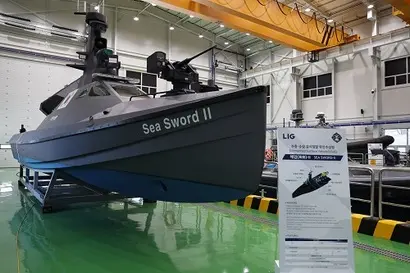
LIG Nex1, Preparing for Future Warfare with the 'Sea Sword' Series
Last year, LIG Nex1 completed a contract with the Defense Acquisition Program Administration for the 'Reconnaissance USV System Development Project.' The project involves developing two 12-meter-class USVs by 2027 to reinforce surveillance and rapid response capabilities for Navy forward bases and major ports.
LIG Nex1 has been accumulating related experience and technology by self-developing the 'Sea Sword' series of USVs since 2015. Through this, the company plans to lead the development of domestic manned-unmanned teaming systems based on the 'reconnaissance USV system development project,' while also exploring new application markets by mounting modular mission equipment centered on armaments and detection systems.
As a maritime unmanned platform prepared for future warfare, the Sea Sword series has evolved into models such as Sea Sword-II, Sea Sword-III, Sea Sword-V, and M-Hunter to perform various operations depending on the mission equipment. Sea Sword-II is equipped with an underwater platform (ROV) module capable of automatic launching and recovery (LARS), enhancing underwater surveillance capabilities. Sea Sword-III carries not only a 12.7mm heavy machine gun in the front but also a 2.75-inch guided rocket (Bigung) launcher. Furthermore, it was the first in the country to successfully complete sea-state 4 (maximum wave height of 2.5m) performance tests in actual sea conditions, allowing for 24-hour operation without manned personnel even in harsh maritime environments. Sea Sword-V is a USV exclusively for ship deployment, capable of separating from a mother ship to identify and immediately respond to suspicious targets.
The company also continues to invest in advancing unmanned platforms. Last year, LIG Nex1 completed the construction of a 'USV-dedicated System Integration Test Facility' at its Gumi House. In a water tank with a capacity of approximately 1,000 tons, the facility can perform system integration tests by checking subsystem units, including platforms, autonomous navigation devices, central controls, wireless communications, armaments, surveillance reconnaissance, and underwater exploration units.
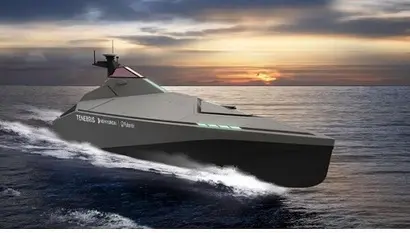
HD Hyundai, Collaborating with U.S. Companies on Development
On the 4th, HD Hyundai signed a Memorandum of Understanding (MOU) with the U.S. defense firm Anduril Industries for the development of USVs and market entry. Anduril supplies AI-based mission control systems, surveillance reconnaissance systems, unmanned underwater vehicles, and drones to the U.S. Navy, the U.S. Department of Defense, and the Australian Department of Defence.
The two companies plan to develop USVs by combining HD Hyundai's autonomous navigation technology with Anduril's autonomous mission execution solutions. HD Hyundai will develop 'AI warship autonomous technology' based on the navigation, engine automation, and integrated safety control technologies it has been pursuing, while Anduril will be responsible for developing an 'autonomous mission execution system' that automates USV swarm control and mission performance.
Last year, HD Hyundai also signed an MOU with Palantir Technologies, a U.S. AI defense specialist, to co-develop the USV 'Tenebris.' The two companies plan to develop Tenebris by 2026 by combining HD Hyundai Heavy Industries' autonomous navigation and warship integrated management systems with Palantir's AI platform. Tenebris is known to apply high-performance hardware (hull) with a lightweight of 14 tons and a length of 17 meters, along with advanced AI.
The reason defense companies such as Hanwha Systems, LIG Nex1, and HD Hyundai are engaging in an all-out war over USV development is to secure exports to overseas markets. Since the USV market is still in its early stages, all these companies believe that securing a lead in the market is crucial. To this end, they are staking everything on future Navy projects. The logic is that being selected and having their USVs delivered to the ROK Navy—evaluated as the 5th strongest in the world—could become the greatest competitive edge in penetrating overseas markets.