

As the market for related products expands, particularly in the beauty industry, there are growing concerns regarding the "dilemma of fake" usage, given that the products in these advertisements have often never been used by the models in reality. Critics also argue that such advertisements, when displayed without clear disclosure, hinder consumers' ability to make rational purchasing decisions.
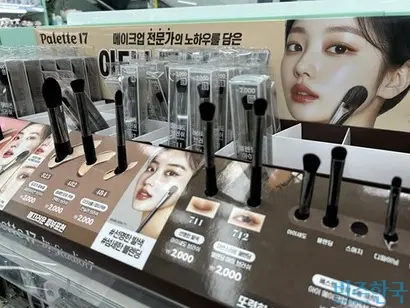
AI Models Take Over Daiso Cosmetic Aisles and Beauty Device Social Media Ads
In Daiso cosmetic aisles, which have gained attention for their "value for money" in an era of high inflation, advertisements featuring AI models are becoming more prominent than those with human models. Both powder brushes, marketed for their "3D volume effect," and foundation brushes for "smooth skin expression" are displayed alongside photos of AI-generated faces. Even product demonstration photos showing the pigmentation and blending capabilities of eyeshadow brushes feature images of eyes with brown eyeshadow applied, clearly created by AI. Different virtual young female models are used to market lip glosses—branded with terms like "glassy shine" and "shiny pearl"—and magic perms, which claim to create soft hair textures thanks to silk keratin.
While the virtual nature of these models is apparent upon close inspection, customer reactions were mixed after realizing they were looking at AI-generated ads. Park, a 21-year-old university student visiting a Daiso store in Yongsan-gu on the 14th, said, "I'm curious about how the product actually looks when applied to the skin, so it’s absurd that these photos are 'color swatches' that have nothing to do with the actual product." Go, an office worker in her mid-20s, stated, "Since they are inexpensive products, it’s understandable if they are trying to save on model fees," but added, "It would prevent misunderstanding if they disclosed beforehand that the model is virtual."
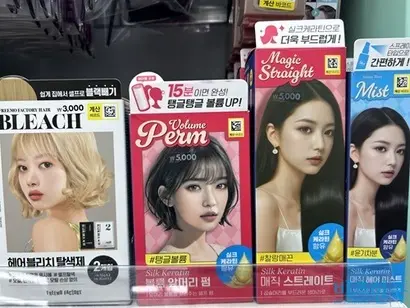
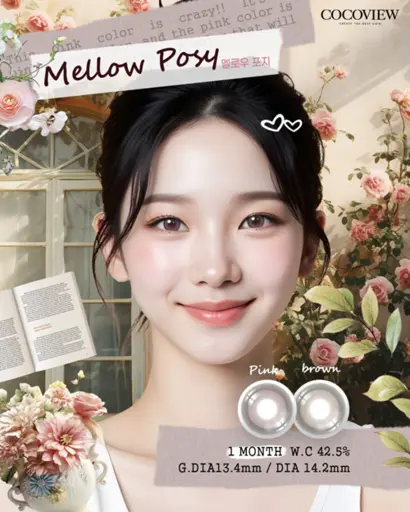
In the cosmetics and beauty industry, virtual models are being actively employed both online and offline. Many social media advertisements for items such as colored contact lenses and hair styling products feature images of doll-like virtual characters wearing or using the products.
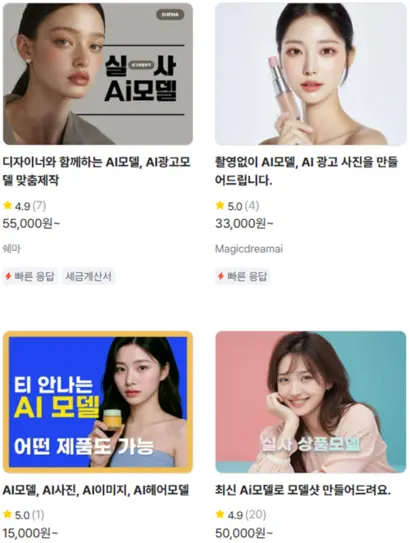
The market for producing AI models, realistic advertising images, and detailed web pages for companies is also fiercely competitive. There are approximately 420 services related to the "AI model" keyword registered on the freelance marketplace platform Kmong, with about 340 experts (suppliers) registered in fields including AI model design, IT/programming, and video/photography. While production costs vary, they start at a low price point of 10,000 to 50,000 won, targeting small and medium-sized businesses that need character advertising marketing, ranging from beauty brand ads to hair salon models.
Rapid Infiltration Raises Need for Standards
Using virtual models significantly reduces costs—from planning and filming to talent fees—and increases production speed compared to using real celebrities or professional models. This is a distinct category from "virtual humans" like Rozy (Naver035420 Webtoon), Esol (Naver), and Sua (Kakao Games293490), who have secured major advertising contracts with brands like Shinhan Life, Mercedes-Benz, and the Korea Tourism Organization. While virtual humans represent the culmination of large-scale corporate capital and technology, current virtual models are accessible to anyone. Since the advent of generative AI, they can be easily created using specialized image generation tools like Midjourney.
Even companies that are not yet considering AI model advertisements acknowledged the high efficiency of virtual models. An official from a listed cosmetics company stated, "The restrictions on contract periods and ad exposure durations are much lower, and there’s no risk of issues outside of the product, such as the model's remarks or personal life," adding, "If the perception of virtual character advertising improves or aligns with customer expectations, it could be advantageous for maintaining brand consistency." However, the official added, "It seems less persuasive in terms of explaining product effectiveness or creating a social connection. It’s also difficult to compare their influence to that of popular celebrities or influencers."
Discussions are ongoing internationally regarding how far the influence and market penetration of AI character advertising will go. The UK's The Guardian remarked, "It seems inevitable that AI-generated influencers will increasingly appear in the mainstream market," and added, "The rise of AI models with flawlessly clean faces will likely be an even bigger boon for plastic surgery and the beauty industry."
Dove is the first beauty brand to pledge not to use AI-generated images to represent real people in its advertisements. This declaration was made in April of last year to commemorate the company's campaign. At the time, citing expert predictions that up to 90% of online content would be generated by AI by 2025, Dove stated in its own research report, "People will face a reality where they compare their appearance to artificial body images or videos," and emphasized, "Representation and transparency regarding AI-generated content remain urgent."
While critics point out that advertisements featuring AI virtual characters lead to consumer misunderstanding, there are currently no judgment criteria. AI images are not subject to copyright law, allowing them to be used commercially. However, in the absence of standards for commercial advertisements that simulate product efficacy and features, this could lead to controversies over consumer deception or false advertising. Lee Eun-hee, a professor of Consumer Science at Inha University, pointed out, "The potential for distortion of product efficacy is much greater than in advertisements using real models. There is significant room for deception or manipulation, especially for basic skincare products where features like wrinkle and pigmentation removal are emphasized."
Experts are citing potential violations of the Act on Fair Labeling and Advertising. This law explicitly prohibits unfair labeling and advertising practices and defines false, misleading, and deceptive labeling and advertising. The Cosmetics Act and the Pharmaceutical Affairs Act also contain separate regulations prohibiting unfair labeling and advertising. Choi Seong-kyung, a professor of Law at Dankook University, observed, "(Generative AI advertising) should be included under the regulations of relevant laws, such as the Fair Labeling and Advertising Act, to ensure fairness and protect consumers," adding, "Regulatory requirements regarding generative AI advertising must be verified in advance to ensure there are no legal violations." Professor Lee Eun-hee emphasized, "A system must be established to disclose when an advertisement utilizes an AI character."