

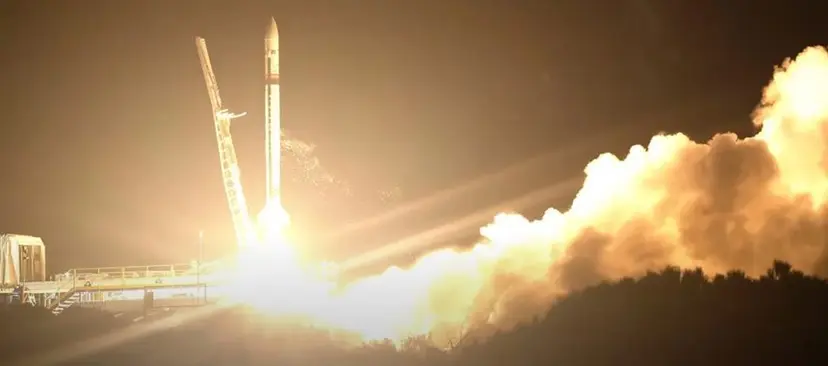
[비즈한국] On March 30 (local time), the German private aerospace startup Isar Aerospace launched its self-developed small satellite launch vehicle, ‘Spectrum,’ for the first time from the Andøya Spaceport in Norway. This marked the first time a launch vehicle independently designed by a European private company has been launched in earnest. However, 30 seconds after liftoff, the rocket deviated from its trajectory and crashed into the sea.
While the result was disappointing, the interview with the CEO of Isar Aerospace, who emphasized the significance of crossing the "30-second barrier," is surprising. Industry experts also evaluate this launch as a "half-success." What is the reason for this?

Space Startups That Must Accumulate Failures
According to the company's announcement, during the first test flight of Isar Aerospace's Spectrum launch vehicle, it took off with the ignition of the first stage, flew for approximately 30 seconds, and then the flight was terminated according to "planned procedures" and dropped into the sea in a "controlled manner." The entire process, from the 30-second flight to the drop, was intentional. All of this was thanks to strict safety protocols. Through this, the launch platform remained undamaged, and the safety of all participating personnel was ensured.
Daniel Metzler, co-founder and CEO of Isar Aerospace, stated, "We evaluate this test launch as a major success, as we achieved a clean liftoff, a stable 30-second flight, and validation of the Flight Termination System." He added, "This achievement goes beyond a simple launch; it is proof that we can go beyond designing and manufacturing rockets to actually launching them, and it will serve as the foundation for providing flexible and highly reliable satellite launch services in the future."
Space industry experts consider the data based on failure to be the most important criteria for moving to the next stage. The reason this launch was evaluated as a "half-success" is because the data collected during the 30-second flight can be analyzed, learned from, and improved upon to lay the groundwork for the next launch.
Isar Aerospace is already producing the second and third Spectrum launch vehicles. By developing, producing, and testing almost all components in-house through a vertical integration method, the company is building infrastructure to produce up to 40 launch vehicles per year through a highly automated series production system.
Bulent Altan, Chairman of the Board at Isar Aerospace and former SpaceX executive, evaluated the test launch by saying, "For a first flight of a completely new design, it was very successful." He viewed the flight and Isar Aerospace’s achievement positively, noting, "Isar's Spectrum, which has a 1,000kg payload capacity, will become a flexible and cost-effective global solution to fill the current shortage in satellite launch capacity. The important point is that Isar Aerospace did not just build a rocket; they built the entire rocket production system."
The Next Stage: The 'Second Launch'
Currently, European space startups are in the process of clearing the first hurdle: "launch vehicle development." Last year, the German aerospace startup RFA (Rocket Factory Augsburg) suffered a major accident where their rocket exploded during the engine testing phase just before the first launch. Since then, they have quickly begun improvement work and are conducting technical upgrades with the goal of relaunching this year. Experts state that the space industry is an industry of accumulation, where failure must be accumulated and one must move step-by-step toward success, as even theoretically viable rockets involve countless variables when realized in reality.
Spain's PLD Space is also a company showing notable achievements in the European small launch vehicle sector. Established in Elche, Spain, in 2011, they are developing the partially reusable small launch vehicle series, 'Miura.' In October 2023, they succeeded in launching the mini launch vehicle 'MIURA 1' from Huelva in southern Spain. This launch was significant as it was the first successful private small rocket launch on the European continent.
They are also accelerating the development of 'Miura 5,' targeting commercial launch in 2025. They have received full support in Europe, including backing from the Spanish government, the German Aerospace Center (DLR), and the EU’s Horizon 2020. PLD Space is pursuing both flexibility and sustainability through eco-friendly bio-kerosene fuel, a first-stage reuse system, and a dedicated launch service delivery model.
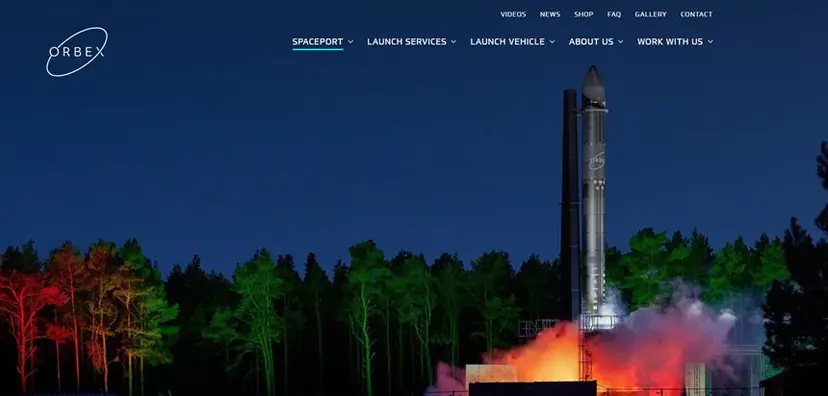
Orbex, headquartered in Sweden, is another noteworthy European startup. Orbex is developing a micro-satellite launch vehicle called 'Prime' and also has subsidiaries in Denmark and Germany. Founded in 2015 under the name Moonspike, it initially started private crowdfunding for lunar exploration, but funding fell through. Afterward, it changed its name to Orbex (Orbital Express Launch) and pivoted into a space company providing commercial launch services for nano and micro-satellites.
What sets it apart from other space startups is that it is a leader in Europe's sustainable space technology market, using bio-LPG fuel, lightweight carbon fiber structures, in-house European production infrastructure, and ensuring reusability. In particular, the fact that it is a pan-European company establishing a launch base network connecting the UK, Scandinavia, and Portugal also draws attention.
From Tech Startups to Policy Drives: 'Europe's Big Picture'
While Europe's technological prowess in this field is accumulating, it still has a long way to go when compared to the United States in terms of market size and policy flexibility. Therefore, government-led strategic R&D and policy drives are being conducted in parallel throughout Europe. As of the second half of 2024, the European Space Agency (ESA) and the European Union (EU) have made securing eco-friendly launch vehicle technology, strengthening space autonomy, and expanding public-private cooperation their core policies.
In the report '2024 Second Half European Space Propulsion/Exploration Research and Policy Trends' published by the Korea-EU Research Centre (KERC), Dr. Min Son, a researcher in Aerospace and Ocean Engineering at the Bundeswehr University Munich, comprehensively analyzed European space propulsion and exploration research and policy trends for the second half of 2024, shedding light on strategic directions for sustainable space development and technological innovation. In particular, by focusing on the expansion of Europe's eco-friendly space exploration propulsion, space exploration technology, and public-private cooperation in the space industry, the report presented future possibilities for space exploration and development while outlining the policy flow of the aerospace-related industry in Europe.
This report introduced the Themis and Ariane Next programs, through which Europe is promoting the securement of independent space capabilities and strengthening global competitiveness through research on space propulsion and launch vehicle technology. These are reusable rocket projects that Europe is developing independently to respond to SpaceX's Falcon 9.
Also, the European Space Agency (ESA) is pushing for the introduction of liquid methane and hydrogen fuels, aiming for carbon emission reduction and sustainable space development, while concurrently running the Prometheus engine and Themis project, with plans to secure fully reusable launch vehicle technology by 2027.
It is also noteworthy that Europe is actively promoting the introduction of eco-friendly propellants based on liquid hydrogen and liquid methane, recognizing the limitations of existing solid fuels and toxic chemical fuels. This is not merely a technological innovation, but a strategic approach for carbon emission reduction and a transition to a sustainable space industry. The ESA's 'Zero Debris' policy is also in line with this, and is expected to function as a space traffic management framework that includes preventing space debris emission, preventing satellite fragmentation, and collision avoidance technology.
Particularly striking is the investment in futuristic fuel technology. The H2POWRD project is developing hydrogen-based Rotating Detonation Gas Turbine (RDGT) technology, with 12 institutions including the Technical University of Berlin (TU Berlin) participating. This technology has the advantages of higher fuel efficiency and lower greenhouse gas emissions than conventional gas turbines. The Technical University of Darmstadt is researching clean energy technology based on aluminum-steam combustion through the A-STEAM project. This is attracting attention as a carbon-zero alternative fuel that can be used not only for space propulsion but also for ground power generation systems.
As such, Europe is reshaping the paradigm of future aerospace around two axes: "eco-friendliness" and "independent propulsion technology."
Another milestone in European space exploration is the Luna analog facility located in Cologne, Germany. This is a simulation facility dedicated to lunar exploration jointly operated by ESA and the German Aerospace Center (DLR). Various tests are underway, including a 700㎡ artificial lunar terrain, a gravity off-load system, rover cooperation experiments, and geological radar (GPR) experiments for underground resource exploration.
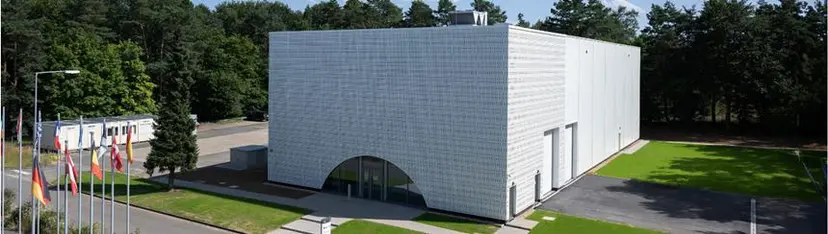
LUNA functions as an outpost for the European aerospace industry preparing for lunar base construction and long-term exploration missions, and is experimenting with various challenges that will be encountered in the actual lunar environment, such as AI-based autonomous exploration robot technology, sustainable habitat experiments, and design to counter lunar dust.
In terms of policy, Europe has also set out to strengthen integrated space policy at an unprecedented level. After the 2024 European Parliament elections, the new Commissioner for Defense and Space, Andrius Kubilius, presented "securing European strategic autonomy and space industry competitiveness" as his core policy direction.
In particular, the EU is comprehensively promoting the development of reusable rocket technology, space security and defense strategies, and legal system reorganization through the enactment of EU Space Law, along with major space infrastructure such as Galileo, Copernicus, and IRIS².
The 1-billion-euro CASSINI program is representative of space industry fostering policies, through which promising startups like PLD Space and Orbex are building the foundation for growth.
The space industry is inherently slow, high-cost, and an industry based on the premise of repetitive failure. People often compare the success of a startup to a "rocket," and the process by which a startup reaches success is very similar to the space industry of building a rocket. This is because success can only follow time, cost, and failure. For that very reason, the resilience and technical depth of a startup that can accumulate and repeat failure is the true competitiveness—another commonality between the space industry and startups.
The author, Lee Eun-seo, majored in law in Korea and studied theater in Berlin. Based in Berlin, a city of art and a European startup hub, she grows with the city and leads 123factory, which connects the Korean and German startup ecosystems.