

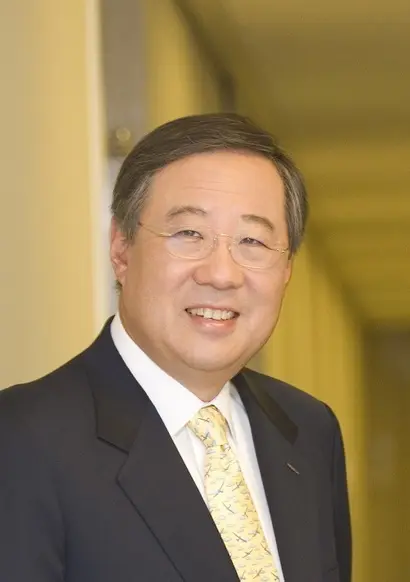
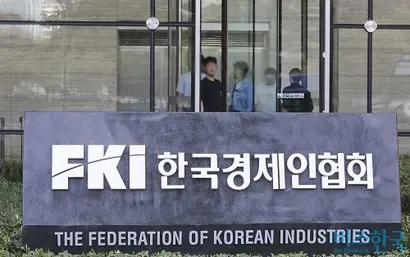
[비즈한국] The domestic business community is on edge due to U.S. President Donald Trump's tariff policies. Within the business sector, there is a growing expectation for the Federation of Korean Industries (FKI, formerly the Federation of Korean Industries) to take a leading role, as FKI Chairman Ryu Jin is known for his extensive network in the United States. The FKI has stated that it must respond as a "Team Korea" in cooperation with domestic political circles. Chairman Ryu Jin is not only the head of the FKI but also the Chairman of Poongsan103140 Group. Poongsan Group is also expected to be affected by the economic downturn resulting from these tariff policies. Chairman Ryu must voice concerns as the FKI chair while simultaneously preparing countermeasures against earnings risks as the chairman of Poongsan Group.
Between Commercial Act Amendments and Tariffs…
President Trump recently announced plans to impose a 25% tariff on South Korean products. The initial plan was to apply a 10% base tariff starting April 5, and then implement country-specific tariffs to raise them to 25% starting on the 9th. However, on the 10th, President Trump announced a 90-day grace period for these country-specific tariffs. While South Korea has gained some breathing room, it is not yet time to lower its guard, as the tariffs have merely been deferred, not withdrawn.
The eyes of the business community are fixed on FKI Chairman Ryu Jin. Chairman Ryu took office in August 2023 and was reappointed in February of this year. One of the reasons the FKI chose him was his broad international connections. There is a prevailing sentiment in the business world that Chairman Ryu should play a role in negotiations with the U.S. At the time of his appointment, the FKI stated, "With his outstanding experience, knowledge, and network on the global stage, he is the right person to provide the leadership needed for the reborn FKI to become a global think tank and a truly central global economic organization."
However, the six major economic organizations, including the FKI, met with Acting President Han Duck-soo on March 27 to demand a veto on the proposed amendments to the Commercial Act, citing concerns over potential difficulties for corporate operations due to tariffs. The key provision of the amendment is expanding the scope of directors' fiduciary duties from the company to shareholders. The business community has been opposing these amendments since last year. Acting President Han exercised his veto on the Commercial Act amendments on April 1, in line with the demands of the business sector.
Some in civil society criticize the FKI for using tariffs as an excuse to demand the veto of the Commercial Act amendments. People's Solidarity for Participatory Democracy criticized the move, stating, "Exercising the veto against the Commercial Act amendments is no different from the government and ruling party ignoring the wishes of numerous retail investors to return to a backward corporate governance system where controlling shareholders can engage in arbitrary management."
If President Trump withdraws his tariff policy, the business community’s justification for vetoing the Commercial Act amendments may weaken. On the other hand, if Chairman Ryu fails to provide countermeasures regarding the tariffs, he will not be free from criticism by the business community. In essence, Chairman Ryu is in a dilemma.
Chairman Ryu has previously expressed confidence in his relationship with President Trump. During a press conference last July, he remarked, "Since I can communicate simply with President Trump, there are aspects that are comfortable." Chairman Ryu is known to be on friendly terms with key figures in the Trump administration. He was also invited to and attended President Trump’s inauguration in January of this year.
There are limits to how much a single company can influence U.S. policy. However, opinions suggest that because the FKI is an economic organization rather than a single company, it can sufficiently voice its concerns to the U.S. A business official stated, "Since it is a negotiation between nations, there is a limit to what the FKI can do," but added, "Still, as a representative economic organization of the country, I hope they express their opinions more actively to the U.S."
The FKI established a task force (TF) in February to respond to President Trump's policies. Chairman Ryu has recently met with political figures several times to discuss related countermeasures. The FKI has also held its own seminars on tariff responses. Jung Chul, head of the FKI’s research division and president of the Korea Economic Research Institute, suggested at a seminar titled 'How to Respond to Trump’s Reciprocal Tariffs?' on April 3, "Since the U.S. first proposed cooperation in the shipbuilding sector, we must effectively communicate the uniqueness of the ROK-U.S. relationship to the U.S." He added, "We need to develop storytelling content that can deeply imprint South Korea's strategic importance on U.S. society, including through specific data and the voices of Americans, such as through U.S. think tanks." However, there have been no significant changes since President Trump announced the 90-day grace period for reciprocal tariffs.
Concerns over Copper Price Drops Amid U.S.-China Conflict
Another challenge for Chairman Ryu is the performance of Poongsan Group. Chairman Ryu heads the group, and it is known that his eldest son, Royce Ryu, is working at Poongsan’s U.S. subsidiary.
Poongsan Group is also expected to be affected by U.S. tariff policies. One of Poongsan's core businesses is the processing and smelting of copper. As the U.S. and China announce retaliatory tariffs against each other, concerns over an economic downturn are fueling fears of a drop in copper prices. Most of the prices for Poongsan’s copper-related products are tied to the price of copper.
While the decline in copper prices has not yet materialized—with prices on the London Metal Exchange (LME) maintaining a range of $8,000 to $10,000 (approx. 11.36 million to 14.2 million KRW) per ton from January to recently—the securities industry continues to voice concerns about a potential price drop.
Kim Jin-beom, an analyst at Sangsangin Securities, explained, "Uncertainty regarding copper prices remains due to the possibility of U.S.-China tariff negotiations and the resulting fears of an economic downturn. Concerns about China's reduced industrial activity due to trade disputes also act as a limiting factor in the supply of copper concentrate and refined copper." Choi Yong-hyun, an analyst at KB Securities, analyzed, "There is a long-term risk of a decline in Poongsan’s stock price following a drop in copper prices."
Poongsan Group’s stance is to wait and see for now. A Poongsan Group official stated, "There has been no major impact from U.S. tariffs yet," adding, "We are in a wait-and-see mode because we do not know what will happen in the future."