

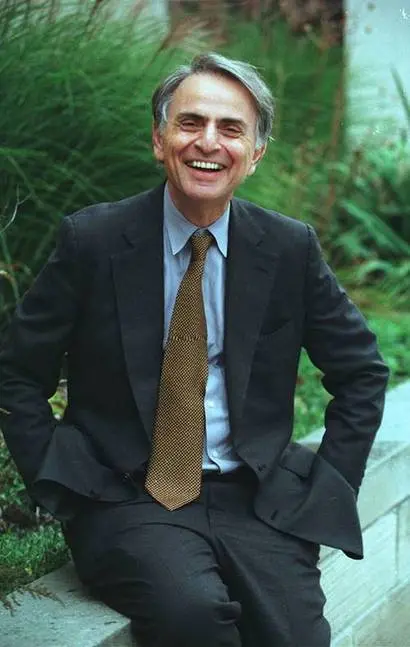
[비즈한국] "We are all made of star-stuff." This famous quote is attributed to Carl Sagan. If we trace the origins of the chemical components that make up our bodies, we inevitably arrive at the countless stars and supernovae that existed briefly in the universe billions of years ago. In that sense, even from a scientific perspective, we are all beings crafted from ingredients left behind by stars.
Although this is a well-known astronomical narrative, we surprisingly do not yet know the true meaning of these words. If the ingredients in our bodies originated from stars, exactly how far away were those stars? Where exactly did the stars that provided the precious materials for life, which we enjoy today here on Earth in the solar system, actually exist before they vanished?
It is easy to assume that our immediate ancestors, the supernovae, lived and died not far from where the solar system currently resides. No matter how long cosmic time may be, there must be a limit to how far the materials held within stars can spread. We had assumed that while it is a beautiful, romantic sentiment to say we are connected to stars, our entire story was likely contained within a range of just tens or hundreds of light-years.
However, recent successive discoveries suggest that we might actually be beings composed of pieces that have traveled across a much wider universe than we imagined. This is because the chemical components that currently make up our bodies may have drifted from far beyond our galaxy, circulating through the vast reaches of space. Sadly, we still live our lives without even being able to freely leave the Earth, let alone our galaxy, but the particles that form our bodies wandered through a universe far greater than we could ever imagine billions of years ago.
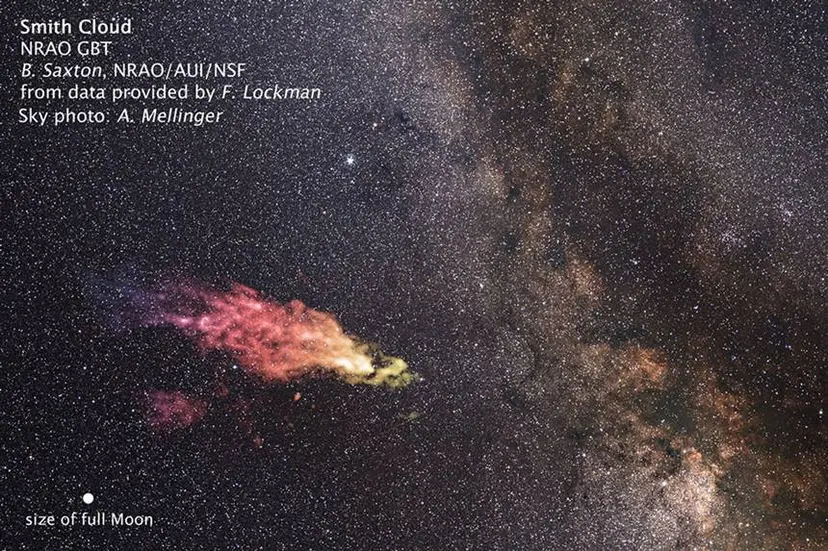
In 1963, Gail Smith, a doctoral student in astronomy at Leiden University in the Netherlands, discovered a peculiar cloud of gas floating next to the Milky Way. It was difficult to view it as an ordinary nebula. It was an elongated cloud of gas that appeared to be rushing toward a specific destination. Named after its discoverer, it has been known ever since as "Smith's Cloud." Later, radio observations revealed that this cloud drifts around our galaxy at a very high speed of 1.12 million km/h. It is a type of High-Velocity Cloud (HVC) that moves rapidly through the halo surrounding our galaxy.
Smith's Cloud is 11,000 light-years long and 2,500 light-years wide. If we could see it with the naked eye in the night sky, we would see a massive gas cloud next to the Milky Way, spanning 30 times the width of the full moon. Astronomers originally speculated that this cloud, which wanders unusually fast through our galactic halo, was gas that had entered from outside our galaxy. They assumed it was a leftover gas cloud that failed to coalesce when our massive galaxy was born 10 billion years ago, or perhaps a cloud that couldn't form stars due to a lack of material, only now being captured by the galaxy’s gravity.
If that hypothesis were true, this gas cloud would have experienced no major supernova explosions, and it should be in a very pure state, untainted by the heavy elements left behind by dying stars. In other words, it should consist almost entirely of hydrogen and helium with almost no heavy elements.
To verify this, astronomers conducted interesting observations using the Hubble Space Telescope. In the distant background of space, billions of light-years beyond Smith's Cloud, there are three galaxies that happen to overlap in a similar direction. These galaxies harbor powerful black holes at their centers, which emit intense ultraviolet radiation. Galaxies with such active and violent central black holes are called active galaxies. As the ultraviolet light emitted from these distant background galaxies passes through the nearby Smith's Cloud, some of it is absorbed by the chemicals within the cloud. Since all chemical elements absorb specific wavelengths of light, looking at which wavelengths are absorbed allows us to determine the chemical composition of Smith's Cloud.
However, a surprising fact was revealed. Contrary to the prediction that it would be pristine—consisting only of hydrogen and helium from just after the Big Bang—Smith's Cloud was significantly "tainted." In particular, clear traces of sulfur were confirmed in the ultraviolet range covered by this Hubble observation. Sulfur is a heavy element that can only be created by stars as heavy as our Sun. This means that Smith's Cloud was not a "failed galaxy" that had never hosted stars, nor was it a pure cloud that had just arrived.
The presence of heavy elements, including sulfur, clearly identified within Smith's Cloud points to the fact that it was actually a piece of our own galaxy that had broken off some time ago. In the midst of the countless star births and deaths that have repeated in our galaxy for a long time, this cloud fragment, stained with the materials of life, was pushed out of our galaxy due to the force of these events. However, it is now being pulled back home by the galaxy's gravity. In about 30 million years, Smith's Cloud will plunge into our galaxy, and the compression caused by the impact will trigger a burst of new star formation, like a fireworks display.
Frequent, massive supernova explosions that occurred within our galaxy long ago likely caused the ejection of this gas cloud. The shockwaves from powerful supernova explosions blasted a piece of our galaxy away, and it is now returning after a long journey. This phenomenon, where gas clouds pushed out beyond the galactic disk return and pour back in, is called a "Galactic fountain," an galactic version of a fountain. This completes a massive, galaxy-scale circulation system that functions like a conveyor belt, connecting the interior and exterior of the galaxy over scales of thousands or tens of thousands of light-years.
Recent additional research using the Hubble Space Telescope has proven that this galaxy-scale circulation system is occurring frequently not only in our galaxy but in many similar galaxies as well. Astronomers observed 11 galaxies where stars are actively forming, using 9 distant quasars as backgrounds. Similarly, they compared the chemical traces left as light from the background quasars passed through the halos surrounding the nearby galaxies. As a result, they confirmed that gas materials containing carbon and oxygen are spread extensively from the galactic disks to far-reaching areas. Carbon and oxygen were even found as far as 410,000 light-years away from the outskirts of the galaxies.
All of these galaxies have spread the precious chemical products—the ingredients for life—left behind by their supernovae out into the empty space between galaxies. Some of that material is later recaptured by the gravity of the galaxies, returning to its original home after billions of years. This has resulted in the spreading of gas cloud halos containing relatively high levels of heavy elements across vast areas reaching hundreds of thousands of light-years around galaxies. The existence of the Circumgalactic Medium (CGM)—traces of components permeating the space between galaxies—has been more clearly proven through actual observation.
The existence of the CGM confirmed by this observation connects us to an even more distant universe. Carbon and oxygen are the most basic ingredients that make up life on Earth. If we were to pinpoint a single atom and trace its journey over the past 13.8 billion years, it might have even traveled through the empty space between our galaxy and the Andromeda Galaxy before returning. We are, in an instant, transported beyond the Earth, the solar system, and even our galaxy, becoming part of the massive gas halo that encircles our star system.
If we could feel the journey of the countless carbon and oxygen atoms that have existed, it would be an unfathomably grand cycle. Just as we inhale and exhale, galaxies breathe. From a biological perspective, one might see galaxies as dead worlds filled only with inanimate objects like stars and planets. But from a grander perspective, a galaxy is a giant ecosystem, a living, breathing world. Astronomy teaches us that we are beings who happened to bloom within the breath that the galaxy inadvertently exhaled.
Reference
https://iopscience.iop.org/article/10.3847/2041-8213/ad9c69
About the author, Ji Woong-bae: He loves cats and the universe. After watching 'Galaxy Express 999' as a child, he dreamed of sharing the beauty of the universe. He is currently researching galaxy evolution through galactic interactions at the Center for Galaxy Evolution and the Near-Field Cosmology Laboratory at Yonsei University. He is also engaged in various science communication activities, including lectures and writing. He has authored books such as 'The Observatory of Flirting', 'Thinking About the Universe All Day', and 'Stars, the Science of Light'.