

[비즈한국] The exodus of foreign investors from the domestic stock market continues. The foreign ownership ratio of the total market capitalization has failed to recover to the 30% level since August 2024, and the value of foreign holdings has shrunk from 738 trillion won at the end of 2023 to 666 trillion won as of January 2025. Feeling a sense of crisis, the government launched a 'Value-Up Program' to resolve the 'Korea Discount' and introduced the 'Korea Value-Up Index,' comprised of 105 undervalued, high-quality stocks. Each week, we select one stock from the index to analyze its management status and corporate value enhancement plans, determining whether it is a stock that can help prevent the 'fall of the KOSPI.'
Global stock markets are fluctuating due to the 'tariff volatility' from the United States. After the market plummeted following the 'Black Monday' of the second week of April, stock prices showed a rebound due to President Donald Trump's announcement of a 90-day tariff delay. These back-and-forth U.S. policies have been reflected in the domestic stock market as well. The Korea Value-Up Index, which hit a 52-week low of 900.23 on April 9, also opened higher on the 14th, recording 961.51.
An unstable market environment is leading to increased interest in financial stocks. Despite risks such as prolonged economic stagnation and falling interest rates, domestic financial holding companies have continued to set new records for net profit every year. Among the top 10 constituents of the Korea Value-Up Index, three are financial stocks (KB Financial105560, Shinhan Financial Group055550, and Meritz Financial Group138040). Following the market leader KB Financial, the next stock is Shinhan Financial Group (Shinhan), which ranks 7th with a market capitalization of 23.2843 trillion won (based on the closing price on April 14).
Shinhan Financial’s stock price is 46,250 won. While its one-year return is 7.0%, it recorded negative returns of –19.8% over the past six months and –7.5% over the past three months. However, the one-month return has turned positive at 2.4%. Shinhan’s stock price reached as high as 64,600 won during intraday trading in August 2024, when it gained attention as a beneficiary of being undervalued, but it has since trended downward, returning to levels seen a year ago. The Price-to-Book Ratio (PBR) shows a similar trend. During the same period, Shinhan's PBR, which had been 0.58x, dropped to 0.42x on the 9th.
Shinhan Financial announced its plan to enhance corporate value in July 2024. The Value-Up plan aims to achieve three main targets by 2027: a Return on Equity (ROE) of 10%, a shareholder return ratio of 50%, and a reduction of outstanding shares to 450 million. The ultimate goal is to enhance corporate value based on improved ROE, creating value for stakeholders including shareholders, customers, employees, and society.
Shareholder return policies center on the cancellation of treasury shares. The company plans to increase the size of cash dividends annually and implement consistent quarterly cash dividends. As the shareholder return ratio is currently lower and improving more slowly than overseas banks, the company plans to accelerate the pace, raising the ratio from 40% to 50%.
The large-scale treasury share reduction plan to reach a 50% shareholder return ratio is also noteworthy. Believing that the value per share has been relatively low due to having more shares than industry peers, the goal is to increase per-share value by reducing the total number of shares. Shinhan Financial announced it would reduce its treasury shares from 513 million shares at the end of 2023 to under 500 million by the end of 2024, with a further reduction of 50 million shares over the next three years. To this end, it has unveiled a plan to buy back and cancel over 3 trillion won worth of treasury shares in the future.
Shinhan Financial set its 2025 shareholder return volume at 1.75 trillion won. It will buy back and cancel a total of 650 billion won in treasury shares (150 billion won already acquired as of January) and aims to achieve a shareholder return ratio of 40–44%. Following this, the board of directors resolved on February 6 to buy back and cancel 500 billion won in shares and pay a fourth-quarter dividend of 540 won. The treasury shares will be purchased in the open market and canceled between February 7 and August 6. In 2024, the company bought back and canceled 700 billion won worth of treasury shares. According to Shinhan Financial’s performance review for the fourth quarter, the number of circulating shares decreased to approximately 499 million as of the end of 2024.
To improve ROE, the company has set a Common Equity Tier 1 (CET1) ratio of 13% as a key metric for financial soundness. By introducing a 2.5% stress buffer capital (capital for normal operations during a banking crisis) and a 1.0% countercyclical buffer capital (capital accumulated flexibly according to the economic cycle), the company is managing its CET1 ratio target, raising the threshold from 12% to 13%.
Similar to KB Financial, which proposed 'CET1-linked returns' as a shareholder return plan, Shinhan Financial has become the first domestic financial firm to introduce a 'Return on Tangible Common Equity (ROTCE)' standard. ROTCE is a concept calculated by subtracting intangible assets such as goodwill from group capital and serves as an indicator to reveal actual capital profitability. Shinhan Financial aims to achieve an ROTCE of 11.5% and boost its ROE from 8.6% to 10%.
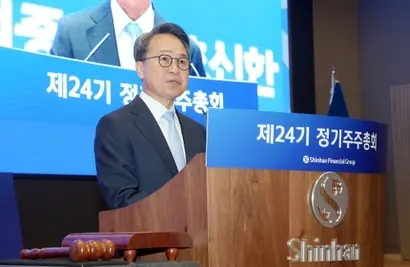
Chairman Jin Ok-dong’s commitment to driving the Value-Up program is also strong. In a recent letter to shareholders, Chairman Jin stated, "The corporate Value-Up program must continue and must succeed. While some point out that the Korean stock market has not performed as well as expected, I am hopeful about the success of the Value-Up program." He added, "I will do my best to achieve the goals of 10% ROE, 50% shareholder return ratio, and reduction to 500 million shares by 2027. I will turn the dreams of 2024 into the reality of 2027."
The securities industry also has high expectations for Shinhan Financial. Although Shinhan’s net profit for the fourth quarter of 2024 fell 64% (473.4 billion won) from the previous quarter, its annual consolidated net profit was 4.518 trillion won, a 3.4% increase from the previous year (4.368 trillion won). Furthermore, its aggressive shareholder return policies have been highly evaluated.
Woo Do-hyung, an analyst at Yuanta Securities, predicted, "In a situation with high economic uncertainty, a highly visible shareholder return policy will act as a factor to defend against stock price declines. With high profit growth expected in 2025 due to the base effect of 2024 performance, there is potential for stock price appreciation."