

[비즈한국] The keywords for South Korea’s real estate market in 2025 are clear: ‘supply shortage,’ ‘reshuffling of core Seoul areas,’ and the resulting ‘re-evaluation of dominant regions in the Seoul Metropolitan Area.’ And at the intersection of these three keywords lies a specific place: ‘Bundang-gu.’ Among the first-generation new towns, Bundang boasts the most advanced urban planning, locational advantages, and potential for policy benefits, and it is preparing for a new leap in the real estate market starting in 2025.
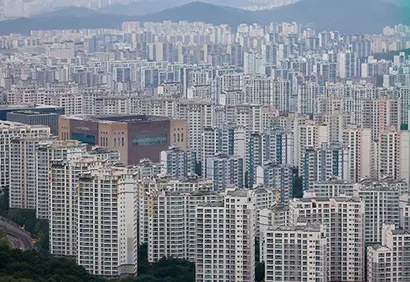
Until now, Bundang has been considered a lower priority by both investors and homebuyers due to the perception that it is “already expensive” or “overvalued.” However, this “overvaluation” frame is currently collapsing. In terms of policy, location, market, and demand, Bundang is rising “again,” and is being re-illuminated as an area with a very high potential for continued growth.
Full-scale redevelopment of 1st-generation new towns… ‘Bundang’ becomes the benchmark
In late 2024, the government designated pilot redevelopment zones among the first-generation new towns in accordance with the Special Act on the Improvement of Old New Towns. As expected, Bundang had the largest scale. This is not just a matter of policy benefits; it means that Bundang has effectively become the standard for new town redevelopment across the country. Among the first-generation new towns, Bundang has the largest scale, the highest level of self-sufficiency, and the broadest demand for improvement. Redevelopment in a situation where infrastructure such as administration, transportation, industry, commerce, and education is already established signifies a ‘reset’ and a ‘new leap forward’ for existing aging apartment complexes.
30-year-old complexes in representative central areas like Jeongja-dong, Seohyeon-dong, and Sunae-dong have already formed remodeling committees, and some are on the verge of project approval. In particular, the possibility of a shift to reconstruction is being raised in the Jeongja-dong area, which could lead to an even greater increase in property value. This implies that Bundang's real estate value has entered a stage of ‘city-wide renewal’ rather than just ‘complex-by-complex remodeling.’
Pangyo Techno Valley expansion… Bundang’s new growth engine
Pangyo, located within Bundang-gu, is more than just a residential area. Centered on the Pangyo Techno Valley, known as the heart of South Korea’s IT industry, the second and third Pangyo Techno Valleys are expanding sequentially. In particular, as full-scale corporate move-ins into the second and third valleys begin in 2025, this will lead to an increase in the high-income population flowing into Bundang-gu and a qualitative shift in residential demand.
In fact, there is a steady increase in demand among high-income professionals working in the Pangyo area to live in ‘core locations within Bundang.’ Due to educational infrastructure comparable to Seoul’s Gangnam, pleasant natural environments, and convenient transportation, the lifestyle of ‘working in Pangyo and living in Bundang’ has now become a high-end trend.
A focal point for multiple transportation projects including the GTX-A
Bundang’s transportation map is being redrawn. With the opening of the GTX-A line, travel time between Suseo, Pangyo, and Dongtan has been dramatically reduced. In addition, the Wirye-Sinsa Line and the Shinbundang Line extension projects are being pursued simultaneously; these lines will serve to directly connect Bundang to the Gangnam area of Seoul, Wirye New Town, and Dongtan.
In short, Bundang will no longer function as a “suburb of Seoul” but as part of the “same living zone as Seoul.” This is the most certain engine for rising housing prices. As ‘accessibility to Seoul’ is strengthened, the trend of assets concentrating in key areas among the outskirts of the capital region will accelerate.
A prime beneficiary in an era of supply shortages
The biggest variable in the Seoul Metropolitan Area’s real estate market in 2025 is the shortage of supply. Private redevelopment projects are being delayed due to regulations and permitting issues, while government-led supply is losing effectiveness due to location issues. In this situation, Bundang—where infrastructure is already complete and large-scale housing supply is possible solely through redevelopment projects—is emerging as practically the ‘only rare area.’
The prices of older apartments, which are cheaper than new ones, have not yet fully reflected the expectations for redevelopment, providing favorable conditions for ‘pre-redevelopment investment.’ In particular, complexes of the national housing size (exclusive area of 84㎡ or less) are seeing stable transactions in line with the real demand of the middle class, and expectations for premiums through future reconstruction and remodeling are high.
Top-tier popularity as a substitute for Seoul’s Gangnam area
Although Seoul’s Gangnam area is still rated as the best real estate location in South Korea, the barrier to entry is too high. As a result, ‘areas that provide a living environment equivalent to Gangnam but at a relatively lower price’ are garnering attention, and Bundang satisfies these conditions almost perfectly.
The areas of Seohyeon-dong, Jeongja-dong, and Sunae-dong lack nothing in terms of school districts, commerce, natural environment, and transportation, and if new apartments are added to this, they will be able to fully absorb a ‘quasi-Gangnam premium.’ In fact, some experts even evaluate that “Bundang is effectively part of Seoul’s four Gangnam districts.”
Disparities and opportunities within Bundang-gu
There are differences in temperature by location within Bundang-gu. While central areas like Jeongja, Seohyeon, and Sunae are already highly rated, areas such as Yatap, Gumi, Imae, and Geumgok still have room for re-evaluation in terms of price. Specifically, the Imae and Gumi-dong areas are relatively undervalued despite being close to transportation infrastructure such as the Bundang Line, GTX, and buses, and they are actively pursuing remodeling and reconstruction.
These areas have significant upside potential starting in 2025, and it is highly likely that both residential and investment demand will flow in simultaneously. Furthermore, in the case of the southern outskirts directly connected to Seoul’s Songpa-gu, connectivity to the Gangnam area will be strengthened once the Wirye-Sinsa Line opens, expanding the pool of potential demand.
A region at the intersection of policy and market value
In 2025, the government is signaling deregulation and tax incentives to expand housing supply. This will create a very positive environment for complexes pushing for remodeling and reconstruction. Also, in the case of Bundang, which is adjacent to the Seoul Metropolitan area’s wide-area plans, the potential for policy benefits is higher than in other regions.
Beyond being a preferred area for actual residents, the fact that policy, finance, and the market are all moving in a direction favorable to Bundang suggests that this region may enter another golden age over the next few years.
Bundang becomes the protagonist of the Seoul Metropolitan Area once again
Many people recall the Bundang of 10 years ago and say, “It has risen too much. Everything is already reflected.” However, the Bundang of 2025 is different. Having passed through a period of stagnation in the past, it has now begun to ride a massive wave of ‘re-improvement and re-evaluation.’ Beyond simple maintenance of aging apartments, a redesign of the entire city is taking place, and all elements—population, industry, policy, transportation, and education—are creating synergies.
Bundang is a place that is starting over right now. It is not an overvalued place, but a place that is starting to be properly evaluated. Bundang in 2025 is a region that can provide the best living environment for residents and the best profitability and stability compared to the Gangnam area for investors.
Kim Hak-ryeol, the director of Smart Tube Real Estate Research Institute, famous by the pen name 'Pashong,' served as a team leader at the Real Estate Research Division of Gallup Korea. He manages and hosts the Naver blog 'Pashong's World Exploration' and the YouTube channel 'Stew TV.' His books include 'The Power of Gyeonggi-do Real Estate (2024),' 'Absolute Principles of Seoul Real Estate (2023),' 'The Future of Incheon Real Estate (2022),' 'Kim Hak-ryeol's Absolute Principles of Real Estate Investment (2022),' 'Future Map of South Korean Real Estate (2021),' 'From Now On, Only Areas That Rise Will Rise (2020),' and 'User Manual for South Korean Real Estate (2020).'