

[비즈한국] A state-run research institute has released an analysis suggesting that South Korea's trade surplus with the U.S., which the U.S. government is using as justification for imposing tariffs, is actually a result of policies from the first Trump administration. The report identifies the intensification of trade sanctions against China over the past decade, which led to demand for Chinese intermediate goods being replaced by South Korean alternatives, and the sharp rise in South Korean direct investment in the U.S. as key contributing factors. It also suggests that South Korea should utilize the context of the complementary industrial structure between the two nations and the legitimacy of the trade surplus as a persuasive argument at the tariff negotiation table.
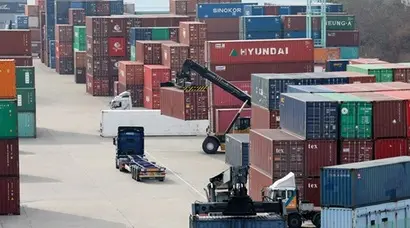
Exports of Intermediate Goods to the U.S. Have Grown Alongside U.S. Production
Amid what is effectively a global tariff bombardment by the U.S. targeting the entire world, South Korea, which recorded the 8th largest trade deficit for the U.S. last year, is devising strategies to minimize the shock. In this context, the Korea Institute for Industrial Economics & Trade (KIET) presented a structural counter-argument to the U.S.'s one-sided trade pressure in its report, "Structural Analysis of South Korean Exports to the U.S.," on the 13th. The report interprets the rapidly increasing exports of South Korean intermediate and capital goods to the U.S. as a phenomenon occurring due to the U.S. manufacturing sector's growing reliance on South Korean products—a trend that has been strengthened since 2015 by the expansion of anti-China containment policies and the increase in South Korean direct investment in the U.S.
KIET focused on the rapid expansion of South Korean intermediate and capital goods exports to the U.S. According to the Korea International Trade Association (KITA), South Korea's exports of key intermediate goods that are essential links in the U.S. industrial supply chain—such as semiconductors, steel, secondary batteries, and petroleum products—have increased significantly over the past four years. Conversely, according to the U.S. International Trade Commission (USITC), U.S. imports from China fell from $504 billion in 2015 to $462.6 billion in 2023.
In particular, the expansion of production elasticity (the ratio of the increase in South Korean exports for every 1 percentage point increase in U.S. production) is cited as evidence that U.S. manufacturing production is directly linked to South Korean intermediate and capital goods. The analysis shows that for intermediate goods (excluding IT), the figure rose from 1.21 in 2016 to 1.28, and for capital goods, it reached 1.10 in 2024, up from 1.05 four years earlier in 2020.
The analysis suggests that these changes were driven mainly by geopolitical factors, such as the U.S. containment of China, rather than simple market logic. As U.S. imports from China continued to decline, South Korea filled a significant portion of the void. In short, the more the U.S. distanced itself from China, the closer it became to South Korea.
At the same time, South Korean direct investment in the U.S. has also surged. The cumulative investment amount, which was only $40 billion in 2014, has approached $130 billion as of 2023. The number of South Korean companies operating in the U.S. has increased by 43% over the past decade, surpassing 15,000, and these companies still source 59% of the materials they need from their South Korean headquarters, acting as a major driver for export growth.
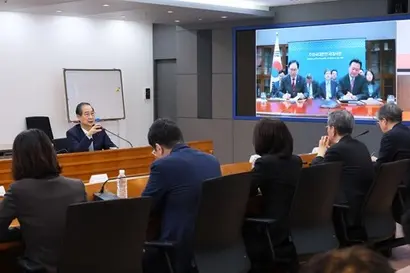
Re-examining the U.S.-Korea Link: Time to Talk 'Structure' Instead of Numbers
The second Trump administration has announced plans to impose a 25% reciprocal tariff on South Korea, citing the need to resolve its trade deficit as the justification. Although the tariff announced on the 2nd (local time) has been suspended for 90 days, concerns are growing that South Korea's exports to the U.S. could plummet.
The government is currently focusing all its efforts on negotiating a reduction or abolition of the tariff rates rather than engaging in a tit-for-tat trade war. This is to minimize damage to South Korea, a country with high trade dependency. The plan is to reduce the trade surplus with the U.S. by focusing on areas of high interest to the Trump administration, such as shipbuilding and the Alaska gas pipeline project, and in return, secure a reduction or abolition of reciprocal tariffs.
The report suggested that South Korea should actively use the legitimacy of its trade surplus, based on the industrial linkage structure between the two countries, as a logic for trade negotiations. It argues that Korea must emphasize its role as a partner to U.S. industry, moving beyond a surplus logic judged solely by numbers. The argument is that the fact that South Korean companies are growing alongside the U.S. industrial sector can serve as a practical diplomatic card to avoid high tariffs.
KIET stated, "We must explain convincingly to the U.S. side that South Korea's trade surplus with the U.S. is by no means an unfair outcome, but a legitimate result stemming from the complementary structure between the two countries' industries," adding, "Future trade negotiations should also be based on this logic to ensure proactive and strategic responses."