

[비즈한국] While mid-sized and small construction firms, which serve as the "backbone" of the industry, are facing receivership one after another, a BizHankook investigation has confirmed that 8 mid-sized construction companies ranked between 20th and 50th in the country last year have exceeded the risk threshold for debt-to-equity ratios (200%). Although their total debt-to-equity volume has decreased compared to the previous year, concerns regarding the financial health of mid-sized builders remain unresolved as cases of companies failing to withstand financial distress continue to emerge.
The debt-to-equity ratio is a key indicator for assessing a company's financial health. It indicates how much external debt a company holds relative to its equity. Typically, a debt-to-equity ratio of 200% or less is considered stable, while exceeding this level is seen as a sign of an unstable financial structure. The construction industry often exhibits higher debt-to-equity ratios compared to other sectors because many projects require large-scale upfront capital investment.
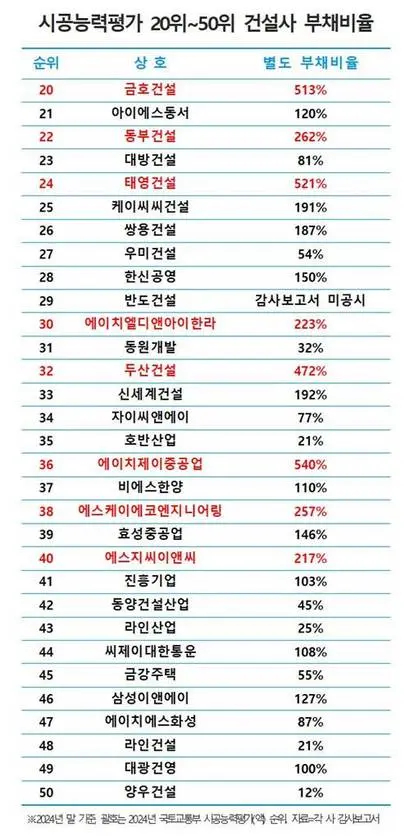
On the 11th, BizHankook analyzed the financial statements of mid-sized construction companies ranked 20th to 50th in domestic construction capability for the previous year. The analysis covered a total of 30 companies, excluding Bando Construction (ranked 29th in construction capability), which has not yet published its audit report. The results show that the average debt-to-equity ratio of the 30 companies was 122%, a 15%p decrease from the previous year. Among them, 19 companies saw their debt-to-equity ratios decrease by between 6%p (Yangwoo Construction) and 784%p (Shinsegae E&C034300), while 11 companies saw theirs increase by between 1%p (Daekwang E&C) and 266%p (Kumho E&C002990), indicating a deterioration in financial health.
Among mid-sized construction firms, HJ Shipbuilding & Construction had the highest debt-to-equity ratio. While the company's ratio fell significantly from 745% in 2023 to 540% last year, it remained the highest among the mid-sized builders. HJ Shipbuilding & Construction097230, which operates in both the shipbuilding and construction sectors, saw its debt-to-equity ratio surge due to accumulated deficits from economic downturns, but it was reduced last year through the sale of assets such as the Dong Seoul Terminal.
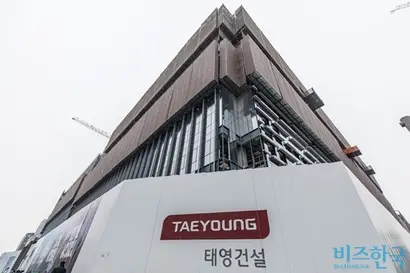
There are 8 mid-sized construction firms whose debt-to-equity ratios exceeded 200% last year. These include HJ Shipbuilding & Construction (540%), Taeyoung E&C (521%), Kumho E&C (513%), Doosan E&C (472%), Dongbu Corporation005960 (262%), SK Eco Engineering (257%), HL D&I Halla (223%), and SGC E&C (217%). Taeyoung E&C, currently under a workout process, saw its financial situation improve from a state of total capital erosion in 2023, but its debt-to-equity ratio remained in the 500% range, while Kumho E&C saw its ratio rise by 266%p due to an increase in floating-rate borrowings.
One of the causes for the deterioration in debt-to-equity ratios is the rise in construction costs. According to the Korea Institute of Civil Engineering and Building Technology, the construction cost index in December last year was 130.18 points, up 1% from the previous year and about 11% higher than in December 2021, three years ago. The construction cost index is an indicator that tracks fluctuations in direct construction costs, such as materials, labor, and equipment. Construction companies that failed to pass on the rise in construction costs during the inflationary period faced declining profitability and, in some cases, losses. The accumulated operating losses were reflected as deficits, leading to a reduction in capital.
Unsold housing units and Project Financing (PF) instability due to the economic downturn also played a role. According to the Ministry of Land, Infrastructure and Transport, domestic unsold housing units stood at 70,173 in December last year, an increase of 7,684 units (12%) compared to the same month the previous year. The number of "post-completion unsold" units, often referred to as malicious unsold housing, reached 21,480, about double (an increase of 10,620) compared to the previous year. In fact, apartments launched by top mid-sized construction firms with high debt-to-equity ratios, such as The Pallist Desian, Gangneung Atera, and Doosan We've the Zenith Central City, saw shortages in first and second-tier subscriptions. Furthermore, as PF projects became insolvent, instances arose where contingent liabilities previously held in the form of payment guarantees were recorded as actual debt.
Meanwhile, nine domestic mid-sized and small construction companies have filed for or are preparing to file for court receivership this year. Court receivership refers to a process where a third party appointed by the court manages a company's operations when it has so much debt that it cannot sustain itself. According to the construction industry, starting with Sindonga Construction (58th) and Daejeo Construction (103rd) in January, Sambu Construction (71st), Angang Construction (116th), Daewoo Shipbuilding & Marine Engineering Construction (83rd in 2022), and Samjung Enterprise (114th) in February, as well as Byucksan Engineering (180th) in March and Ewha Construction (134th) on the 1st, have filed for receivership. Daeheung Construction, the top construction firm in the North Chungcheong region and 96th in construction capability as of last year, also announced on the 8th that it is preparing to file for corporate rehabilitation procedures.