

[비즈한국] On the 9th, U.S. President Donald Trump announced that 13 hours after imposing reciprocal tariffs, he would only apply the base tariff (10%) to all countries except China, while suspending individual country-specific tariffs. Consequently, South Korea is subject only to the base reciprocal tariff (25%), with the additional individual tariff (15%) being deferred. However, President Trump warned that he would impose the remaining individual tariffs on any country that fails to reach a trade agreement within the 90-day grace period. Although President Trump granted a temporary deferral, the reciprocal tariffs have effectively set off alarm bells for the South Korean economy.
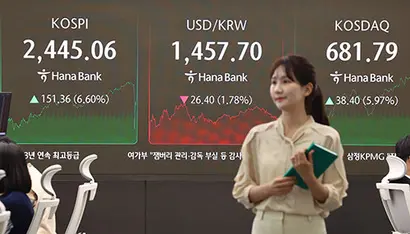
This is because President Trump has dealt another fatal blow of export deceleration to an economy already shaken by the martial law crisis involving former President Yoon Suk-yeol last December. In particular, as the situation unfolds even worse than the "pessimistic scenario" presented by the Bank of Korea in its February economic outlook, concerns are mounting that South Korea’s growth rate could fall into the 0% range. Furthermore, unlike countries such as Japan or other Asian and European nations where heads of state have engaged in tariff reduction negotiations, South Korea’s inability to conduct summit diplomacy until the presidential election on June 3 is further exacerbating concerns over economic slowdown.
As President Trump has introduced steel and aluminum tariffs (25%), automobile tariffs (25%), and now reciprocal tariffs, pessimistic outlooks on the Korean economy from domestic and international economic institutions are spreading. The Conference Board, a U.S. think tank that publishes key economic indicators such as the Leading Economic Index and Consumer Confidence Index, stated in a report titled "Reciprocal Tariffs Will Weaken the U.S. and Global Economy" that "the implementation of reciprocal tariffs will lead to worsened growth, rising inflation, and global supply chain disruptions for both the U.S. and the world." It projected that these tariffs could shave 1.2 percentage points off U.S. growth this year.
It also estimated that global economic growth would fall by 0.5 percentage points. Specifically, it projected that South Korea’s growth rate would also drop by 0.3 percentage points this year due to the reciprocal tariffs. The Conference Board explained that these projections assume the tariffs remain in place for one year and do not account for retaliatory tariffs against U.S. goods. If President Trump’s reciprocal tariffs remain for an extended period and retaliations from countries like China intensify, the downward revision of South Korea’s growth rate will inevitably widen.
Aston University in the UK, using trade data from 132 countries regarding the U.S., stated in its "Tariffs and Victory" report that a trade war featuring President Trump's reciprocal tariffs and full-scale retaliatory tariffs by other nations could cause $1.4 trillion (approximately 2,052.34 trillion KRW) in global losses. In particular, it noted that while the U.S. would suffer the most with a 66.181% decline in exports, South Korea would see a 7.528% drop in exports, marking the 5th largest decline among major global economies. It further predicted that South Korea’s export-oriented economy would see its growth rate fall by 0.859 percentage points.
Global investment bank Wells Fargo also projected that South Korea’s economic growth rate this year would fall by 0.5 to 1.0 percentage points due to the U.S. reciprocal tariffs. The reason foreign research institutions are predicting such a decline is that President Trump’s reciprocal tariffs not only act as significant downward pressure on South Korea’s export-dependent economy but may also lead to reduced domestic investment and employment as export companies expand their local production within the United States.
These negative outlooks were already foreshadowed in the Bank of Korea’s February economic forecast. At the time, the Bank of Korea projected South Korea’s growth rate at 1.5% based on a base scenario involving U.S. tariffs on China, tariffs on other countries, and low-intensity retaliatory tariffs. It predicted that in a "pessimistic scenario" involving significant U.S. tariff hikes and high-intensity retaliation, the growth rate would drop by an additional 0.1 percentage points from 1.5%. However, with the U.S. imposing a total of 54% in tariffs on China, followed by tariffs on steel, aluminum, automobiles, and now the reciprocal tariffs, a situation worse than the pessimistic scenario is currently unfolding.
Consequently, there are expectations that the Bank of Korea will significantly lower the country’s growth projection in its next economic outlook. Some have already lowered their forecasts to the 0% range. JPMorgan has reduced its South Korea growth forecast for this year from 1.2% to 0.9%. Given that Citigroup’s forecast stands at 1.2% and both HSBC and Barclays are at 1.4%, it is expected that the number of institutions lowering their outlook to the 0% range will continue to grow.