

[비즈한국] The use of 'robots' in medical institutions is on the rise. Hyundai Motor Company005380 and Kia000270 recently signed a business agreement with Hallym University Medical Center to promote the concept of a 'robot-friendly hospital.' While there have been 'robot-friendly buildings' and 'smart hospitals' in the past, this is the first time a hospital centered specifically on 'robot' technology has been introduced. The companies plan to develop robot services optimized for hospital environments and establish related standards and certification systems. However, experts point out that for robot usage to be fully activated in medical institutions, challenges such as high development costs and building structural issues like steep inclines must be addressed.
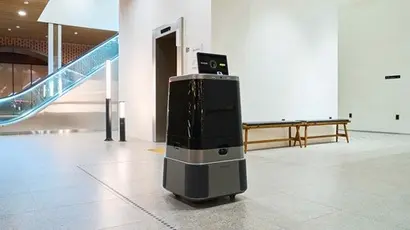
Announcement of the First 'Robot-Friendly Hospital' Construction
Hyundai Motor and Kia recently signed a business agreement with Hallym University Medical Center, announcing the construction of a 'robot-friendly hospital' that integrates the company’s 'robotics total solution' into the medical space. Hallym University Medical Center will provide its actual medical space as a testbed, managing operations to verify usability and collect requirements and feedback from internal hospital users. Specifically, Hyundai Motor and Kia will develop hospital-customized delivery robots, control systems, facial recognition-based authentication, and a tracking system for special item deliveries. They will also jointly establish standards and a certification system for 'robot-friendly hospitals.' While there have been cases where artificial intelligence (AI) and information and communication technology (ICT) and robots were used as part of 'smart hospitals,' this is the first time for a 'robot-friendly hospital.'
Hyundai Motor and Kia stated, "Hospitals are high-density environments where an unspecified number of patients and medical staff mix with various objects such as wheelchairs and portable beds, making a robot's precise navigation performance and safety the key technical elements." They added, "As we must consider special purposes like medical information protection, infection control, and access control, developing hospital-specific robot technology that differentiates itself from existing offices is crucial for realizing a true robot-friendly hospital." Previously, the company operated 'DAL-e delivery robots' based on private offices like Factorial Seoul Forest. These robots integrate with building elevators and access control systems to navigate entire floors in real time via optimal routes, and use AI facial recognition technology to identify recipients.
Similar to the 'robot-friendly hospital,' one might think of the Naver035420 1784 headquarters, which has received 'robot-friendly building' certification. The 1784 building utilizes cutting-edge technologies such as digital twins, robots, AI, and cloud computing. Inside the building, over 100 service robots provide convenience services like delivery, and it features robot-exclusive elevators and a cloud-based multi-robot intelligence system linked to building infrastructure. Features that require almost no 'contact,' such as touchless meeting room doors that open via motion recognition and speed gates that open via facial recognition, are also characteristic. It is expected that 'robot-friendly hospitals' will also operate based on such 'service robots' and 'robot-centric spaces.'
Focus on 'Services' like Transport, Disinfection, and Guidance… Low Satisfaction Among Medical Staff
Robots in hospitals have so far been utilized in 'service' areas such as transporting pharmaceuticals and medical samples, disinfection, and guiding patients. Previously, the COVID-19 pandemic created a need for solutions to medical staff shortages and changes in medical service delivery methods, and with the launch of state-led service robot demonstration projects and smart hospital programs, 'robots' began to take hold in hospitals in earnest. The service robot demonstration project and the smart hospital project have been operated by the Korea Institute for Robot Industry Advancement and the Korea Health Industry Development Institute, respectively, since 2020.
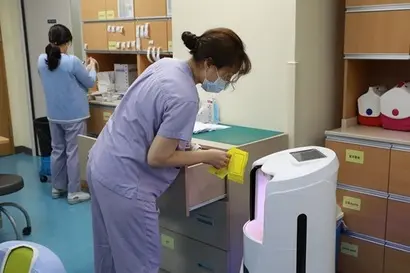
In the case of Hallym University Sacred Heart Hospital, which is the most active user of medical service robots, they use 77 robots across 11 categories for nursing and medical support tasks, including transporting pharmaceuticals and samples, in-hospital disinfection, patient guidance, inter-ward item delivery, and patient education. Regarding the results of 'medical service robots' to date, the hospital explained in a press release, "The pharmacy team used them most actively. The 'Pharmacy Narmi' robot delivers medication throughout the wards, reducing face-to-face tasks for pharmacists and eliminating the need for nurses to come down to the pharmacy, thereby improving work efficiency for both groups."
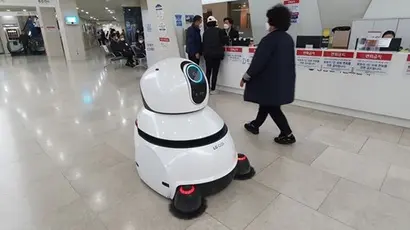
The Korea Health Industry Development Institute categorizes 58 individual smart hospital leading models into 9 types of modules. The leading models that currently directly use 'robots' are the 'autonomous disinfection robot' and the 'AI-based logistics transport system.' These correspond to the 'Integrated Infection Control' and 'Intelligent In-hospital Logistics Delivery' modules, respectively. The 'autonomous disinfection robot' features real-time location tracking data to move to crowded areas for social distancing guidance, uses AI facial recognition for mask-wearing guidance, and conducts nighttime UV disinfection on various kiosks such as elevator buttons and automated payment machines. The 'AI-based logistics transport system' is characterized by using biometric authentication (finger vein method) to open and close entry points when transporting medical equipment, pharmaceuticals (anti-cancer drugs, narcotics, etc.), and supplies (instruments, laundry, waste, etc.).
While support staff are generally satisfied with the use of robots for 'service' tasks, the common consensus in medical fields is that medical staff do not really feel the benefits. Medical staff suggest that aspects like speed and safety need improvement. Professor A at a tertiary hospital that conducted a robot demonstration project said, "Take medical samples, for example; some hospitals have conveyor belt systems for transport, while others rely on people moving them directly. Ultimately, speed and safety are the most important. Conveyor belts are simpler and therefore more advantageous than robots in terms of potential for accidents and speed. When people move things themselves, it is just as fast." He added, "It might be somewhat helpful for tasks where time isn't critical, but hospital logistics systems are still far too complex and diverse for robots to handle."
Cost and building structure are cited as obstacles to expanding the use of robots within hospitals. While costs vary by type, robots are known to cost hundreds of millions of won on average per unit. Companies also find it difficult to develop them without state support, which is why robots are currently being introduced to hospitals mainly through state-funded projects. Hospital building structure is also an issue. The Korea Health Industry Development Institute noted in its report, 'Research on Smart Hospital Development Plans for Medical Service Innovation in the Digital Era,' that "There are steep sections difficult for robots to pass, requiring construction for relief, and many doors that need to communicate with robots are manual. Reviews of door direction, spacing, and communication capabilities are necessary. Elevators also present difficulties in many cases where different companies' elevators are installed in different parts of the same building."