

[비즈한국] Daishin Securities003540 is facing controversy after filing indemnity claims against employees who sold Lime funds. The company argues that it is seeking compensation from the sales staff because the firm suffered losses due to "incomplete sales" (mis-selling), with the insurance claims against individual employees reaching as high as 240 million won. As this follows a wave of private equity fund redemption suspensions that cost numerous financial firms hundreds of billions of won in compensation, the industry is watching this unprecedented move of a financial firm seeking indemnity from its sales staff.
The insurance policy Daishin Securities holds is a fidelity guarantee insurance from SGI Seoul Guarantee, which covers losses caused by employees. Once the company receives an insurance payout, the insurer then pursues indemnity claims against the employees. According to the Daishin Securities labor union, the targets of the collection are 12 sales employees who sold Lime funds at the Daishin Securities Banpo WM Center. The total amount is approximately 1.8 billion won, with individual liability ranging from 50 million to 240 million won.
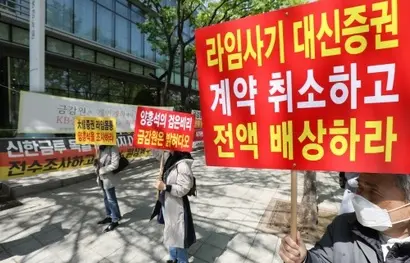
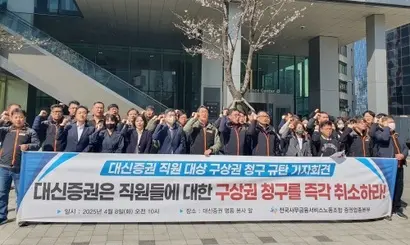
On the 8th, the Daishin Securities union (the Daishin Securities branch of the Korean Financial Industry Union) held a press conference in front of the company's headquarters to condemn the indemnity claims against staff. The press conference was attended by the employees who sold the Lime funds and a representative of the Lime Fund Victims' Group. The union has also been conducting one-person protests in front of the Financial Supervisory Service (FSS) over 100 times, demanding the withdrawal of the indemnity claims and protesting the financial authorities' poor supervision.
Oh Byeong-hwa, the head of the labor union, asserted, “The Lime fund crisis was an organizational problem rooted in the irresponsible product selection and failed risk management by the major shareholder family and management. The employees were merely performing their duties in accordance with company policy. Claiming hundreds of millions of won in indemnity is not just a simple matter of compensation for damages. It is a cruel act and an economic death sentence.”
The Lime fund crisis is an incident that occurred in October 2019, when the suspension of redemptions for funds managed by Lime Asset Management caused trillions of won in losses. It also marked the beginning of the so-called private equity fund redemption suspension crisis. After the incident, it was revealed that there were structural problems with the products themselves and that financial firms, including securities companies, had engaged in incomplete sales during the distribution process. Subsequently, various financial firms became embroiled in lawsuits with investors. Financial authorities proceeded with dispute mediation and sanctions against the firms.
Daishin Securities is one of the primary sellers of Lime funds. In 2021, the Financial Dispute Mediation Committee set the compensation ratio for an investor at the maximum limit of 80%, citing that the headquarters failed to control the long-term incomplete sales occurring at the Daishin Securities branch (Banpo WM Center). In lawsuits related to the Banpo WM Center head and other employees who sold the Lime funds, the court also found that the company's internal controls were insufficient.
The employees are resisting the company's exercise of indemnity rights and pointing out procedural issues. An employee named Lee, who sold Lime funds, said, “Before filing for indemnity through the insurer, there should have been an order for reimbursement issued to the employee; if the employee refused, it would then become an insurance incident, but there was no such order. The basis for the claimed amounts is also vague. Some employees were charged 1% of the fund sales amount, while others were charged 80%.”
In the payment process for fidelity guarantee insurance, the insurer typically goes through a review process once an insurance claim from the policyholder (the company) is received. This is done to hear opinions from both the company and the employee, and to determine whether to pay after the employee’s objections have been addressed. Currently, it appears to be at the stage of gathering employee opinions before collection.
The employees targeted for the claims are considering legal action. Lee stated, “I was told during a consultation with the guarantee insurer that the company (Daishin Securities) is continuously pressuring them (SGI Seoul Guarantee) to pay the insurance claim. To stop the payment (to the company), an employee must file a lawsuit for the non-existence of debt against the company. I tried to mediate with the company before suing, but I only received the response that ‘there is nothing we can do.’ There is almost no communication channel other than the union.”
Daishin Securities maintains that the exercise of indemnity rights is a disciplinary measure to strengthen internal controls. The company explained, “This fidelity guarantee insurance claim is a minimal measure taken to raise awareness about incomplete sales among employees and to reinforce a sense of responsibility. Eradicating incomplete sales cannot be achieved solely through the company’s internal control system. It is impossible without a change in perception and voluntary efforts by the frontline sales staff.”
Furthermore, the firm stated, “The company has already paid over 106.8 billion won in compensation to customers, and the amount claimed from employees through this insurance is less than 2% of the total amount. The economic burden imposed on employees through this insurance will be the minimum responsibility for their involvement in incomplete sales.”
However, the union counters that the company is shifting the responsibility for the Lime fund crisis onto its employees. Lee replied, “The company calls it ‘breach of duty,’ but there is shared responsibility, and the insurance amounts are at a level that individuals cannot bear. It feels like they are pinning the entire crisis on individual employees.” Union leader Oh added, “Demanding compensation from frontline employees, rather than from executives or those in charge, is a cruel and unprecedented act. There is also a view that this is effectively a signal for corporate restructuring.”
Concerns are also rising that Daishin Securities may follow up the Lime fund case by seeking indemnity from employees for other funds that suffered losses. The union claims that the company pressures employees to sell risky products while holding them individually accountable. Oh stated, “Recently, the ‘IGIS Global Real Estate Fund No. 229 (IGIS Trianon Fund),’ which invests in German real estate, suffered a total loss. This was a product sold to individual investors as a public fund, and there is growing anxiety that the company will subrogate the losses of that fund and then exercise indemnity rights against the sales staff. It is not easy for employees, who are under pressure from the company and their superiors to sell risky products, to collect evidence of that pressure. The employees have no choice but to watch the current situation with anxiety.”