

[비즈한국] With the Constitutional Court's removal of former President Yoon Suk Yeol on the 4th, the risk of a national governance vacuum is expected to be resolved. The domestic defense industry, which faced setbacks in exports due to the absence of a head of state, is growing optimistic that a defense export control tower will be reactivated with the inauguration of a new government.
Domestic defense firms continued working-level negotiations with export target nations despite the four-month governance vacuum. Defense companies such as Hanwha Aerospace 012450, Korea Aerospace Industries (KAI), Hyundai Rotem 064350, and LIG Nex1 079550 continued to pursue strategic export cooperation with countries including Saudi Arabia, Poland, Romania, and Australia.
The domestic defense industry was directly and indirectly affected by export projects following the declaration of martial law. The absence of a president and defense minister led to a decline in export negotiation leverage. In the defense industry, which typically involves government-to-government (G2G) transactions, the government's role and national credibility are paramount.
In fact, defense diplomacy is currently at a standstill as overseas military officials have canceled or postponed visits to South Korea related to defense matters. Recently, U.S. Secretary of Defense Pete Hegseth excluded South Korea from his first tour of the Indo-Pacific region after taking office. Analysts suggested that the domestic political situation, characterized by a leadership vacuum and a defense ministry operating under an acting head, played a role in this decision.
The second 'K2 Tank' export contract with Poland, originally scheduled for completion last year, was also delayed. Although the Polish side requested the visit of the South Korean Minister of National Defense for events related to the second contract, it fell through due to the ministry's acting system. Consequently, the government put its full effort into finalizing the deal. Foreign Minister Cho Tae-yul visited Poland last month with a delegation from the Defense Acquisition Program Administration (DAPA) to hold talks with his Polish counterpart, reaching an agreement to provide all necessary support for the second K2 tank implementation contract. It is reported that the Polish side has recently conveyed to our government that the contract can be signed even without the attendance of South Korea's defense minister.
The establishment of a new defense control tower is also expected to be a significant boost for the Polish submarine project, which will select a final bidder this coming September. The project is valued at 8 trillion won, and currently, HD Hyundai Heavy Industries 329180 and Hanwha Ocean are competing against European defense leaders from countries like France and Germany. German and French companies are working as one team with their respective governments, offering not only defense cooperation but also long-term industrial collaboration between governments.
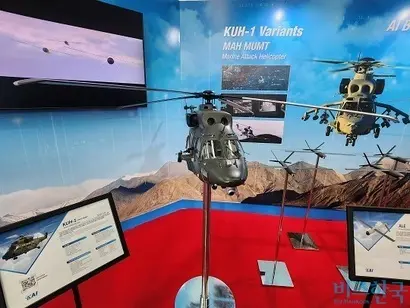
KAI, which was also directly hit by the martial law crisis, plans to expand its helicopter export channels. Sadyr Japarov, President of Kyrgyzstan, who intended to visit South Korea on December 2 last year to discuss helicopter purchases, urgently canceled his visit to KAI's facilities due to the declaration of martial law. As a result, the Central Asian helicopter export project that KAI was pursuing was put on hold at a critical stage. A KAI official explained, "Discussions on the introduction are still ongoing, and as long as the government vacuum does not continue for a prolonged period, there shouldn't be any major issues with export negotiations."
As there is a political vacuum of approximately 60 days until the next government is inaugurated, short-term risks such as the severance of diplomatic channels and delays in export schedules still exist. Consequently, it is pointed out that it is crucial for working-level ministries like DAPA and the Ministry of National Defense to maintain continuity in exports and sustain the momentum of policy implementation. An industry insider emphasized, "Recently, both ruling and opposition parties are talking about the importance of the defense industry. Interest in the defense sector is likely to continue from the presidential campaign onwards," adding, "Even during the remaining vacuum period, government agencies including DAPA must fulfill their responsibilities and support defense export activities to mitigate risks."