

[비즈한국] The exodus of foreign investors from the domestic stock market continues. The foreign ownership ratio of total market capitalization has failed to recover to the 30% level since August 2024, and the total value of foreign holdings dropped from 738 trillion won at the end of 2023 to 666 trillion won in January 2025. Sensing a crisis, the government pushed for a "Value-Up Program" to resolve the "Korea Discount," introducing the "Korea Value-Up Index" composed of 105 undervalued blue-chip stocks. We select one stock from the Korea Value-Up Index each week to analyze its management status and corporate value enhancement plans, and determine if it is a stock with the potential to prevent the "fall of the Korean market."
The stock market has turned grim due to the tariff shock originating from the U.S. Trump administration. As the KOSPI index plummeted, a sidecar (a temporary suspension of program trading) was triggered at 9:12:11 AM on the 7th. This occurred because the U.S. stock market crashed following President Trump's announcement on the 2nd (local time) of reciprocal tariffs of up to 49%, with the aftermath spilling over into the domestic market.
Prior to the reciprocal tariff announcement, President Trump stated on March 26 (local time) that a 25% tariff would be imposed on imported cars and auto parts entering the U.S. starting April 3. Fortunately, additional reciprocal tariffs were not imposed by item, but automotive-related stock prices began to slide starting March 27. The share price of the "leader stock" Hyundai Motor005380 fell 4.3% from the previous day to 212,500 won on March 27, and sank to 178,900 won on the 7th, a day dubbed "Black Monday."
Hyundai Mobis012330, the auto parts division of Hyundai Motor Group and the 8th constituent of the Korea Value-Up Index, also could not escape the tariff shock. Its stock price fell 2.1% from the previous day on March 27 (from 285,500 won to 279,500 won) and dropped to 248,000 won on the 7th. Its market capitalization stood at 23.1093 trillion won.
Despite the tariff shock, Hyundai Mobis’s returns remain at a decent level. It recorded a 6-month return of 19.3%, 1-year of 6.1%, 3-month of 5.1%, and 1-month of 3.6%. Ironically, this is because the Hyundai Mobis stock price has been trapped in a long-term "trading range." For 10 years, the stock has moved between the 200,000 and 250,000 won range. This means even if the stock price falls, the impact is mitigated as long as it stays within the 200,000 won range.
Hyundai Motor's response to the Trump administration's policy with large-scale investments also helped soften the blow. On March 24 (local time), Euisun Chung, Chairman of Hyundai Motor Group, personally visited the White House to announce a $21 billion (approximately 30 trillion won) investment in the U.S. from this year through 2028. By sector, this includes $8.6 billion for automobiles, $6.1 billion for parts, logistics, and steel, and $6.3 billion for future industries and energy. The goal is to strengthen business competitiveness within the U.S. while responding to the Trump administration's import car policy.
On March 26, Hyundai Motor Group held a completion ceremony for its third production base in the U.S., "Metaplant America (HMGMA)." Through HMGMA, it has established a future mobility cluster that includes not only automakers like Hyundai Motor and Kia00270, but also affiliates like Hyundai Mobis, Hyundai Glovis086280, Hyundai Steel004020, and Hyundai Transys, as well as joint ventures and partners.
Hyundai Mobis built the largest factory among its global production bases at HMGMA. This plant produces 300,000 battery systems and the four major core parts modules (cockpit, front-end, chassis, and PE systems) annually. By establishing an integrated logistics system, the company has also reduced logistics costs by supplying produced parts directly to the plant.
While the securities industry is concerned that the domestic auto industry, which has a high proportion of exports to the U.S., will be hit by tariffs, they also point out that this is already reflected in the stock prices. Song Sun-jae, an analyst at Hana Securities, noted, "Domestic auto companies are inevitably going to be negatively affected (by the tariffs)," adding, "Tariffs are also being imposed on key components from auto parts suppliers, which could weaken local price competitiveness, and a decrease in finished car exports could impact supply volumes."
However, he also forecasted, "We must remember that the stock prices of finished car manufacturers have fallen 15-20% as the tariff issue has persisted over the past few months," and added, "As industry responses, local production expansion, and partnerships become tangible, we expect stock prices to recover."
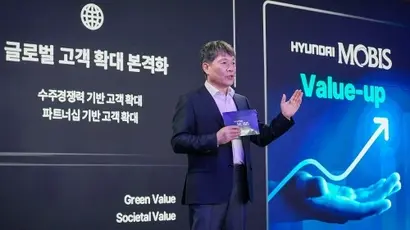
The fact that Hyundai Mobis previously announced shareholder return policies that exceeded expectations is another factor that could defend against stock price declines. At the CEO Investor Day held on November 19, 2024, Hyundai Mobis announced its mid-to-long-term growth and corporate value enhancement plans. First, its mid-to-long-term growth goal is to achieve an average annual revenue growth rate of 8% or more and an operating profit margin of 5-6% by 2027. This is based on the judgment that revenue from core parts, centered on electrification and automotive electronics, has increased and the company has entered the recovery phase of its past large-scale investments.
As for shareholder returns, the company declared it would expand the Total Shareholder Return (TSR), currently at the 20% level, to 30% or more over the next three years. To this end, it will cancel treasury shares held by 2027. It also established a strategy to operate cash dividends and share buybacks flexibly. Thanks to this Value-Up plan, Hyundai Mobis was newly included in the Korea Value-Up Index in December 2024.
Regarding Hyundai Mobis's shareholder return policy, Kim Sung-rae, an analyst at Hanwha Investment & Securities, predicted, "The cost required to reach the TSR target is estimated at 1.35 trillion won per year," adding, "The scale of share buybacks and cancellations will be around 500 billion to 550 billion won annually until 2026." Lim Eun-young, head of the EV & Mobility team at Samsung Securities, forecasted, "If half of the 30% TSR is allocated to share buybacks, it is possible to buy back 700 billion to 800 billion won in shares annually, which corresponds to 3-3.5% of the current market capitalization."