

[비즈한국] Cloud. The Korean dictionary defines a cloud as follows: water droplets floating in the air. However, to astronomers, the term "cloud" is used in a broader sense. It doesn't necessarily have to be in Earth's sky, nor does it have to be made of water droplets. As long as large and small particles are spread out over a vast space, it is called a cloud. It doesn't even have to be as small as a water droplet; for astronomers, a collection of massive celestial bodies and chunks of ice spanning hundreds or thousands of kilometers is still a cloud.
A prime example is the Oort Cloud, known to surround the outer reaches of the solar system. The Oort Cloud is considered the cradle and birthplace of comets, where comets that have not yet embarked on their journey are gathered. I use the cautious expression "known to surround" rather than just "surrounds" because the reality of the Oort Cloud has not yet been verified through direct observation. Nevertheless, most astronomers believe that the Oort Cloud exists.
Usually, when you search for the Oort Cloud on Google, the images are similar. It is depicted as white dots spread widely and spherically around the Sun. It looks almost like dandelion seeds. The estimated scale of the Oort Cloud is enormous. It is estimated that ice debris of various sizes is spread from 10,000 AU to as far as 100,000 AU from the Sun. This is almost on the scale of light-years. The Sun’s gravity exerts its force even on debris located at such a vast distance. It has been assumed that this debris gathers in a spherical shape to form the Oort Cloud.
However, the possibility has recently been raised that our imagined image of the Oort Cloud is completely wrong. Interestingly, recent analysis suggests that the Oort Cloud may not simply be a round, massive "dandelion seed" cloud. The new shape of the Oort Cloud proposed by astronomers is entirely unexpected.
In fact, although the name Oort Cloud is widely known, some who are particular about its origins also call it the Öpik Cloud. Estonian astronomer Ernst Öpik already estimated in the 1930s that the origin of the long-period comets that occasionally fly into the inner solar system must lie in the outer reaches of the solar system. He thought a structure acting as a kind of comet reservoir was spread out at the very edge of the solar system. He believed that as the Sun’s gravity continuously caused slight perturbations in the orbits of small celestial bodies, some of them would occasionally leave their original home and fly in long, elongated elliptical orbits. In a sense, he was the first to imagine the prototype of the Oort Cloud that we envision today.
A particularly mysterious aspect of comets is that while they are observed frequently, each individual comet appears very fragile. Most comets, when approaching even slightly close to the Sun, were quickly sublimated and destroyed. Most comets, especially those arriving on extremely elongated elliptical orbits, seemed as if their first encounter with the Sun was their last.
If every comet that approaches is destroyed immediately, where do the comets that arrive from various directions every year without rest actually come from? Dutch astronomer Jan Oort thought there was only one answer to explain this mystery: there must be a massive comet reservoir beyond the darkness at the edge of the solar system that sends out comets continuously.
Later, Oort carefully analyzed the orbits of observed comets and discovered an interesting fact: the aphelion distances of most of them were similar. According to Oort’s calculations at the time, most long-period comets had their aphelion at about 20,000 AU from the Sun. This meant that comets were not just alien objects flying in from outside the solar system (like 'Oumuamua), but entities that repeated long journeys, drawing elongated yet closed elliptical orbits around the Sun. Based on Oort's conjecture, astronomers imagined a world swarming with ice fragments waiting for their next journey at a similar distance from the Sun, and they named this cloud of ice fragments the Oort Cloud.
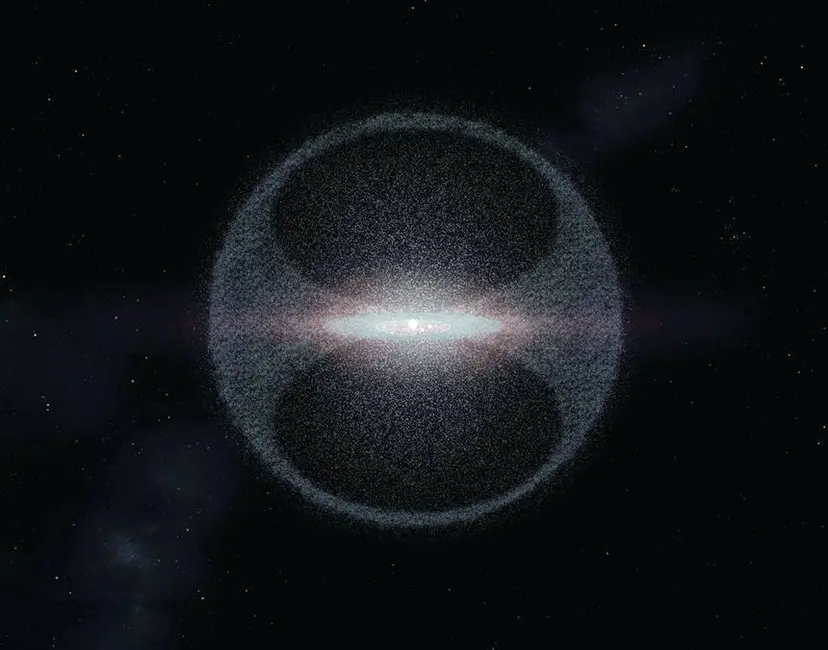
However, unfortunately, the existence of the Oort Cloud has never been proven through observation. At first glance, this might sound like a contradiction. If such a massive cloud of comets and ice debris is surrounding our solar system, shouldn't it have been discovered by now? That is not the case. First, the predicted scale of the Oort Cloud is too vast. Astronomers currently distinguish between an inner and outer Oort Cloud; the inner Oort Cloud, or Hills Cloud, begins at 10,000 AU from the Sun. Even the Voyager probes, which left long ago dreaming of escaping the solar system, have not yet even entered the inner boundary of the Oort Cloud. They will need to travel for at least another 300 years to reach the inner boundary.
The outermost Oort Cloud is estimated to extend up to 2 to 3 light-years away. If Voyager continues its journey at the same speed, it will take nearly 70,000 more years to finally escape the Oort Cloud. That is how massive the Oort Cloud is.
A bigger problem is that the Oort Cloud is filled only with cold ice debris that does not emit bright light. No matter how well ice fragments reflect sunlight, they are too far away and too small. Therefore, with current telescope capabilities, it is very difficult to directly observe the faint light of the debris drifting in the Oort Cloud.
Some people ask how it is possible to see other, much more distant stars and galaxies if such Oort Cloud debris is surrounding us. That is also a misunderstanding. The Oort Cloud is a very sparse, thin cloud. While it is estimated to be filled with about 1 trillion comets and ice fragments, it is spread out over a radius of 2 to 3 light-years. In reality, the density is extremely low, at the level of having only one celestial body in a giant box measuring dozens of AU on each side. The molecular density of Earth's atmosphere is 10^19 molecules per cubic centimeter. If we compare the number density—how many particles are packed into the same volume—the Oort Cloud has a much lower density than Earth's atmosphere, or even typical interstellar matter. Therefore, it does not significantly hinder the observation of the deeper universe.
The immense scale of the Oort Cloud places this structure in a very subtle position. They are clearly fragments held by the Sun’s gravity, but because the distance is quite far, the gravity received from the Sun is not that strong. If another celestial body with comparable gravitational pull approaches the vicinity, they can leave the solar system and attach themselves to another star. Indeed, astronomers estimate that giant perturbations were caused in the Oort Cloud by other celestial bodies passing near the solar system, which led to massive "carpet bombing" of comets toward the inner planets, including Earth. Some even find the cause of dinosaur extinction in the fluctuations of the Oort Cloud. A representative example is 'Scholz's Star,' which is estimated to have approached and disturbed the Oort Cloud about 70,000 years ago.
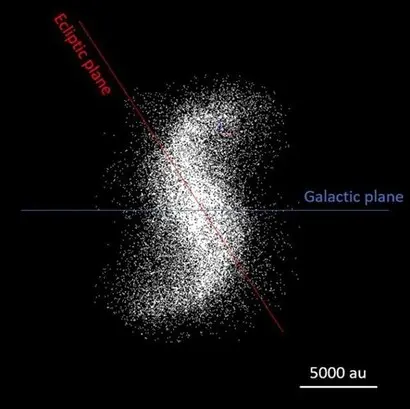
Gravitational perturbation does not occur solely at the level of neighboring stars. The Milky Way also exerts a very strong gravitational force. Naturally, the solar system and the Oort Cloud trapped within it are affected by the gravity of the Milky Way itself, which is filled with countless stars. In particular, because the solar system is trapped within the vast Milky Way, it receives a kind of tidal force that seems to pull the Oort Cloud from all directions. During this process, the solar system slowly rotates while leading the Oort Cloud.
In this study, astronomers raised the issue that we might have overlooked the presence of the Milky Way that harbors our solar system. The astronomers used supercomputers to simulate how the shape of the Oort Cloud should change if galactic-scale tidal forces were continuously applied. The result was that the Oort Cloud is not a simple spherical cloud, but has transformed into a shape tracing clear S-shaped spiral arms, like the Milky Way.
A more interesting difference was revealed at the inner boundary of the Oort Cloud. In previous models, it was assumed that while the outer Oort Cloud was spread round like a dandelion seed, it would turn into a shape like a round donut as it approached the inner solar system. It was assumed that the inner Oort Cloud would maintain a ring shape like a giant version of the Kuiper Belt and exist as a stable structure less affected by external perturbations compared to the outer Oort Cloud. However, according to the new simulation, both the inner and outer Oort Cloud trace clear spiral arm shapes. Moreover, the results showed that this spiral-armed Oort Cloud has maintained its shape since 4.2 billion years ago, not long after the solar system was born. This S-shaped Oort Cloud is spread out in a direction tilted about 30 degrees from the plane of Earth's orbit.
The results of this simulation suggest that we may have been searching for the Oort Cloud in the wrong places. Until now, we expected a faint ring with gradually decreasing density to be spread out beyond the Kuiper Belt, so we searched for traces of the Oort Cloud in the sky that did not deviate significantly from the ecliptic, the plane of Earth's orbit. However, this simulation provides a new clue: we must look far away from the ecliptic plane to find it.
This discovery does not stop at simply suggesting that the Oort Cloud may be more twisted than originally thought. It may be an important discovery that makes us realize once again how the solar system interacts with the galactic space beyond its borders, how strongly our solar system is influenced by the gravity of the outside world, and that it is a fragile existence capable of changing its shape due to such forces.
If this discovery is confirmed as fact, the "cloud" in the history of astronomy might repeat a sublime coincidence once again. In the early 20th century, astronomers discovered a spiral-shaped, swirling cloud in the night sky, and after pondering its identity, they encountered the vast universe beyond our galaxy. And exquisitely, the cloud named Oort has also appeared not as a simple ball, but in a swirling shape. It might be forcing a new paradigm regarding the world beyond our solar system. Perhaps the definition of the word "cloud" in astronomers' dictionaries should include "something that swirls."
References
https://ui.adsabs.harvard.edu/abs/2025arXiv250211252N/abstract
Who is author Woong-bae Ji? He loves cats and the universe. After watching 'Galaxy Express 999' as a child, he developed a dream of informing people about the beauty of the universe. Currently, he researches galaxy evolution through galaxy interactions at the Center for Galaxy Evolution and the Near-Universe Laboratory at Yonsei University, and is engaged in various science communication activities such as lectures and writing. He has written books such as 'The Observatory for Lovers', 'Thinking About the Universe All Day', and 'Stars, the Science of Light'.