

[비즈한국] One of the questions I am frequently asked during recent lectures and broadcasts is, "What is the next growth engine for K-Defense?" From the perspective of the general public—not just experts or those working in the field—there is significant interest in "K-Defense as a product," largely because K-Defense has seen strong export performance, and defense stocks are holding up well in a volatile stock market currently affected by headwinds like the Trump administration's tariff policies.
Of course, there is also skepticism about whether the signature export items of K-Defense are weapon systems that will remain relevant in the future. The primary K-Defense export products—such as ground weapon systems like tanks, armored vehicles, and self-propelled howitzers, as well as air defense systems and light combat aircraft—are all currently threatened by drones, which have played a pivotal role in the Ukraine war.
In the Ukraine war, massive quantities of tanks, armored vehicles, and self-propelled howitzers have been destroyed by drone attacks. Furthermore, while the Cheongung-II surface-to-air missile system, which has seen export success, can intercept large drones and cruise missiles, it is not designed to counter small, fast drones. Additionally, there is active discussion about replacing manned fighter jets with drones that offer lower operation and maintenance costs. Consequently, many are concerned about the future of K-Defense exports, which are currently centered on "conventional weapons produced by large conglomerates."
On the other hand, it is true that large corporations, small and medium-sized enterprises (SMEs), and startups are beginning to enter the "anti-drone business" to quickly respond to these changes in modern warfare, and results are gradually becoming visible. We are already hearing reports that several companies are showcasing their independently developed, new-generation anti-drone systems overseas or are nearing the completion of export deals.
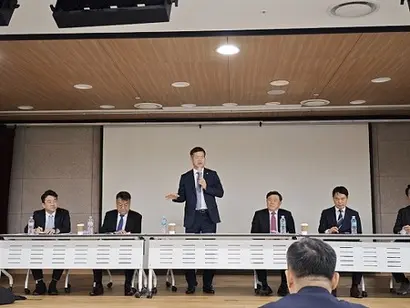
However, the companies pushing for these exports or developing anti-drone equipment have expressed significant grievances. At a recent meeting held by the Korea Anti-Drone Industry Association (KADIA) with the Defense Acquisition Program Administration (DAPA), domestic anti-drone developers took turns appealing their difficulties to DAPA Commissioner Seok Jong-gun.
The first hurdle for anti-drone developers is the lack of domestic infrastructure, which hampers their export efforts. Company D, an SME developing "soft-kill" equipment that is nearing export to Southeast Asia, stated at the meeting that they are in a bind because there is no domestic test site where they can demonstrate the performance of their fixed mid-to-long-range jammers to potential customers.
In reality, while there are a few anti-drone training grounds or drone flight test centers in Korea, there are no test sites capable of performing mid-to-long-range jamming. Anti-drone testing requires large airspace, and because jamming signals are subject to strict regulations under the Radio Waves Act, the restrictions are severe.
Another company, which is developing a "hard-kill" anti-drone solution, also complained of difficulties in preparing for large-scale exports to the Middle East due to the lack of domestic hard-kill test facilities. Even if a company develops anti-drone equipment, it is difficult to export without test facilities to verify the product's performance.
There are many other issues as well. Not only SMEs but also large corporations are facing difficulties in entering the anti-drone industry. First, among domestic anti-drone projects, only three are being pushed forward swiftly: the anti-drone integration system for frontline areas, the anti-drone integration system, and the Block-II small drone response system. Even among these, only the frontline anti-drone integration system is currently having its business strategy and procurement plan established by DAPA this month, while the other two are somewhat delayed. Unlike the drone business, which has many projects underway, it is evident that DAPA's preparation regarding requirement determination, establishing specifications, and business strategy for anti-drone projects has been somewhat lacking.
Fortunately, high-ranking DAPA officials who attended the meeting, including Commissioner Seok Jong-gun, the Director of the Advanced Technology Center, and the Director of the Maneuver Business Division, expressed a strong will to overcome the current difficulties facing the anti-drone system project.
For example, the Director of the Maneuver Business Division stated that to overcome the fact that maneuver equipment (tanks, armored vehicles, self-propelled howitzers) is suffering heavy losses from enemy suicide drones in the Ukraine war, DAPA, the Army, and the Joint Chiefs of Staff are joining forces to research ways to integrate anti-drone capabilities into ground maneuver weapon systems. The Director of the Advanced Technology Center announced that they are considering using military firing ranges or new sites on the west coast to test anti-drone equipment due to the shortage of test facilities.
DAPA’s support measures for the anti-drone industry were also unveiled. Policy research results for the growth of national high-tech strategic industries are due within this month, and drones have been included in this research. This can be linked to the "Defense Innovation Company 100" program currently operated by DAPA. There was also mention of supporting development costs or military trial operations for anti-drone systems through initiatives like identifying defense export items or supporting modification and development projects.
While DAPA's strong expression of commitment to supporting anti-drone developers is commendable, it remains to be seen whether the agency will succeed in resolving two key issues. The first issue is that DAPA's support system is inadequate for "technologically competent companies that achieved exports without government help." Because policies are basically centered on supporting large corporations and listed companies, there are no performance guarantee insurance or startup export support measures for unlisted startups, even when they are recognized for their technology and secure large-scale export contracts.
The second issue is the failure to establish a grand principle on how to bridge the "gap" between the military (the end-user) and the companies. From the military's perspective, domestic anti-drone equipment is immature and cannot be trusted for combat use. From the perspective of anti-drone manufacturers, DAPA's R&D budget is focused on large corporations, meaning that if the military does not purchase their products, they cannot secure a technology development budget, effectively blocking any path for continuous performance improvement. Both sides remain dissatisfied.
Foreign drone and anti-drone companies are targeting this gap to enter the Korean market, but it is also a fact that there is a significant discrepancy between the performance claimed by foreign companies and the performance shown in actual operational tests.
To resolve this, the military should enhance its drone and anti-drone testing and evaluation capabilities to accurately assess equipment performance. Furthermore, if a piece of equipment falls short of the military's Required Operational Capability (ROC), the authorities should provide both production and performance improvement budgets simultaneously. One cannot expect fruit after planting seeds in a dry desert without water.
While many large corporations and SMEs have already unveiled anti-drone equipment worth showing to the global market, they must also strive to meet the requirements of the Korean military. I look forward to seeing whether the new anti-drone industry promotion policy unveiled by DAPA will produce results that satisfy both our military and the industry.