

[비즈한국] With the Constitutional Court’s decision to remove President Yoon Suk Yeol from office, it is generally assessed that much of the political uncertainty hanging over the financial markets has been resolved. Nevertheless, the stock market remains sluggish.
On the 4th, the day of President Yoon's impeachment, the KOSPI opened at the 2450 level, down 1.46% due to the aftermath of President Trump's tariff policies. The index subsequently pared its losses, hitting an intraday high of 2506.71 at 11:15 AM while Acting Chief Justice Moon Hyung-bae was reading the ruling. However, the moment President Yoon's impeachment was confirmed by a unanimous decision from the justices, the index turned slightly downward. Expectations for the resolution of political uncertainty were not properly reflected in investment sentiment.
The KOSDAQ index followed a similar path. It reached 697.72 at 11:20 AM but gradually increased its losses to fall to the 670 level by 2:00 PM, eventually closing near the 680 line.
On this day, foreigners net-sold 1.7892 trillion won in the KOSPI market. They also sold off 88.6 billion won in the KOSDAQ market and 704.5 billion won in the KOSPI 200 futures market. Despite the Constitutional Court acknowledging the fact of President Yoon's constitutional violations, the stock market failed to show a positive reaction due to the foreign sell-off.
Shin Min-seop, an analyst at DS Investment & Securities, stated, "Because the impeachment ruling came just one week after the resumption of short selling on March 31, uncertain factors were resolved quickly, but from April 2 onward, the market became more focused on the issue of reciprocal tariffs from the Trump administration."
Shin Eol, an analyst at Sangsangin Securities001290, also analyzed, "It can be seen that the impact of the wider decline in the U.S. stock market caused by U.S. tariff policies played a larger role than the impeachment ruling itself."
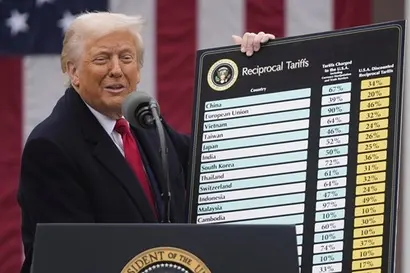
Due to Trump's tariff policies, which significantly exceeded both his campaign promises and market expectations, Asian stock markets were in full panic on the 7th. On that day, the KOSPI broke below the 2400 level, and a sell-side circuit breaker was triggered for the first time in eight months. The KOSDAQ also recorded a crash of over 4% during the day. Japan's Nikkei index also saw a decline of 8% at one point early in the session.
Assessments are emerging that the possibility of a global economic recession has increased significantly due to this reciprocal tariff shock. The Korea Center for International Finance projected that global growth would decline by 0.49 percentage points each year compared to the International Monetary Fund (IMF) outlook from last January due to these U.S. tariff measures.
Byun Jun-ho, an analyst at IBK Securities, explained, "Global growth averaged 3.8% between 2000 and 2019, before COVID-19, and the stock market typically tends to fall sharply when growth is expected to fall below 3%. Actual sharp market declines occurred when global growth fell to the low-to-mid 2% range or lower."
Financial circles believe that while the political risk weighing on the domestic stock market has eased somewhat due to the impeachment decision, the market is likely to continue reflecting the crisis until the tariff shock settles. However, some project that the possibility of further sharp declines in the domestic stock market will be limited.
Analyst Byun Jun-ho said, "Risks of a stock market downturn due to deteriorating export fundamentals will likely persist, but given that valuations are already at extreme lows, we expect a pattern of fluctuations within the current low levels."
Lee Kyung-min, an analyst at Daishin Securities003540, also analyzed, "A short-term shock to the KOSPI is inevitable, but further sharp declines in the future will be limited. The realization of China's economic recovery, strong expectations for stimulus in China and Germany, and a weak dollar are factors supporting relative strength. Also, the resolution of political risk in Korea could be a driving force for market recovery."
If the market moves past the short-term shock, it is highly likely that future stock market attention will shift to the presidential election to be held within 60 days. There are also predictions that political theme stocks will surge, similar to the time of President Park Geun-hye's impeachment.
Analyst Lee Kyung-min stated, "With the resolution of political uncertainty, monetary and fiscal policy drives will strengthen, and the shift toward an early presidential election will heighten policy expectations based on the campaign promises of each party and leading candidates. Supplementary budget bills are also expected to gain momentum, which will likely lead to a rapid improvement in consumer sentiment."
The analysis suggests that during this process, along with the confirmation of an early presidential election, expectations for policies related to presidential candidates may flow in, and expectations for a new government are also likely to be reflected in the stock market.
Accordingly, some suggest focusing on industries less affected by tariffs or those expected to be fostered as national strategic industries regardless of the ruling or opposition party. Analyst Shin Eol said, "Political uncertainty has been resolved, but since tariff negotiations with the U.S. remain at a limited level, the domestic stock market is likely to show a weak-sideways movement with restricted upward momentum. By industry, we expect gains in sectors less affected by tariffs, such as shipbuilding, defense, and bio."
Along with this, advice has emerged that it is necessary to pay attention to domestic demand stocks such as retail, as expectations for economic revitalization and domestic demand recovery policies are growing. Yoo Jung-hyun, an analyst at Daishin Securities, analyzed, "A presidential election held after political uncertainty like an impeachment will act very positively on the rise in consumption propensity and the improvement of sentiment. As consumer sentiment and propensity to consume improve, domestic retailers are highly likely to benefit, with department stores being the biggest beneficiary channel."