

[비즈한국] On the 4th, the Constitutional Court decided to remove President Yoon Suk-yeol from office, 123 days after his emergency martial law declaration. While the business community had voiced concerns about the political and diplomatic instability caused by the President's absence, some have noted a "small benefit": they no longer have to accompany the President on his unprecedentedly frequent overseas trips and domestic events.
21 Overseas Trips in Two and a Half Years
In fact, former President Yoon enjoyed the company of "corporate leaders" more than any previous president. He embarked on 21 overseas trips in two and a half years, and with the exception of events like the G20 summit, he was accompanied by business leaders for most of them.
Past administrations also often encouraged corporate heads to accompany them on trips. However, none required them to tag along on more than ten overseas trips throughout a five-year term. This was not just a problem for the private sector; President Yoon frequently urged the heads of public financial institutions and others to join him as well. While the presidential office framed these as mere invitations, it is an open secret that no one considered them anything less than a "request."
A secretary to the head of a public enterprise lamented, "When an overseas schedule is set by the presidential office, they inquire if we can join—who can say no? Even if there weren't any specific pending issues, they would keep calling, so I had to follow the chairman on over ten overseas trips while working in the secretary's office."
He added, "The problem was that because there were no real issues to discuss in the host countries, we had to force schedules to visit local offices or staff, or arrange visits to local universities. Since anyone 'blacklisted' by the presidential office would not receive invitations at all, once a 'suggestion' came, we had no choice but to go. It is much more comfortable for the chairman to travel separately, but it was very difficult to handle the chairman's protocol when moving with the presidential office."
In fact, Lee Jae-yong, Chairman of Samsung Electronics, accompanied the President on more than 10 trips in 2023 alone, a year when 13 of the President's overseas trips were concentrated. During the trip to the Czech Republic last September, Euisun Chung, Chairman of Hyundai Motor005380, joined at the very last minute, leading to rumors that "the heads of the top 4 groups were mobilized unreasonably." While Samsung and LG explained that they were "encouraging local employees and checking business status," criticism arose that they were being used as "human screens" when the leaders were mobilized again for a trip to three ASEAN countries just half a month later.
An employee who once accompanied the President on overseas trips with a conglomerate chairman said, "Because it is a presidential schedule, security is so strict that it is difficult to handle protocol separately. It must have been quite uncomfortable for the chairmen, who usually travel in first class, to sit in economy seats on the presidential plane for over 10 hours. Everyone kept quiet, but how many of them actually wanted to go?"
Talk of a "Tteokbokki Prevention Act"
Naturally, this led to significant controversy. The Paris drinking party incident is a prime example. In November 2023, during a visit to Paris, France—the headquarters of the Bureau International des Expositions (BIE)—to promote the Busan Expo bid, the President invited conglomerate heads to a dinner and held a "poktanju" (boilermaker) party. It is an open secret that even though the President reportedly told the business leaders that "only those who can attend should attend," no one was in a position to refuse.
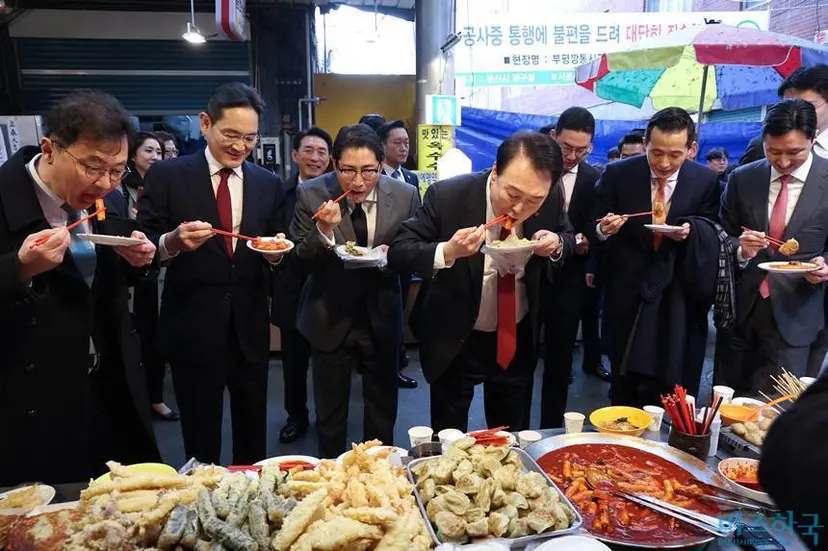
On December 6, a few days after the disastrous failed Expo bid, the conglomerate heads were abruptly summoned to Busan, where the President went to soothe local sentiment. The image of them standing in a row in front of a market snack stall eating tteokbokki, or Samsung Electronics Chairman Lee Jae-yong enjoying "fish cake soup" and asking for a refill, became both a controversy and a viral topic.
As the business leaders were summoned to Busan ahead of the general election at the time, the Reform Party stated, "We will propose a 'Tteokbokki Prevention Special Act' in the 22nd National Assembly that guarantees business people a 'tteokbokki veto'." The Reform Party argued, "Business people are not the President's subordinates. A nation where the heads of companies with a combined market capitalization of thousands of trillions of won have to eat tteokbokki with the President at events suspected of being for a specific regional election is not a republic." They also mentioned the possibility of pushing for a so-called "Emperor Trip Prevention Act" to transparently disclose the President's overseas travel schedules and budgets.
The aforementioned secretary to a public enterprise head said, "Even if the government changes, aren't there many instances of being summoned for overseas trips or regional events? There are countless cases where public enterprises have to change their schedules just because an influential figure in the ruling party asks for it, let alone the President. While appearing as a 'human screen' to boost a politician's image can benefit a company, until a system or culture where there is no retaliation for refusing is firmly established, there will be no business leader who can refuse the President's overseas trips."