

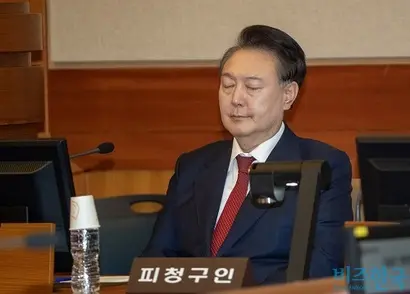
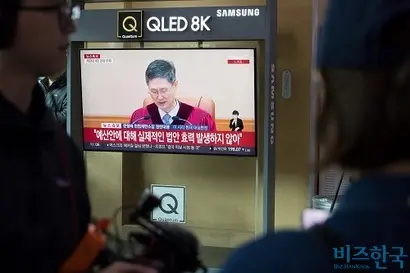
[비즈한국] The Yoon Suk Yeol administration came to an end on the 4th, following the Constitutional Court's ruling to remove former President Yoon Suk Yeol from office. The economic sector generally views the economic policies of the past three years under the Yoon administration negatively. Upon taking office, the Yoon administration implemented tax cut policies, which led to large-scale tax revenue shortfalls. Many of the projects ambitiously pursued by the administration also ended in failure. Economic growth remained sluggish, recording figures in the 1% range, a poor performance compared to previous administrations. This is why negative public sentiment surrounds the Yoon administration's economic policies.
After the launch of the Yoon Suk Yeol administration, national tax revenue showed a downward trend every year. According to the Ministry of Economy and Finance (MOEF), annual national tax revenue was recorded as follows: 395.9 trillion won in 2022, 344.1 trillion won in 2023, and 336.5 trillion won in 2024. The MOEF cited worsening corporate performance and a contraction in the asset market as reasons for the decline in tax revenue. The market also evaluates that the Yoon administration’s tax cut policies had an impact. The Yoon administration implemented tax reduction policies, such as lowering the corporate tax rate by 1 percentage point (p) in 2022. Additionally, with the abolition of the financial investment income tax starting this year, the outlook for this year's tax revenue is not bright.
The decline in national tax revenue led to tax shortfalls. The national budgets set by the Yoon administration were: 396.6 trillion won in 2022, 400.5 trillion won in 2023, and 367.3 trillion won in 2024. Consequently, a total of approximately 87 trillion won in tax shortfalls occurred over two years, with 56 trillion won in 2023 and 31 trillion won in 2024, respectively. Despite significantly cutting the national budget last year, the Yoon administration could not avoid a tax shortfall.
Many projects that the Yoon administration pursued with massive tax expenditures also ended in failure. The Yoon administration allocated a significant budget to win the bid for the 2030 World Expo in Busan. The budget for the Expo bid was 251.6 billion won in 2022 and 322.8 billion won in 2023. Separately, Busan Metropolitan City also allocated 33 billion won of its own funds. However, the bid for the Busan Expo failed, losing to Saudi Arabia.
The "King Crab Project," a deep-sea gas field development project in the East Sea ambitiously pursued by the Yoon administration, is also considered a de facto failure. In June 2024, former President Yoon stated, "Recent results show a very high possibility that up to 14 billion barrels of oil and gas are buried there, and it has been verified by leading research institutes and experts," adding, "It is estimated to be over 300 times the size of the East Sea gas field discovered in the late 1990s, and it is judged that our entire country could use natural gas for up to 29 years and oil for up to 4 years."
However, the Ministry of Trade, Industry and Energy (MOTIE) stated last February, "The scale was not at a significant level, nor was it at a level that could secure economic feasibility." The government poured over 100 billion won into just the first round of drilling for the King Crab project. Park Kyung-mee, spokesperson for the Democratic Party of Korea, criticized this, saying, "The King Crab project, which the government promoted on a massive scale as a 'game changer' on which the country's future depends, was merely a reflection of the moon on a lake. The dismal reality of an oil development project that turned into a political event with sloppy verification and overblown projections is entirely the consequence of Yoon Suk Yeol’s arrogance and self-righteousness."
Nevertheless, the Ministry of Trade, Industry and Energy maintains its position to continue the King Crab project. Intermediate results of the drilling are scheduled to be announced this coming May or June. The ministry stated, "We have not reached a definitive conclusion," adding, "It is difficult to conclude that this drilling attempt has failed."
The Yoon administration was unable to actually execute about 20 trillion won of its 367.3 trillion won budget last year. It could not be used due to the decline in national tax revenue. When government spending decreases, it affects people's daily lives through reductions in public welfare, infrastructure management, and public finances. In particular, metropolitan and provincial governments are heavily dependent on national taxes. As of 2023, out of 17 cities and provinces nationwide, only Seoul Metropolitan Government and Gyeonggi-do had a financial independence rate of 50% or higher.
People's Solidarity for Participatory Democracy pointed out, "(The tax shortfall) makes a regression in the role of local governments inevitable," adding, "Unilateral cuts in local allocation taxes weaken the fiscal stability and projects of local governments." Local allocation tax refers to tax revenue that the central government collects on behalf of local governments and redistributes to them based on certain criteria.
One of the reasons the Yoon administration put forward tax cut policies was to create a "country good for doing business." Promoting domestic demand through tax cuts was also a goal of the Yoon administration. Deputy Prime Minister and Minister of Economy and Finance Choi Sang-mok said during a parliamentary questioning session in February last year, "Tax support for large corporations is to enable them to expand investment, and when large corporations' investment and exports increase, jobs are created," adding, "We are implementing 'tax cuts to promote domestic demand' to stimulate the local economy."
However, the Yoon administration's economic growth rate failed to meet expectations. According to the Bank of Korea, South Korea's economic growth rate was 2.7% in 2022, 1.4% in 2023, and 2.0% in 2024. The Ministry of Economy and Finance originally projected South Korea's economic growth rate at 1.6% for 2023 and 2.2% for 2024. It recorded a growth rate lower than projected.
Such economic growth rates are lower figures even when compared to the Park Geun-hye and Moon Jae-in administrations. Looking at the economic growth rates for the 10 years before the launch of the Yoon Suk Yeol administration: 2.5% in 2012, 3.3% in 2013, 3.2% in 2014, 2.9% in 2015, 3.2% in 2016, 3.4% in 2017, 3.2% in 2018, 2.3% in 2019, minus (-) 0.7% in 2020, and 4.6% in 2021. Excluding 2020, which was affected by the COVID-19 pandemic, there was no year that recorded a 1% growth rate.
The outlook for this year is also not good. The Ministry of Economy and Finance expected this year's economic growth rate to be 1.8%. However, there are concerns that this year, too, could record a lower growth rate than expected. The Bank of Korea stated last February, "The growth rate for this year is expected to be 1.5% as export growth slows amid sluggish domestic demand," adding, "There remains uncertainty surrounding the trade environment next year as well."
Major political parties have entered preparation mode for the next presidential election, expected this coming June. The economic sector is demanding economic recovery from the next administration. Political and business circles are focusing on whether the next government can overcome the mistakes of the Yoon Suk Yeol administration and succeed in economic recovery.
The Korea Chamber of Commerce and Industry stated, "Considering the severe economic situation, we hope that the state of affairs will be normalized as soon as possible, moving beyond social confrontation and conflict, and that efforts for economic recovery and the stabilization of people's livelihoods will continue." The Korea Enterprises Federation also stated, "We must end the extreme political and social confrontation and conflict caused by the impeachment situation and concentrate our capabilities on social integration and stability."