

[비즈한국] In May last year, the Ministry of Land, Infrastructure and Transport launched the "K-Pass," which provides a refund of 20–35% of public transport expenditures for those who use public transport 15 or more times a month, up to twice a day and 60 times a month. As of January this year, it is available in 210 basic local governments, excluding 19 areas including 7 in South Jeolla Province, 9 in North Gyeongsang Province, and 3 in Gangwon Province, and it has already surpassed 3 million users.
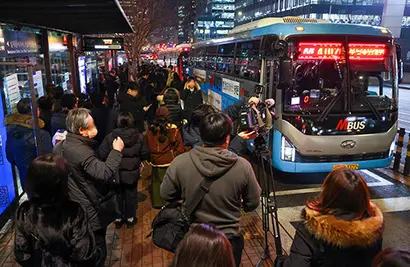
The average monthly refund amount for K-Pass users was 18,000 won. In addition to the K-Pass, public transport discount cards such as Seoul's Climate Card, Gyeonggi-do's The Gyeonggi Pass, and Incheon's I-Pass are widely used by the public. A key feature of these public transport card discounts is that the benefits primarily go to working professionals who commute. Local governments are increasingly expanding these benefits for commuting workers whose residences and workplaces are far apart.
This is because there are many commuting workers (those whose residence and workplace are in different cities or provinces) who do not mind the inconvenience of long commute times in order to work at better jobs. In fact, it has been found that commuting workers have higher wages, work for larger companies, and have a higher rate of full-time employment compared to non-commuting workers (those whose residence and workplace are in the same city or province).
According to Statistics Korea's National Statistical Institute, while there are 640,000 workers living in Seoul and working in other regions, there are 1,389,000 workers entering Seoul from other regions, which is more than double. Of these, 178,000 workers live in Incheon and commute to Seoul, while 1,188,000 live in Gyeonggi-do and commute to Seoul. Others travel to companies in the Seoul area from regions such as Daejeon, Sejong, North Chungcheong, South Chungcheong, and Gangwon.
Conversely, there are 66,000 workers living in Seoul and commuting to Incheon, and 534,000 commuting to Gyeonggi-do. While these commuting workers are numerous in other regions as well, unlike in Seoul, people in these areas often commute from metropolitan cities to nearby cities. In the case of Daejeon, 77,000 workers commute from Daejeon to other regions, while 55,000 workers come into Daejeon from other regions.
In Daegu, 116,000 workers commute to other regions, while only 43,000 workers come to Daegu, less than half. In Gwangju, 70,000 workers commute to other regions, while 25,000 come to Gwangju. In Busan, 117,000 workers commute to other regions, while 87,000 do the opposite.
As such, excluding Seoul, many residents of other metropolitan cities commute to peripheral cities. This suggests that while family members live in areas with good residential conditions, the workers themselves shoulder the burden of long commutes.
However, the reason they endure the inconvenience of commuting to other regions is influenced by the better wage levels and working conditions offered by their companies compared to non-commuting workers. The average monthly wage for commuting workers nationwide was 3,675,000 won, which is 30.4% (856,000 won) higher than that of non-commuting workers (2,819,000 won). In the Seoul metropolitan area, the average monthly wage for commuting workers was 3.74 million won, 26.3% (778,000 won) higher than that of non-commuting workers (2,962,000 won). The gap in the Chungcheong region was 33.0% (923,000 won), with commuters earning 3,722,000 won versus 2,799,000 won for non-commuters, and the gap in the Gwangju-Jeonnam region was 31.2% (818,000 won), with commuters earning 3,444,000 won versus 2,626,000 won for non-commuters.
The situation is similar in the Yeongnam region: the gap in the Daegu-Gyeongbuk region was 23.1% (609,000 won), with commuters earning 3,250,000 won versus 2,641,000 won for non-commuters, and in the Busan-Gyeongnam region, the gap was 28.3% (744,000 won), with commuters earning 3,375,000 won versus 2,631,000 won for non-commuters.
Furthermore, the ratio of commuting workers is higher in larger companies, indicating that working conditions are a significant factor in the choice to commute. For large companies with 300 or more employees, the national average commuting rate was 21.2%, whereas it was only 10.6% for companies with fewer than 10 employees. In the Seoul metropolitan area, the commuting rate for large companies with 300 or more employees reached 28.2%.