

[비즈한국] President Yoon Suk Yeol has been removed from office. At 11:22 AM on April 4, the Constitutional Court issued a unanimous decision to uphold the impeachment motion against President Yoon Suk Yeol. Former President Yoon Suk Yeol is now recorded as the second president in the history of the Republic of Korea to be removed from office.

All eight Constitutional Court justices—Moon Hyung-bae, Lee Mi-son, Kim Hyung-du, Jung Jung-mi, Jung Hyung-sik, Kim Bok-hyung, Jo Han-chang, and Jung Gye-sun—unanimously agreed to the president's removal, stating that President Yoon Suk Yeol's actions "infringed upon the constitutional order and caused serious harm to the stability of the democratic republic."
In its decision, the Constitutional Court stated that the "negative impact and ripple effects of President Yoon Suk Yeol's illegal acts on the constitutional order are significant; therefore, the benefit to protecting the Constitution gained by removing the respondent from office is recognized as overwhelmingly greater than the national loss resulting from the president's removal."
The Court further declared, "The declaration of martial law in this case violated the substantive requirements for declaring an emergency martial law," adding, "Martial law was declared even though the Prime Minister and relevant cabinet members did not countersign the declaration, and the time of implementation, the area of implementation, and the Martial Law Commander were not publicly announced. Furthermore, it was not notified to the National Assembly without delay, thus violating the procedural requirements for declaring emergency martial law as stipulated by the Constitution and the Martial Law Act."
The Constitutional Court pointed out that "a president's authority is granted solely by the Constitution," noting that President Yoon Suk Yeol caused distrust in the exercise of his presidential powers. The Court judged that he "abandoned his duty to protect the Constitution by mobilizing the military and police to undermine the authority of constitutional institutions such as the National Assembly and infringe upon the basic human rights of citizens, thereby gravely betraying the trust of the people of the Republic of Korea, who are the sovereign power of the democratic republic."
From the perspective of constitutional protection, the Court also viewed the benefits of removing President Yoon Suk Yeol as substantial. The Constitutional Court stated, "Because the negative influence and ripple effects of the respondent's illegal acts on the constitutional order are grave, it is recognized that the benefit of upholding the Constitution through the removal of the respondent outweighs the national losses that follow the removal of a president."
Acting Chief Justice Moon Hyung-bae declared, "With a unanimous opinion from all justices, I will announce the order. The time is now 11:22 AM. Order: The respondent, President Yoon Suk Yeol, is removed from office."
Jung Chung-rae, the head of the National Assembly's impeachment prosecution team, stated immediately after the ruling, "This is a victory for the Constitution and democracy. It is a victory for the people. It is a victory of the people who defeated the enemies of democracy through democracy. I deeply thank the Constitutional Court for its wise and historic ruling." He added, "It is a victory by the people, for the people. Even if you wring the rooster's neck, the dawn will come. We have welcomed a new spring of democracy."
President Yoon Suk Yeol will step down from the presidency immediately following the Constitutional Court's decision, and Prime Minister Han Duck-soo will continue to serve as the acting president.
According to Article 68, Paragraph 2 of the Constitution, which states, "In case the presidency is vacant or the president-elect dies or loses their qualification due to a judgment or other reasons, a successor shall be elected within 60 days," an election for a successor must be held within 60 days. Consequently, an early presidential election is expected to take place this coming June. Below is the full summary of the Constitutional Court's ruling.
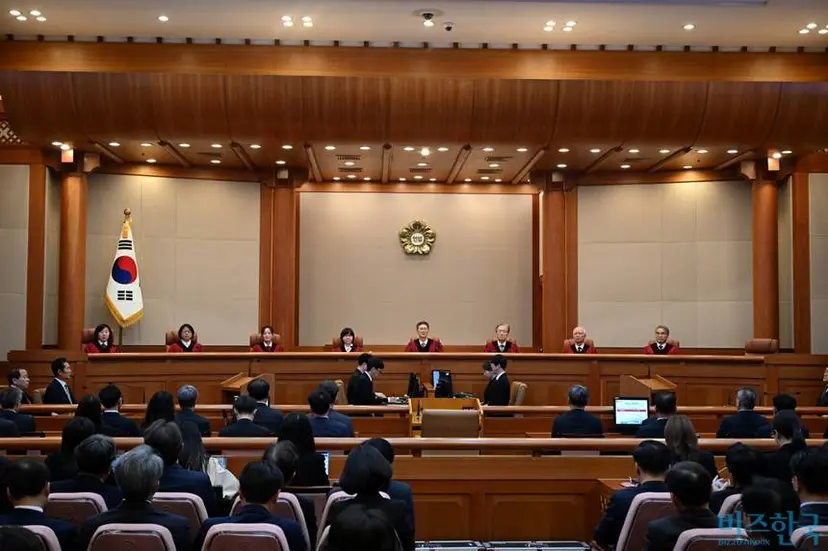
[Full Text of the Ruling Summary]
We will now begin the sentencing for the impeachment case of President Yoon Suk Yeol, 2024Heon-Na 8. First, we will examine the requirements for legality.
① Regarding whether the declaration of martial law in this case is subject to judicial review:
Considering the purpose of an impeachment trial, which is to protect the constitutional order from violations of the Constitution and laws by high-ranking officials, the constitutionality and legality of the martial law declaration can be reviewed, even if the act requires a high level of political judgment.
② Regarding the fact that the impeachment motion was resolved without an investigation by the National Assembly's Legislation and Judiciary Committee:
The Constitution entrusts the impeachment process of the National Assembly to legislation, and the National Assembly Act defines whether an investigation by the Legislation and Judiciary Committee is conducted at the discretion of the National Assembly. Therefore, it cannot be said that the resolution for impeachment is illegal simply because there was no investigation by the committee.
③ Regarding whether the resolution of this impeachment motion violates the principle of non bis in idem:
The National Assembly Act stipulates that a rejected motion cannot be re-proposed during the same session. Although the first impeachment motion against the respondent failed to form a quorum during the 418th regular session, this impeachment motion was proposed during the 419th extraordinary session; therefore, it does not violate the principle of non bis in idem.
Meanwhile, Justice Jung Hyung-sik has provided a concurring opinion suggesting the need for legislation to limit the number of impeachment motions that can be proposed even in different sessions.
④ Regarding whether there is a lack of protective interest because the martial law in this case was lifted within a short period and no damage resulted:
Even though the martial law has been lifted, the grounds for impeachment had already occurred due to the martial law, so it cannot be said that the interest in the trial is denied.
⑤ Regarding the point where acts violating the Criminal Act, such as insurrection, were included as acts violating the Constitution after the impeachment trial request:
Maintaining the same fundamental facts while withdrawing or changing the applied legal provisions does not constitute a withdrawal or change of the charges and is permitted without special procedures.
The respondent argues that the quorum for the resolution would not have been met if there were no parts related to the crime of insurrection in the charges, but this is merely a hypothetical argument with no objective basis to support it.
⑥ Regarding the argument that the impeachment prosecution power was abused to usurp the presidency:
Since the resolution process of this impeachment motion was lawful and the respondent's violation of the Constitution or laws was substantiated to a certain level, it cannot be considered an abuse of the impeachment prosecution power.
Therefore, the impeachment trial request in this case is lawful.
Meanwhile, regarding the rules of evidence, Justices Lee Mi-son and Kim Hyung-du provided a concurring opinion that the hearsay rule under the Criminal Procedure Act can be applied in a relaxed manner in impeachment proceedings, whereas Justices Kim Bok-hyung and Jo Han-chang provided a concurring opinion that the hearsay rule should be applied more strictly in future impeachment proceedings.
Next, we will examine whether the respondent violated the Constitution or laws in the performance of his duties, and whether his illegal acts are serious enough to warrant his removal. First, we will examine the case by each ground of prosecution.
① Regarding the declaration of martial law in this case:
According to the Constitution and the Martial Law Act, one of the substantive requirements for declaring emergency martial law is that "a state of war, civil strife, or a corresponding national emergency must actually occur, where the country is in a state of engagement with an enemy or social order is extremely disrupted, making it significantly difficult to perform administrative and judicial functions."
The respondent argues that such a serious crisis occurred due to the opposition party’s abuse of its legislative power, attempts to cut budgets, and the unprecedented push for impeachment motions in the National Assembly, where the opposition holds a majority.
From the respondent's inauguration until the declaration of martial law, the National Assembly had proposed a total of 22 impeachment motions against the Minister of the Interior and Safety, prosecutors, the Chairperson of the Korea Communications Commission, and the Chairman of the Board of Audit and Inspection. This raised concerns that the National Assembly used the impeachment system as a political pressure tool against the government based only on suspicions of legal violations, without contemplating the unconstitutionality or illegality of the grounds for impeachment.
However, at the time of the declaration of martial law, only impeachment proceedings against one prosecutor and the Chairperson of the Korea Communications Commission were ongoing.
The bills that the respondent claims were problematic because they were unilaterally passed by the opposition were in a state where they were not effective because the respondent had requested reconsideration or withheld promulgation.
The 2025 budget bill could not have had any effect on the situation at the time of the martial law declaration, which was executing the 2024 budget, and there had only been a resolution by the National Assembly's Special Committee on Budget and Accounts, not a resolution by the plenary session.
Therefore, it cannot be seen that the National Assembly's exercise of its powers—such as impeachment, legislation, and budget deliberation—actually created a serious crisis at the time of the martial law declaration.
Even if the National Assembly's exercise of power is illegal or unfair, it can be dealt with through routine methods of exercising power, such as the Constitutional Court’s impeachment trial or the respondent's request for reconsideration of bills; therefore, it cannot justify the exercise of national emergency powers.
The respondent also argues that he declared martial law in this case to resolve suspicions of election fraud. However, the mere existence of suspicion does not mean that a serious crisis has actually occurred.
Furthermore, the National Election Commission announced that it had addressed most security vulnerabilities before the 22nd National Assembly elections, and the respondent’s claim cannot be seen as valid given that measures were prepared, such as 24-hour CCTV disclosure of early/absentee ballot storage locations and the introduction of a manual counting system in the vote-counting process.
Ultimately, even considering all the circumstances claimed by the respondent, it cannot be seen that a crisis situation existed at the time of the declaration of martial law sufficient to objectively justify the respondent's judgment.
The Constitution and the Martial Law Act require, as a substantive requirement for declaring emergency martial law, that "there must be a need and purpose to respond to military necessity with armed force or to maintain public peace and order."
However, the state of administrative paralysis or suspicions of election fraud caused by the National Assembly's exercise of power—as claimed by the respondent—is a problem that should be resolved through political, institutional, and judicial means, not through the mobilization of troops.
The respondent claims that this martial law was a "warning-type" or "appeal-type" martial law intended to inform the public of the opposition party’s arbitrary rule and the national crisis, but this is not the purpose of declaring martial law as stipulated by the Martial Law Act.
Furthermore, because the respondent went beyond merely declaring martial law and proceeded to commit acts violating the Constitution and laws, such as mobilizing the military and police to obstruct the National Assembly's exercise of power, the respondent’s claim of a warning-type or appeal-type martial law cannot be accepted.
Therefore, the declaration of martial law in this case violated the substantive requirements for declaring emergency martial law.
Next, we will examine whether the declaration of martial law in this case complied with procedural requirements.
① The declaration of martial law and the appointment of the Martial Law Commander must go through deliberations by the State Council.
It is recognized that the respondent briefly explained the purpose of the martial law declaration to the Prime Minister and nine state council members just before declaring martial law.
However, considering that the respondent did not explain specific details of the martial law, such as the Martial Law Commander, and did not provide other members an opportunity to state their opinions, it is difficult to see that deliberations regarding the declaration of martial law took place.
Moreover, the respondent declared martial law in this case even though the Prime Minister and relevant state council members did not countersign the declaration of emergency martial law, and he failed to publicly announce the implementation time, area of implementation, and Martial Law Commander, nor did he notify the National Assembly without delay, thus violating the procedural requirements for declaring emergency martial law as stipulated by the Constitution and the Martial Law Act.
② Regarding the deployment of the military and police to the National Assembly:
The respondent instructed the Minister of National Defense to deploy troops to the National Assembly. Consequently, soldiers entered the National Assembly premises using helicopters, and some even broke windows to enter the main building.
The respondent issued instructions to the Commander of the Army Special Warfare Command and others, such as, "It seems the quorum has not been met, so break down the doors and drag the people inside out."
In addition, the respondent informed the Commissioner General of the Korean National Police Agency of the contents of the proclamation through the Martial Law Commander and called him personally six times. Consequently, the Commissioner General ordered a complete blockade of access to the National Assembly. As a result, some of the National Assembly members who were gathering at the National Assembly had to climb over walls or could not enter at all.
Meanwhile, the Minister of National Defense instructed the Commander of the Defense Counterintelligence Command to locate 14 individuals, including the Speaker of the National Assembly and the heads of each political party, for the purpose of arrest if necessary. The respondent called the First Deputy Director of the National Intelligence Service and ordered support for the Defense Counterintelligence Command, and the Commander of the Defense Counterintelligence Command requested the First Deputy Director to confirm the locations of those individuals.
As such, the respondent mobilized the military and police to control the National Assembly members' access to the National Assembly and instructed them to drag the members out, thereby obstructing the exercise of the National Assembly's authority. This violated the constitutional provision granting the National Assembly the right to demand the lifting of martial law and infringed upon the National Assembly members' right to deliberate and vote, as well as their immunity from arrest. Furthermore, by participating in the attempt to locate the heads of political parties, he infringed upon the freedom of political party activities.
By deploying troops for political purposes, such as blocking the National Assembly's exercise of power, the respondent made soldiers, who have served the country with the mission of national security and defense, confront ordinary citizens.
Accordingly, the respondent infringed upon the political neutrality of the Armed Forces and violated the duty of military command according to the Constitution.
③ Regarding the issuance of the proclamation in this case:
Through the proclamation in this case, the respondent prohibited the activities of the National Assembly, local councils, and political parties, thereby violating the constitutional provisions granting the National Assembly the right to demand the lifting of martial law, the constitutional provisions stipulating the political party system, and the principles of representative democracy and separation of powers.
He violated the constitutional and Martial Law Act provisions establishing requirements for limiting basic rights under emergency martial law and the warrant principle, thereby infringing upon the citizens' basic political rights, the right to collective action, and freedom of occupation.
④ Regarding the search and seizure of the National Election Commission:
The respondent instructed the Minister of National Defense to mobilize troops to inspect the National Election Commission's computing system. Accordingly, troops deployed to the National Election Commission building controlled access, confiscated the cell phones of staff on duty, and photographed the computing system.
This violated the warrant principle by allowing a search and seizure of the National Election Commission without a warrant and infringed upon the independence of the Commission.
⑤ Regarding the attempt to locate legal professionals:
As mentioned earlier, the respondent was involved in the attempt to confirm locations for the purpose of arrest if necessary, and the targets included a former Chief Justice and a former Supreme Court Justice who had not long retired. Since this puts pressure on sitting judges that they could become targets of arrest by the executive branch at any time, it infringed upon the independence of the judiciary.
We will now examine whether the respondent's illegal acts examined so far are serious enough to warrant his removal.
After declaring martial law in this case to overcome the confrontation with the National Assembly, the respondent mobilized the military and police to obstruct the exercise of the National Assembly's constitutional authority, thereby denying popular sovereignty and democracy. He ignored the governing structure set by the Constitution by mobilizing troops to search and seize the National Election Commission, and extensively infringed upon citizens' basic rights by issuing the proclamation in this case.
These acts violated the fundamental principles of the rule of law and the democratic state, and in themselves infringed upon the constitutional order and caused serious harm to the stability of the democratic republic.
Meanwhile, the fact that the National Assembly was able to quickly pass a resolution demanding the lifting of the emergency martial law was thanks to citizens' resistance and the military and police's passive performance of duties, so this does not affect the judgment on the severity of the respondent's legal violations.
A president's authority is granted solely by the Constitution. The respondent exercised national emergency powers, which should be exercised with the utmost caution, beyond the limits set by the Constitution, causing distrust in the exercise of his presidential powers.
Since the respondent took office, the authority of many high-ranking officials has been suspended during impeachment trials due to an unusually high number of impeachment motions led by the opposition party.
Regarding the 2025 budget bill, for the first time in constitutional history, the National Assembly's Special Committee on Budget and Accounts decided, by the opposition party alone, only on reductions without any increases.
Major policies established by the respondent could not be implemented due to opposition from the opposition party, and the opposition party unilaterally passed bills opposed by the government, leading to repeated requests for reconsideration by the respondent and passage of bills by the National Assembly.
In that process, it appears the respondent would have felt a great sense of responsibility that he had to somehow overcome the situation, recognizing that national affairs were being paralyzed and national interests were being significantly hindered by the opposition party's arbitrary rule.
The respondent's judgment that the National Assembly’s exercise of power was an abuse of power or an act causing paralysis in national affairs should be respected politically.
However, the confrontation that occurred between the respondent and the National Assembly is difficult to attribute to the responsibility of one side, and this is a problem of politics that should be resolved according to democratic principles. The expression of political views or public decision-making regarding this must be done within a scope that can be harmonized with democracy guaranteed by the Constitution.
The National Assembly should have respected minority opinions and tried to derive conclusions through dialogue and compromise, premised on tolerance and restraint in its relationship with the government.
The respondent also should have respected the National Assembly, which represents the people, as a partner for cooperative governance.
Nevertheless, the respondent treated the National Assembly as an object of exclusion, which destroys the premise of democratic politics and can hardly be seen as harmonious with democracy.
Even if the respondent judged that the National Assembly's exercise of power was tyranny of the majority, he should have allowed checks and balances to be realized through the remedies envisioned by the Constitution.
The respondent had an opportunity to persuade the people to let him lead national affairs in the National Assembly election held about two years after he took office. Even if the result did not match the respondent’s intention, he should not have attempted to exclude the will of the people who supported the opposition party.
Nevertheless, by declaring martial law in this case in violation of the Constitution and laws, the respondent reproduced the history of abuse of national emergency powers, shocking the people and causing confusion in all fields—social, economic, political, and diplomatic.
As president for all citizens, he violated his duty to transcend those who support him and integrate the social community.
By mobilizing the military and police to damage the authority of constitutional institutions such as the National Assembly and infringing upon the fundamental human rights of citizens, he abandoned his duty to protect the Constitution and gravely betrayed the trust of the Korean people, who are the sovereign of the democratic republic.
Ultimately, the respondent's unconstitutional and illegal acts constitute a grave violation of the law that cannot be tolerated from the perspective of protecting the Constitution, as they betrayed the people's trust.
Because the negative impact and ripple effects of the respondent's illegal acts on the constitutional order are significant, it is recognized that the benefit to protecting the Constitution gained by removing the respondent from office is overwhelmingly greater than the national loss resulting from the president's removal.
Accordingly, we announce the order with the unanimous opinion of all justices.
Since this is an impeachment case, we will confirm the time of the sentence. The time is now 11:22 AM.
Order: The respondent, President Yoon Suk Yeol, is removed from office.
This concludes the sentencing.