

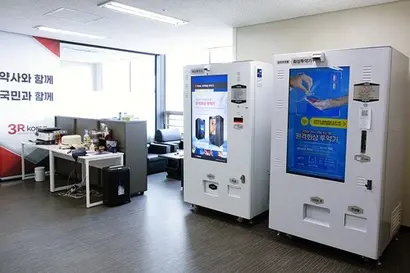
[비즈한국] The pharmaceutical industry is pushing back against the government's attempt to expand the installation of remote medication dispensers, which allow customers to purchase medicine through video calls with pharmacists. While the pharmacy sector has challenged the project itself, citing concerns over safety and economic viability, they have failed to persuade the government. Meanwhile, some argue that while the technological trend cannot be stopped, it must be operated cautiously to ensure it does not compromise the public service role of pharmacies. Currently, there are only eight remote medication dispensers installed at pharmacies nationwide.
Both the Korean Pharmaceutical Association and the Korean Oriental Pharmaceutical Association 'Protest' the Recommendation
Recently, the New Industry Regulatory Innovation Committee under the Office for Government Policy Coordination discussed two agenda items for which deliberations by the Regulatory Special Committee had been delayed and reached a mediation recommendation. The items involved changes to the supplementary conditions for over-the-counter (OTC) remote medication dispensers (smart remote kiosks) and the granting of special permits for purchase management services for veterinary-exclusive medicines. Regarding the remote medication dispensers, the committee announced a recommendation centered on: △allowing 13 additional therapeutic groups on top of the current 11; △disallowing installation in pharmacies operated by oriental pharmacists (herbal pharmacists); and △permitting the installation of these dispensers in locations other than pharmacies in remote areas like rural villages where pharmacies are scarce.
According to the recommendation, the committee determined that concerns over public health and safety due to the expansion of drug categories would not be significant, considering the requirements that pharmacists must install and manage the sales system under their own responsibility, provide mandatory video-based medication guidance, and record and store the entire process. Regarding installation in pharmacies run by oriental pharmacists, the committee disallowed it for now, citing the argument that under the current system and management framework where the distinction between OTC drugs and herbal medicines is not clear, oriental pharmacists cannot be granted the authority and obligation to manage general pharmaceuticals; they noted that this could be re-discussed after future legal refinements.
The Korean Pharmaceutical Association (KPA), the Ministry of Health and Welfare, and the Korean Oriental Pharmaceutical Association are actively working to submit their positions. The KPA is filing formal objections in writing and collecting opinions to push for a revision of the recommendation. The Korean Oriental Pharmaceutical Association stated that they have visited the relevant departments at the Office for Government Policy Coordination and the Ministry of Health and Welfare to express their stance. Three-R Korea, the manufacturer of the dispensers, stated, "We are watching to see if the opinions of the KPA and the Ministry of Health and Welfare will be accepted. Even if they are, it is not the end. The matter must be discussed once more in a plenary session."
The pharmacy sector has opposed the pilot program for OTC remote medication dispensers on the grounds of safety and economic feasibility. They argue that it is difficult to safely use and manage drugs through video-based medication guidance, which goes against the in-person principle stipulated in the Pharmaceutical Affairs Act, and that the dispensers lack economic viability due to low utilization rates and sales performance. A KPA official said, "It is difficult to verify the specific indications for drugs through a remote dispenser. Safety is the fundamental principle of pharmaceuticals, and it is necessary to clarify the scope of liability in the event of harm. The biggest issues are practical ones like costs and employment. The price of the machine and labor costs are a burden for pharmacists. I understand that monthly earnings barely cover the cost of the machine." According to Three-R Korea's website, the total cost for a dispenser is 20 million won, including a 10 million won deposit and a 10 million won sign-up fee. The KPA explains that over five years, this amounts to a steady cost of about 300,000 won per month.
When asked if the KPA's stance is for a complete withdrawal or to maintain the status quo, the official replied, "We've tried it for two years, and seeing that it hasn't expanded and remains at eight units, I think the market has already made its judgment. I don't think extending the project for another two years or adding more drug categories will solve the practical problems."
Manufacturer and Participating Pharmacies: “No Safety Issues… Hiring Pharmacists is Easy”
Three-R Korea, the manufacturer, refutes the KPA’s claims as groundless. Park In-sul, CEO of Three-R Korea, said, "All OTC drugs are products designed for self-judgment. They are products that anyone can safely use without a doctor's prescription. In fact, I believe remote dispensers are safer as they require recording the time of sale, the pharmacist on duty, and the temperature at the time of sale, and keeping those records for six months. In a physical pharmacy, if a customer comes back a few days later saying, 'I bought this here,' there are many cases where the pharmacist doesn't know who sold it. The remote dispenser records and stores the entire process, starting with the consulting pharmacist asking, 'How can I help you?' until the user retrieves the medicine."
Regarding the claims about economic viability, he argued, "Remote medication dispensers and public late-night pharmacies cover the market after regular pharmacy hours. It's done for the public good, so questioning its economic viability makes no sense. Public late-night pharmacies receive tens of millions of won in annual subsidies despite having limited operating hours." CEO Park added, "To improve profitability, more dispensers need to be installed, but KPA executives visit participating pharmacies to protest, and they file complaints with local governments citing reasons like environmental cleanliness. Because of this, pharmacists who are interested are hesitant, waiting to see what happens to others."
Furthermore, he mentioned that, unlike public late-night pharmacies, there is no major difficulty in hiring pharmacists for consultations. CEO Park said, "We hire them at 35,000 won per hour, and because they don't have the stress of commuting and the work intensity is lower, they are generally quite satisfied. In rural or small-to-medium-sized cities where there are no pharmacists available to work in pharmacies, I believe remote medication dispensers are a viable alternative."
Pharmacist 'A', currently participating in the project, stated, "There is almost no profit, but I installed it for the convenience of my patients. Recently, due to doctors' strikes and other factors, wasn't it difficult to even visit the emergency room? Thinking about safety, I thought it was more desirable to go through a pharmacist's guidance via a remote dispenser than to buy medicine at a convenience store where there is no qualified personnel. I intend to keep using the remote dispenser unless there is a specific problem."
Meanwhile, regarding the decision to disallow the installation of remote medication dispensers in oriental pharmacies, the Korean Oriental Pharmaceutical Association stated, "It is common sense that oriental pharmacists handle OTC drugs," adding, "We are internally discussing various regulatory sandbox applications using diverse technologies. The Office for Government Policy Coordination has also shown a positive response."