

[비즈한국] Noise continues to surround the state-run IBK (Industrial Bank of Korea)024110. Following a solitary general strike earlier this year due to labor-management conflict, the bank is now embroiled in an 80-billion-won unfair lending scandal. The controversy has deepened as evidence has emerged that the incident was falsely reported and downplayed within the bank. Immediately after the financial authorities released their audit results, IBK CEO Kim Sung-tae issued a public apology and announced a reform plan, but internal backlash suggests the reform is headed in the wrong direction.
On March 25, the Financial Supervisory Service (FSS) announced the results of an investigation into unfair transactions, such as conflicts of interest, revealing that 88.2 billion won in unfair loans had been issued by IBK. The 58 identified cases of unfair lending were perpetrated through collusion between individuals connected by personal ties, such as retired employees and current staff, or current employees and their relatives.
The largest case involved a retired employee who colluded with a spouse and a former entry-class colleague (both current employees) to execute or facilitate 78.5 billion won in unfair loans over a seven-year period (2017–2024). In other instances, a current employee who invested 200 million won in a retired employee executed 7 billion won in unfair loans at the retiree's request and received real estate worth 400 million won under the guise of recovering the investment. There was also a case where a screening center head, responsible for auditing and reviewing loans, applied for a loan through relatives and former entry-class colleagues and then approved it themselves.
According to the audit, the outstanding balance of the 88.2 billion won in unfair loans was 53.5 billion won as of the end of February, with 9.5 billion won having already soured. The FSS expects the scale of non-performing loans to grow as "loan cycling"—the practice of using new loans to pay off old ones—becomes more difficult following the exposure of the scandal.
Another issue is that IBK, aware of the scandal, attempted to cover it up due to concerns over its reputation and provided false reports to financial authorities. According to the FSS, while the bank received a tip-off about misconduct in August 2024 and became aware of the financial accident by September or October, it failed to forward the findings to relevant departments and systematically concealed the incident by drafting documents containing false details of the accident.
In fact, the trend of financial accidents at IBK raises concerns about its internal control system. The number of financial accidents over the past five years (2020–2024) surged from 5 in 2020, 8 in 2021, 5 in 2022, and 5 in 2023 to 11 in 2024. Notably, while there were no cases classified as breach of trust between 2020 and 2023, there were three such cases in 2024 (along with 5 cases of private lending, 1 case of theft/robbery, 1 case of bribery, and 1 other).
Cases exceeding 10 billion won that occurred in 2024 were classified as occupational breach of trust occurring between June 2022 and November 2024, with the total accident amount reaching 23.95 billion won. This differs significantly from the scale uncovered by financial authorities. IBK stated that the accident amount "refers to the damages or estimated damages at the time of discovery."
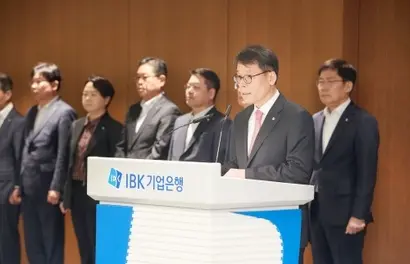
Struck by the damage to its credibility, IBK moved immediately to contain the situation. CEO Kim Sung-tae held an expanded executive meeting on March 26 to announce a reform plan. "I sincerely apologize to our customers and the public," Kim said, bowing his head. "We will treat these audit results as an opportunity for deep self-reflection and do our utmost to restore trust through flawless follow-up measures and plans to prevent recurrence."
IBK cited weak internal controls, inefficient work processes, and an unreasonable organizational culture as the causes of the accident. The reform plan focuses on three main areas: work processes, internal controls, and organizational culture. The measures include establishing a database of employees' relatives to block conflicts of interest, mandatory confirmation statements to prevent unfair lending, operating an audit advisory group composed of internal and external experts, establishing an independent reporting channel, and implementing a zero-tolerance policy.
On March 31, the composition of the "IBK Reform Committee" was completed. Jung Soon-sup, a professor at Seoul National University School of Law, was named chairman, and Kim Woo-jin, a professor at Seoul National University, and attorney Song Chang-young were appointed as external members. The bank's Chief Compliance Officer and the Executive Vice President of Management Strategy were included as internal members.
However, the reform plan is facing internal backlash. On the 2nd, the IBK labor union (the IBK branch of the Federation of Korean Financial Industry Trade Unions) raised its voice, stating, "CEO Kim's reform plan is misguided in both composition and direction." Union leader Ryu Jang-hee pointed out, "It fails to address the core issue, instead passing the burden onto frontline employees rather than the management who are the actual parties responsible for the unfair lending scandal." He added, "The internal members of the reform committee are figures responsible for the situation, and there are concerns about the objectivity of the external members, including a legal advisor who has been working with the bank for over a decade."
Furthermore, the union presented its own 10-point reform plan, including the collective resignation of management and accountability for those responsible, the abolition of Key Performance Indicators (KPIs) related to SME loans, startup financing, and technology finance, the eradication of parachute appointments of retired employees, and the conversion of the loan screening department into a completely independent unit.
Meanwhile, CEO Kim Sung-tae, who has less than a year left in his term, faces deepening concerns. Amidst a four-month impasse in wage and collective bargaining negotiations with the union, he now faces the daunting task of completely reforming the organization's culture and internal controls.
A union representative emphasized, "We believe this is a critical turning point for IBK. How this incident is resolved and how the staff are treated will affect the bank’s future sustainability. Since it is difficult for a CEO to be reappointed in the public sector compared to private firms, these issues must be properly resolved within this year."