

[비즈한국] On April 2 (local time), U.S. President Donald Trump announced a 45% tariff on all products imported from South Korea. Consequently, South Korea's major exports to the U.S.—including automobiles, semiconductors, and batteries—are expected to face inevitable damage. Automobiles, in particular, are known to account for over 25% of South Korea's exports to the U.S.
The business world's attention is focused on Hyundai Motor Group (Hyundai Motor 005380). The group sold 1.7 million vehicles in the U.S. market last year. The automotive industry expects Hyundai Motor's U.S. sales to decline this year due to this tariff policy. While Hyundai Motor Group is responding by localizing production, including large-scale investments in the U.S., it has become impossible to avoid the "tariff bomb" until its U.S. production facilities are fully completed.
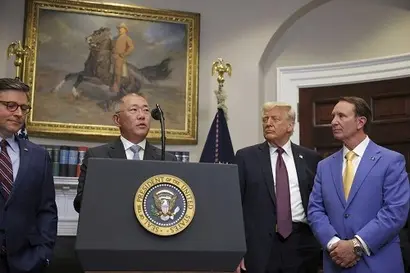
On March 24 (local time), Hyundai Motor Group announced that it would invest $21 billion (approximately 31 trillion KRW) in major U.S. sectors, including automobiles, parts, logistics, and steel, from this year through 2028. The group explained that this investment aims to respond to U.S. administration policies and strengthen its standing in the U.S. by expanding business opportunities across various fields.
Specifically, Hyundai Motor Group plans to invest a total of $8.6 billion (approximately 12.64 trillion KRW) to build a system capable of producing 1.2 million vehicles locally in the U.S. It also plans to invest $6.1 billion (approximately 9 trillion KRW) in parts, logistics, and steel, and $6.3 billion (approximately 9.26 trillion KRW) in future industries and energy.
Analysts suggest that this investment by Hyundai Motor Group was made with President Trump's policies in mind. Even before taking office, President Trump maintained a stance of imposing strong tariffs on imported goods. After the group's investment announcement, Yoo Min-ki, a researcher at Sangsangin Securities, assessed that "the risk of universal tariffs, estimated at around 1.5 to 1.8 trillion KRW, is expected to be resolved."
A representative for Hyundai Motor Group also stated, "It reflects our will to strengthen future competitiveness through active challenges and constant change and innovation, without being discouraged by uncertain domestic and international business environments, while simultaneously creating new possibilities for humanity," adding, "We will continue to create future opportunities through bold investments, internalizing core technologies, and strategic cooperation with top-tier companies at home and abroad."
However, despite the group's investment announcement, President Trump announced that a 25% tariff would be imposed on cars imported into the U.S. A base tariff of 10% will be applied starting the 5th, and this will rise to 25% as country-specific tariffs take effect on the 9th. Previously, South Korean vehicles could be exported to the U.S. without tariffs under the Free Trade Agreement (FTA). Once the tariffs are imposed, however, price competitiveness in the U.S. market will inevitably decline.
Vehicles produced by Hyundai Motor in the U.S. are not subject to these tariffs. The group currently operates its Alabama plant, Georgia plant, and Metaplant America. The combined annual production capacity of these three plants is around 1 million units. Yet, the group's total sales in the U.S. market last year reached 1.7 million units. Local U.S. plants alone cannot meet the total sales demand.
Furthermore, a significant portion of the automotive parts produced at these local U.S. plants are sourced from outside the United States. President Trump is also expected to announce tariffs on automotive parts soon. For Hyundai Motor, this means facing substantial tariffs until its U.S. production facilities are fully established by 2028. Consequently, there are forecasts that it will be difficult for the company to avoid a decline in performance until 2028.
Song Sun-jae, a researcher at Hana Securities, analyzed, "South Korean automakers are bound to be negatively affected. Automotive parts manufacturers will also face tariffs on core components, weakening their local price competitiveness, and their supply volumes may be negatively impacted depending on whether finished vehicle exports decrease."
Kim Young-hoon, a senior researcher at Korea Ratings, explained, "The negative impact is expected to be significant on the domestic automotive industrial value chain (autos, parts, secondary batteries, etc.) that relies heavily on the U.S. market. Given that automobiles account for 26.8% of total exports to the U.S. as of 2024 and approximately 60% of the trade surplus, they are a major export item; thus, the ripple effects are expected to extend beyond the automotive industry to the overall domestic economy."
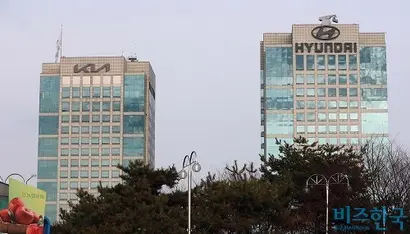
For Hyundai Motor, the best-case scenario is securing a waiver for these tariffs from President Trump, given their commitment to U.S. investment. There are opinions that the help of the South Korean government is necessary because this is a policy-related matter.
A business industry official said, "Large-scale overseas investments and policy matters are often coordinated through government officials. It is unusual for Hyundai Motor to announce its U.S. investment independently, which is understandable given the current confusion in domestic politics."
Indeed, the domestic political sector is watching the U.S. tariff policy closely. Acting President Han Duck-soo met with the heads of six major economic organizations at his official residence in Samcheong-dong on March 27, stating, "We will pour all our wisdom and capabilities into overcoming the crisis and protecting South Korea's national interests and industries," adding, "To minimize the damage to our companies, the government will communicate with the U.S. government using all private and public networks."
On April 1, Acting President Han hosted the first Economic Security Strategy Task Force (TF) meeting, inviting Hyundai Motor Group Executive Chair Euisun Chung, Samsung Electronics (005930) Chairman Jay Y. Lee, SK (034730) Group Chairman Chey Tae-won, and LG (003550) Group Chairman Koo Kwang-mo. Acting President Han stated, "Centering on the Economic Security Strategy TF, we will devise response strategies together with companies and mobilize all public-private networks to conduct full-scale outreach."
However, the U.S. tariff policy begins at 0:00 on April 5 (local time). Time is of the essence for Hyundai Motor. While the political sector has expressed a willingness to solve the problem, no concrete measures have been put forward. Furthermore, this is not a problem that Hyundai Motor can solve with President Trump on its own.
Another industry official commented, "Tariffs are not an issue a single company can handle; they are an issue between nations. As of now, there is no way forward other than watching the situation unfold and responding accordingly."
Because of this, market concerns regarding Hyundai Motor are growing. To maintain profitability, Hyundai Motor would need to raise prices in the U.S. market. However, raising prices could lead to a vicious cycle of losing consumer favor. Although Hyundai Motor has stated it has no immediate plans to raise prices, there is no clear solution for its profitability issues. José Muñoz, President of Hyundai Motor, said at the '2025 Seoul Mobility Show Media Day' on the 3rd, "I have seen the tariff announcement and are evaluating its impact," while adding, "There are no plans to raise prices in the U.S."