

[비즈한국] Hanwha000880 Group Chairman Kim Seung-youn (73) has announced that he will gift shares of Hanwha Corporation to his children. With this, Hanwha Group has officially opened the era of third-generation management. Chairman Kim has three sons: his eldest, Hanwha Group Vice Chairman Kim Dong-kwan (42); his second, Hanwha Life088350 President Kim Dong-won (40); and his third, Hanwha Galleria452260 Vice President Kim Dong-seon (36). The business community expects that Hanwha Group will proceed with a separation of affiliates centered around the three sons. Some, however, suggest the possibility that they may manage the group through consensus, similar to SK Group, rather than pursuing a formal separation. Although rumors of a spin-off within Hanwha Group have circulated for years, the company itself has refrained from making official comments.
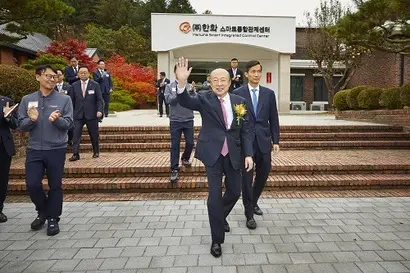
Circumstances before and after Chairman Kim Seung-youn's share transfer
On March 31, Hanwha Group announced that Chairman Kim Seung-youn would gift 11.32% of Hanwha Corporation—half of the 22.56% stake he currently holds. Chairman Kim is gifting 4.86% to Vice Chairman Kim Dong-kwan, and 3.23% each to President Kim Dong-won and Vice President Kim Dong-seon.
Following the transfer, the shareholder composition of Hanwha Corporation will be: Hanwha Energy at 22.16%, Chairman Kim Seung-youn at 11.33%, Vice Chairman Kim Dong-kwan at 9.77%, President Kim Dong-won at 5.37%, and Vice President Kim Dong-seon at 5.37%. Hanwha Energy is 50% owned by Vice Chairman Kim Dong-kwan, with President Kim Dong-won and Vice President Kim Dong-seon each holding 25%. The total direct and indirect stake held by the three brothers in Hanwha Corporation becomes 42.67%. In effect, the succession of shares within Hanwha Group is now complete.
The gift tax to be paid by the three brothers—Dong-kwan, Dong-won, and Dong-seon—following this transfer amounts to 221.8 billion won. This figure was calculated based on the average closing price of Hanwha Corporation shares between March 4 and 31. Hanwha Group stated that it plans to pay the gift tax transparently. Furthermore, Chairman Kim Seung-youn is not stepping down completely from the management of Hanwha Group; he will maintain his position as group chairman and continue to provide management advice and support for global business.
Hanwha Group stated that it gifted the shares to preempt unnecessary misunderstandings. This follows suspicions raised after Hanwha Aerospace012450 purchased a 2.31% stake in Hanwha Ocean042660 from Hanwha Energy on March 13, leading some to wonder if it was a deal meant to boost Hanwha Energy, given that Chairman Kim’s children own 100% of Hanwha Energy. A week later, on March 20, Hanwha Aerospace announced a 3.6 trillion won capital increase. Skeptical voices questioned why Hanwha Aerospace, already holding sufficient cash, would pursue a capital increase, with some alleging it was intended to finance the acquisition of the Hanwha Ocean stake.
In response, Hanwha Group stated, "We have taken measures to ensure that normal and essential business activities, such as Hanwha Aerospace's capital increase and the acquisition of the Hanwha Ocean stake, are not linked to the succession," adding that it was "a broad-minded decision to eliminate uncertainty in the governance structure, further strengthen responsible management, maximize shareholder value, and contribute to the development of the national economy."
Hanwha Group further emphasized, "With the succession now completed through this share transfer, we hope to dispel speculations and distortions connecting the large-scale overseas investment, which is urgent and critical, to the succession process. By completing the succession through this gift, we aim to correct the misunderstanding that 'Hanwha Corporation is lowering its corporate value for the sake of a merger with Hanwha Energy,' and resolve doubts regarding the erosion of shareholder value."
The three brothers maintain a good relationship; a split may not be necessary
Hanwha Group did not provide specific details regarding future plans for governance restructuring. The eldest, Vice Chairman Kim Dong-kwan, currently oversees the defense, shipbuilding, and energy businesses. The second son, President Kim Dong-won, handles finance, while the third, Vice President Kim Dong-seon, is in charge of retail and robotics. The business community expects the brothers to maintain this division of roles in the future.
The key question is the possibility of a spin-off. To date, Hanwha Group has not officially mentioned any plans for such a separation. Given that the roles of the three brothers are clearly defined, industry observers view the possibility of a split as high. Indeed, many major corporations have separated their affiliates during the succession process. A notable example is Hyundai Group, which split into Hyundai Motor Group, HD Hyundai Group, Hyundai Department Store Group, HL Group, KCC Group, and HDC Group as it transitioned to second-generation management.
If a group does not split, disagreements between brothers can escalate into conflicts. While Vice Chairman Kim Dong-kwan holds a larger stake, his younger brothers also hold significant shares, making it impossible to ignore their input. For example, in the case of Kumho Group, while brothers took turns serving as chairman, a bitter dispute between former Kumho Asiana Group Chairman Park Sam-koo and Kumho Petrochemical Group Chairman Park Chan-koo eventually led to the separation of the two groups.
However, not all companies choose to split. In the case of SK Group, although Chairman Chey Tae-won leads the group, SK Discovery and its subsidiaries are managed independently by Vice Chairman Chey Chang-won, and Chairman Chey Tae-won is known not to interfere in the management of SK Discovery. Nevertheless, since Vice Chairman Chey Chang-won was appointed as the chairman of the SK Supex Council last year, he is now involved in the management of the broader SK Group as well.
A business industry official remarked, "Proceeding with a spin-off entails substantial costs, including share consolidation, logo design changes, and signage replacements. If the brothers' relationship is good, or if they reach an agreement to rotate the group chairmanship as seen in Doosan Group or LS Group, avoiding a spin-off can also be a good method."
It is known that the brothers—Dong-kwan, Dong-won, and Dong-seon—have a good relationship. Because of this, the possibility that Hanwha Group may not proceed with a split is being cautiously raised. Securities firms appear to be adopting a wait-and-see approach, as there has been no official mention or movement regarding a split. Lee Dong-heon, a research analyst at Shinhan Securities, noted, "The gift of some of Chairman Kim Seung-youn's shares has opened the curtain on full-scale third-generation management," while adding, "The structure and justification of this succession remain issues for the market to judge moving forward."