

[비즈한국] The ‘Korea SOHO Bank Consortium,’ led by Korea Credit Data (KCD), has revealed its ambitions to become the nation's fourth internet-only bank. Korea SOHO Bank is preparing for its launch with the goal of becoming the country's first bank dedicated to small business owners. As other previously strong contenders have recently abandoned or postponed their applications for authorization, attention is focused on whether Korea SOHO Bank, which has emerged as a powerhouse candidate, will successfully complete the race.
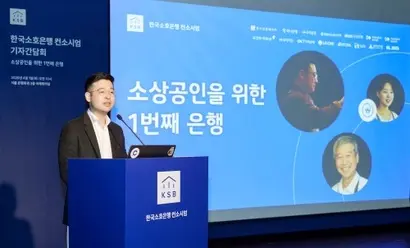
The Korea SOHO Bank Consortium, the fourth internet-only bank candidate led by Korea Credit Data, held its first press conference since its inception. The race for the fourth internet-only bank was initially dominated by Douzone Bank, led by Douzone Bizon012510, and U-Bank, spearheaded by Lendit. However, the landscape shifted after Douzone Bizon suddenly announced the abandonment of its internet-only bank plans in March, followed by U-Bank announcing the postponement of its authorization application.
According to the Financial Services Commission, the preliminary authorization applications received from March 25 to 26 included four entities: Korea SOHO Bank, Soso Bank, Podo Bank, and AMZ Bank. Among them, Korea SOHO Bank and Soso Bank target small businesses and entrepreneurs, Podo Bank aims to serve overseas Koreans, and AMZ Bank targets financially underserved groups such as farmers and the MZ generation.
The Korea SOHO Bank Consortium includes three of the top five commercial banks: Hana Bank, Woori Bank, and NH Nonghyup Bank. Beyond these, various financial institutions are among the shareholders, including Busan Bank, Eugene Investment & Securities001200, Woori Card, OK Savings Bank, Heungkuk Life Insurance, and Heungkuk Fire & Marine Insurance000540. Additionally, IT firms such as LG CNS, ITcen Entech, Megazone Cloud, Iljin, and Tsis have joined hands with Korea SOHO Bank.
At the press conference held on the 1st, Kim Dong-ho, CEO of Korea Credit Data, said, "There has never been a bank specialized for small business owners. People ask why such a bank is needed, often because of the perception that 'small businesses are difficult.' Small business owners do not need charity; they need finance." He added, "Although 99% of businesses in Korea are small businesses, financial services have been focused on individuals and large corporations. While there are structural issues, it is also because it is difficult to obtain or trust data on small businesses."
On this day, Korea SOHO Bank declared that it would show innovation in the lending sector, distinct from existing banks. They pointed out that while the three existing internet banks (KakaoBank, K-Bank, and Toss Bank) showed innovation in the deposit sector—such as '26-week savings' and 'group accounts'—they failed to innovate in the lending sector.
CEO Kim also mentioned the differences between his consortium and others. He emphasized, "Korea Credit Data has been building credit evaluation models for small business owners for five years. Furthermore, we are collaborating with the government and local authorities in various regions." He added, "Unlike other consortia that say 'we will do business if we get authorized,' we are starting already equipped with expertise and sincerity."
Korea Credit Data leverages the data from its small business management service, 'Cashnote.' As they process over 522 trillion won in annual data for 1.7 million affiliated stores nationwide via Cashnote, they explain that they can perform accurate credit evaluations based on this data. They added that they have a strength in regional finance, noting that they have signed MOUs with credit guarantee foundations in nine regions.
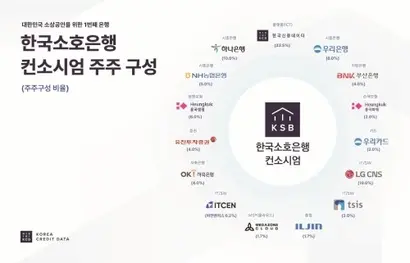
They also emphasized that the IT companies in the consortium possess strong capabilities in the financial and public sectors. LG CNS provides customized AI evaluation tools to financial firms, while ITcen Entech is a company that built the government's integrated computer network and the National Tax Service's next-generation system. The goal is to utilize the know-how of these commercial banks for banking operations.
The vision presented by Korea SOHO Bank consists of four pillars: supply chain finance, fundraising rather than loans, AI-assisted policy finance, and banking services rather than just a 'bank.' In terms of supply chain finance, the bank acts as a supply chain partner for stably operating businesses. They announced products such as 'Pay Later' and 'Same-Day Settlement.' 'Pay Later' involves the bank paying vendors in advance, with the business owner paying back later, while 'Same-Day Settlement' is a service where the bank pays the business owner on behalf of the customer first. Credit evaluations and transaction verification are based on real transaction data from tax invoices.
They also proposed a unique business model that prioritizes providing necessary funds to small business owners over simply selling products. The plan is to prioritize connecting owners with government, local authority, or relevant agency subsidies, and then offering advantageous financial products, such as those from partner companies, for any remaining needs. They added that they would use AI to recommend policy financing tailored to the life cycle of small business owners and provide customized non-financial services.
However, despite the blueprint of operating based on small business data, concerns remain regarding profitability and risk management. Shin Seo-jin, head of the Korea SOHO Bank TF at Korea Credit Data, responded, "Korea SOHO Bank will focus on non-interest income. We will maintain non-interest income at more than 20% of total revenue." Park Ju-hee, a director at the Korea SOHO Bank TF, stated that they "expect to turn a profit in the fourth year after beginning operations."
When asked about conflicts of interest among participating financial institutions, CEO Kim Dong-ho explained, "While shareholder ratios are important, it was agreed through prior consensus in the shareholders' agreement that Korea Credit Data would lead management. There will be no concerns regarding operations."