

[비즈한국] Since the 1980s, when film-transport motor drives were integrated into camera bodies, 35mm camera designs have—to varying degrees—evolved primarily toward ergonomics, focusing on ease of handling and comfort. As a result, professional cameras have become burdened with vast arrays of features, requiring countless buttons, protrusions, and complex body designs. However, a model that directly defies this trend has recently emerged: the full-frame mirrorless camera 'BF' unveiled by Japan's Sigma.
Sigma is a manufacturer better known for its lenses than its camera bodies. Perhaps that is why the BF, despite being equipped with an expensive full-frame sensor, was released with a uniquely niche appeal. Sigma sought to improve upon the shortcomings of modern cameras, which have become too complex for everyday use, and to restore the essence of photography by stripping away elements that might even slightly hinder intuitive shooting. The result is a highly avant-garde exterior design. In automotive terms, it calls to mind the Caterham Seven, which pursues extreme lightweight performance by stripping away every unnecessary component.
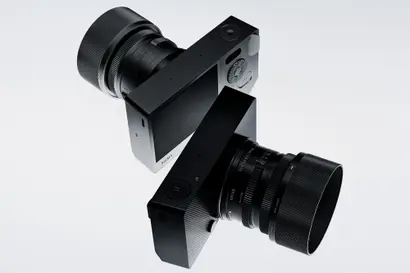
The BF features a simple design that makes it difficult for a first-time viewer to immediately recognize it as a "camera." Its rectangular body, milled from a solid piece of aluminum, evokes the aesthetic of the Apple MacBook series. The primary buttons are not mechanical, but pressure-sensitive, providing only haptic feedback. The body is not a perfect rectangular parallelepiped; it widens slightly from front to back, taking on a trapezoidal shape when viewed from above to avoid monotony. The sharp edges also raise concerns among some users about how it might feel in the hand.
The minimalist concept extends to the controls. Unlike traditional cameras covered in various dials, knobs, and buttons, Sigma limited the BF's controls to only two types, centered on circular shapes, while suppressing other forms as much as possible. All button designs remind one of the standardized, modular UI of digital products under a consistent guideline. The internal menus of the BF are also designed simply, in harmony with its exterior. By placing main shooting settings on the live-view screen, auxiliary settings in an options menu, and minor details in a system menu, the camera moves away from traditional professional menu structures toward a simple, intuitive experience.
The BF's disadvantages, such as the fixed screen without tilting, reduced expandability due to limited ports, and the closed nature of lacking a dedicated memory card slot (requiring file transfers via a USB-C port from internal memory), are frequently cited. This is because people think of the BF as an extension of traditional cameras. However, what if we change our perspective and view this model as a type of smartphone? By pursuing extreme minimalism, the BF has become quite similar to a smartphone, whether intended or not. In short, with a bit of exaggeration, the BF can be seen as a smartphone equipped with an overwhelming sensor size and an interchangeable lens system. Its ability to shoot quickly without cumbersome operation is also similar to a smartphone camera.
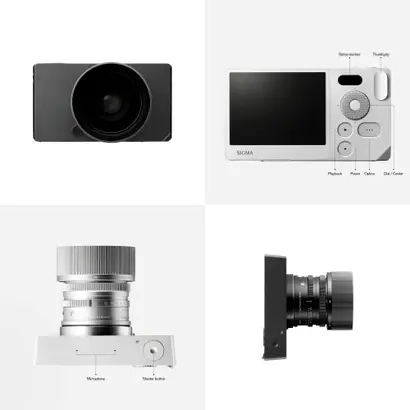
It has been a long time since electronic engineering permeated cameras. However, the transitional period where analog and digital coexisted—like in DSLRs requiring pentaprisms or mirrorless cameras using mechanical shutters—lasted quite a while. The BF, emerging from this, poses a critical question: "the complete electronic transformation of the camera." Professional cameras after the BF will likely split into two paths: those that pursue the idea of a smartphone with interchangeable lenses, or conversely, those that retain mechanical controls to provide the tactile satisfaction of traditional models. Just as there are iPhone users who want external keyboards even in an age where virtual smartphone keyboards are the norm, or BlackBerry users who prefer physical QWERTY keyboards, there is no single right answer or correct direction. However, I have a feeling that the BF will serve as that turning point.
It is difficult for the BF, which adopts a proprietary lens mount, to steal demand from Canon, Nikon, or Sony users. But the significance of the BF lies elsewhere. We are currently living in an era where products that once relied heavily on mechanical elements are merging within the larger framework of electronic engineering. As electronic technology advances, product designs across various fields are converging into one, and the BF is a model that demonstrates this flow in the camera industry. It is much like how the designs of the Tesla Cybertruck and the Sigma BF look far closer to each other than the Ford F-Series pickup does to a Nokia feature phone.
About the author, Han Dong-hoon?
A typeface designer. Interested in everything related to lettering, including writing, calligraphy, and designing and teaching typography. Currently, he designs various corporate-exclusive fonts and commercial retail fonts at the typeface studio 'Align Type'. He has contributed to 'Monthly Design' and the quarterly 'Design Review', and conducts typography design lectures on various online and offline platforms. In 2021, he published the essay collection 'The Universe Inside Letters'.