

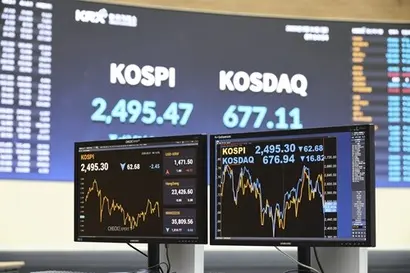
[비즈한국] With short selling fully resumed after 1 year and 5 months, concerns have grown that stock market volatility will increase. On the 31st, the KOSPI index opened at 2,513.44, down 44.54 points (1.74%) from the previous trading day, and fell below the 2,500-point line during intraday trading. It is the first time in about two months since the 10th of last month that the KOSPI index has dipped below the 2,500-mark. The KOSDAQ index also opened at 683.42, down 10.34 points (1.49%) from the previous trading day, and recorded a decline of over 3% during the session.
Short selling has been banned and subsequently resumed in the past. This occurred during the 2008 global financial crisis (approx. 8 months), the 2011 European debt crisis (approx. 3 months), and the 2020 COVID-19 pandemic (approx. 14 months). These were all measures taken to suppress volatility caused by external risks.
Byun Jun-ho, a researcher at IBK Securities, stated, "Looking at the three-month periods before and after the resumption of short selling in 2009, 2011, and 2021, the KOSPI showed an upward trend both before and after the resumption." He added, "Since the timing of the resumption usually coincided with when market crises had eased to some extent, it often reflected a relief rally or an upward trend."
In fact, experts believe that the correlation between the resumption of short selling and stock price fluctuations is low. Shinhan Securities stated, "Many studies show that short selling either does not affect or even reduces stock price volatility," adding, "It is difficult to find a correlation between stock price fluctuations and the resumption of short selling in the past." They further explained, "This is because economic and industrial fundamentals, as well as the prospects of individual companies, have a greater impact on stock prices than the mere existence of short selling." Of course, this current ban and resumption of short selling is different from the past. Financial authorities completely banned short selling in November 2023 to eradicate illegal naked short selling and have since reformed the system by introducing a computerized short selling system.
The current market situation is difficult. This is because, in addition to the resumption of short selling, there are variables that could affect investor sentiment, such as US economic instability, reciprocal tariffs by the Trump administration, and uncertainties surrounding the impeachment of President Yoon Suk-yeol. Researcher Byun Jun-ho said, "If short selling is resumed, there is a possibility of short-term price adjustments, particularly for overheated stocks. The fact that the US-China reciprocal tariffs under the Trump administration are imminent at the time of the resumption could also act as a factor for increased short-term volatility."
Nevertheless, some advise that the resumption of short selling should be viewed as an opportunity, as it is positive from a mid-to-long-term perspective. This is because it provides an opportunity to re-examine portfolios, such as by improving foreign capital inflows and adjusting overvalued stocks. Researcher Byun stated, "The increase in volatility due to event risks can be utilized as a short-term investment opportunity, and a strategic approach considering the possibility of improved foreign capital inflows is advisable for the mid-to-long term." Lee Kyung-min, a researcher at Daishin Securities003540, also forecasted, "Although investors are very anxious, the trends during and after past resumptions of short selling were positive. Currently, the KOSPI's valuation is more attractive than ever, and foreign ownership is at a low level since the financial crisis, so the resumption of short selling will not have a negative impact on the market as a whole."
Ultimately, the advice is to pay attention to KOSPI sectors or sectors that have been oversold but have strong earnings. Yang Hae-jung, a researcher at DS Investment Securities, predicted, "Even if short selling is resumed, the market trend will reorganize around sectors with good performance. Shipbuilding, semiconductors, entertainment, and chemicals are expected to perform well." Kim Dae-jun, a researcher at Korea Investment & Securities, said, "Stocks that have risen rapidly without a growth story will be exposed to selling pressure, whereas stocks that are expected to have high profits and growth but have faltered in the short term may be worth watching from a contrarian perspective."
In addition, there is a strategy of focusing on the domestic market when the external environment is uncertain. Researcher Kim said, "Domestic demand stocks are maintaining a very stable trend. Since most domestic demand stocks are defensive, their revenue volatility is not large, and they consistently produce results regardless of changes in the external environment."