

[비즈한국] Apple. There have been four apples that changed the history of humanity. First, the forbidden fruit of Adam and Eve, commonly represented as an apple. Second, the apple in Cézanne's still life paintings. Third, Steve Jobs’ Apple. And fourth, the apple that fell on Isaac Newton’s head.
We often believe that Newton discovered the Earth's gravity, which pulls apples downward, simply by seeing an apple fall on his head. But that is not the case. The true significance of the scientific revolution Newton represents lies elsewhere. Newton realized that the Earth's gravity, which pulls apples, and the Earth's gravity, which keeps the Moon in the sky, are essentially the same. This was a massive leap.
Before that, humanity had two types of physics: physics for the terrestrial realm and physics for the celestial realm. It was believed that the Earth and the heavens were different worlds, from their constituent materials to their operating principles. However, Newton showed that these two divided worlds were actually operating on a single principle. Two physics textbooks were no longer needed to understand the Earth and the heavens. A single, unified physics became sufficient to explain both the ground and the universe. Making the two previously distinct worlds into one, and demonstrating that both the land and the sky are governed by the same physical laws, is the true value of Newton's scientific revolution.
Now, we have become even bolder. We believe that the gravity we experience and understand on Earth operates exactly the same way in galaxies tens of millions or hundreds of millions of light-years away. That belief has been proven true. Gravity remains constant beyond the apple on the tree and the Moon in the sky, all the way to a galaxy 57 million light-years away.
Look at the image of the galaxy LEDA 1313424 recently captured by the Hubble Space Telescope. It is truly unique. It is not just a case of two or three spiral arms winding around. Multiple circular rings form concentric circles from the inside to the outside. It looks like a giant archery target. That is why astronomers named this galaxy the ‘Bullseye galaxy’.
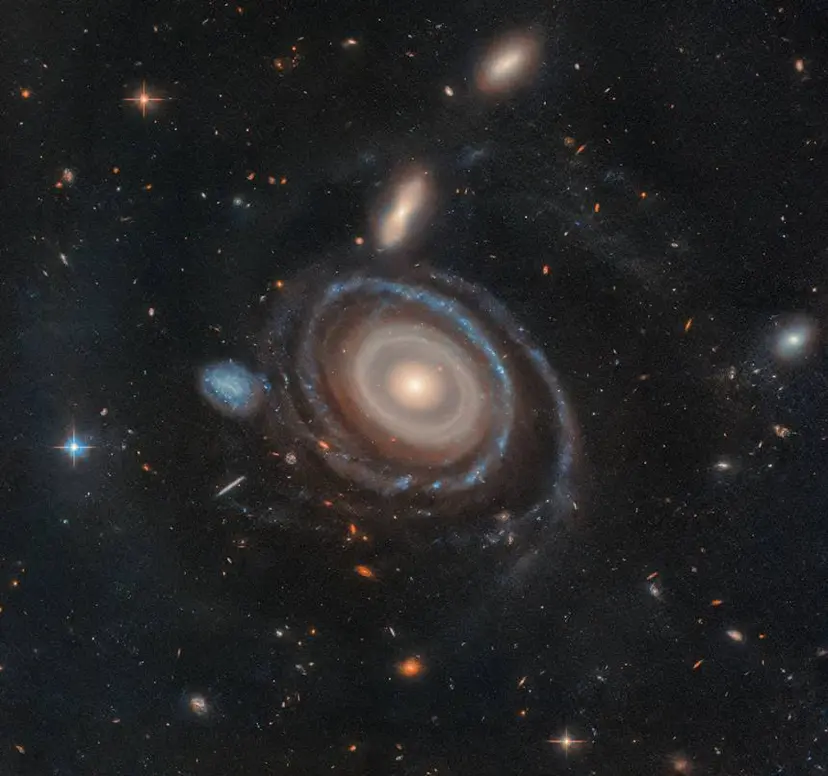
This galaxy had been captured by other telescopes before, but no one thought it had such a distinctive appearance. The data that first identified the galaxy's appearance came from the Sloan Digital Sky Survey (SDSS), which maps the entire sky using a 2.5-meter telescope. In the SDSS photo, the Bullseye galaxy appears very blurry, with only about two rings visible. In fact, it was difficult to expect from this image alone that the galaxy was hiding such a surprising appearance, as having one or two rings on the outskirts is not particularly rare for galaxies.
Generally observed ring galaxies feature a distinct bar structure at their center. The bar is a structure created by the overlapping of stars in the galactic center as their orbits become elongated and resonate. These galactic bars pull gas material from the outskirts toward the center. As a result, gas is compressed at high density at the edges of the bar structure, giving birth to new stars. During this process, the bar rotates along with the galaxy, and the newly born stars are distributed in a circle along the edge of the bar. Such bar structures are known to be the primary mechanism for creating and maintaining ring shapes. However, this can only explain galaxies with about two rings, one inside and one outside.
Astronomers analyzed data from the Legacy Survey, which observed galaxy images at a higher resolution than the SDSS. This survey captures light from the universe using the 4-meter Blanco telescope at the Cerro Tololo Inter-American Observatory in Chile. Thanks to this, they were able to identify up to four rings surrounding the Bullseye galaxy. But that wasn't the end. By pushing the contrast of the observed image to the extreme and analyzing it in detail, they identified as many as seven rings surrounding the galaxy. This is an overwhelming number that has never been seen in any other ring galaxy before. From that moment on, the Bullseye galaxy was no longer just an ordinary galaxy.
To unravel the secrets of this galaxy, astronomers aimed the Hubble Space Telescope at the Bullseye galaxy once more. Because the Hubble Space Telescope is not hindered by the Earth's atmosphere, it can capture much sharper images and even dimmer rings. Surprisingly, the photos taken by Hubble show at least eight rings! How could such a complex and magnificent galaxy exist?
Just as an apple fell on Newton's head when he was young, something fell toward this galaxy a billion years ago. Originally, this galaxy did not contain such complex rings; it was an ordinary galaxy. However, a billion years ago, another small galaxy passed almost directly through its center. Two galaxies collided head-on. This is like throwing an apple into a pond and watching circular ripples spread out in all directions. What makes this discovery even more remarkable is that the explanation of the Bullseye galaxy through the head-on collision of two galaxies is not just a hypothesis based on imagination. Solid evidence has been confirmed based on very mathematical and physical calculations.
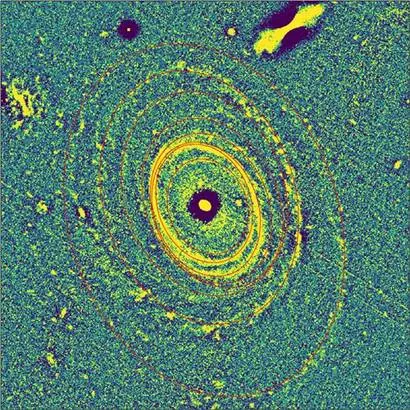
Previously, astronomers calculated a simple mathematical model of how shockwaves would spread in all directions when another small galaxy collided head-on and passed through a large galaxy. Let's revisit the ripples spreading when an apple is thrown into a calm lake. The first shockwave formed at the very beginning spreads out most rapidly in all directions. Subsequently, a second, slightly smaller ripple is generated inside. In the meantime, the first ripple that had already spread expands to a wider radius, causing it to gradually fade. In the meantime, a third, smaller ripple occurs further inside. In this way, smaller rings are continuously created as one moves inward from the first ring that spread to the outermost edge.
Astronomers hypothesized that the radii of the outer ring and the ring immediately inside it should have a very consistent mathematical ratio. Expressed as a formula, this can be represented quite simply: R(i)/R(i+1)=(2i+1)/(2i-1)
Here, 'i' denotes which ring it is. The first ring that spread to the outermost edge first is the first ring, and the ring created immediately inside it is the second ring. For example, let's calculate how many times larger the outermost first ring (i=1) is compared to the second ring. Substituting i=1, (2*1+1)/(2*1-1)=3/1, which results in it being three times larger. Similarly, let's calculate how many times larger the second ring should be compared to the third ring. Substituting i=2, (2*2+1)/(2*2-1)=5/3=1.67, meaning it should be 1.67 times larger. The third ring should be 1.4 times larger than the fourth ring. In this way, by continuously increasing 'i' from 1, one can mathematically predict exactly how many times smaller the succeeding inner rings should be.
Based on this, astronomers analyzed whether the rings in the photo of the Bullseye galaxy taken by Hubble follow this ratio precisely. However, there is a problem. It is not certain whether the outermost ring of the Bullseye galaxy in the Hubble photo is really the very first ring created. There might have been larger rings that spread out to even wider radii even longer ago. Therefore, astronomers assumed various scenarios—such as the outermost ring in the photo being the first, or the second, or the third—and compared the size ratios of the consecutive rings. They then checked which assumption regarding the sequence of the outermost ring best matched the mathematically predicted ratio with the observed ratio. The results were astounding.
If the outermost ring of the Bullseye galaxy in the Hubble photo is assumed to be the third ring, the size ratios of the smaller observed rings perfectly followed the mathematical predictions. In other words, it means that even larger rings exist further out, even if they were not captured in the photo! The eight rings captured in the Hubble photo were not all of them! There must be a ninth and a tenth ring further out.
Since the outermost ring in the Bullseye galaxy photo taken by this Hubble observation is the third ring, the second ring that should be just outside it must have spread to a radius 1.67 times wider than this third ring. Astronomers conducted additional observations to see if wider rings were hidden in the outskirts. They viewed the Bullseye galaxy with observations from the Keck Telescope in Hawaii and the Dragonfly Telescope. For reference, the Dragonfly Telescope, living up to its name, looks at the universe like a dragonfly’s eye by gathering 48 telescope lenses. It can clearly see even the traces of very faint and dimly spread gas clouds.
Surprisingly, through the Dragonfly observation, astronomers confirmed the traces of the second ring spread wider in exactly the location they had expected! Not only were there the eight rings captured in the Hubble photo, but there was actually a ninth ring expected to be further out. This ring became very faint as it spread out in a circle far outside the galaxy a long time ago. Thus, it is at a level where it is difficult to distinguish from background galaxies much further away. However, thanks to the Dragonfly survey, which observes galaxies with 48 lenses at once, it was possible to confirm the traces of the faint gas tail while leaving the dense background stars behind.
This means that a tenth ring, even further out, may also exist. It refers to the first ring that spread out in all directions and faded away at the very moment the intergalactic head-on collision that birthed this Bullseye galaxy occurred.
Astronomers also found out who might be the culprit that flew straight through the center of this Bullseye galaxy long ago; they estimate that the blurry, bluish-shining galaxy in the middle left of the Hubble photo is the culprit. As a result of analyzing the galaxy's spectrum, this blue galaxy is at a similar distance to the Bullseye galaxy and is moving away at a high speed. Given the current distance and velocity between the two galaxies, it appears that this blue galaxy passed through the Bullseye galaxy about 1 billion years ago, causing the unique concentric ripples we see now.
After suffering such a violent head-on collision, the Bullseye galaxy is spreading out and becoming disturbed. It has already spread to 250,000 light-years in width, twice as wide as our Milky Way, and its surface brightness is significantly dimming. In fact, there are galaxies in the universe that appear so faint because stars are spread over such a wide area that it is difficult to distinguish whether they are galaxies or the background universe. These galaxies are called Low Surface Brightness galaxies.
Astronomers estimate that the aftermath of the intergalactic head-on collision, which was mathematically proven very accurately in this Bullseye galaxy, is the key to creating such faint galaxies. The lesson Newton taught us long ago—that all physical laws apply equally in the universe—has once again become the key to unlocking one of the most mysterious secrets of the universe and galaxies.
There is another famous legend that comes to mind when we think of apples. It is the story of the marksman William Tell. According to the legend, he hit an apple placed on his son's head with an arrow with perfect precision. Newton can be called the greatest marksman, having shown amazing accuracy for over 400 years. The small arrow called the "apple," shot by Newton 400 years ago, escaped Earth's gravity and reached the Moon, and now it has struck the center of a giant galaxy 57 million light-years away. Looking at the ripples of the Bullseye galaxy, created as the ripples left by the apple passing through the galaxy spread out in circles, we reminisce about Newton's apple, which continues to fly toward the more distant universe unchanged.
Reference
https://www.stsci.edu/contents/news-releases/2025/news-2025-006
https://iopscience.iop.org/article/10.3847/2041-8213/ad9f5c
Who is the writer, Ung-Bae Ji? He loves cats and the universe. After watching 'Galaxy Express 999' as a child, he dreamed of spreading the beauty of the universe. Currently, at the Center for Galaxy Evolution Research and the Near-Field Cosmology Laboratory at Yonsei University, he studies the evolution of galaxies through their interactions and is engaged in various science communication activities, including lectures and writing. He has written books such as 'The Observatory of Having a Thing,' 'Thinking About the Universe All Day,' and 'Stars, the Science of Light.'