

[비즈한국] We live in an age of overflowing goods. There are so many things with similar prices, quality, and designs. Consumers no longer feel the need to stick to just one. Yet, amidst all this, there are brands that strangely draw us in. When you hear the name of such a brand, certain things like colors, textures, or a specific atmosphere come to mind. It’s a certain sensation that is hard to explain but clearly exists. 'Core Experience Theory' is a book about that very sensation—the core experience a brand leaves with a consumer, that one single fragment of memory.
The author, Jeon Woo-sung, is someone who has worked in branding for a long time. Many brands create advertisements, decorate stores, and host events to win consumer choice. However, he argues that there is something more fundamental than all that: the experience that a brand 'must' provide to the consumer. The clearer that experience is, the more distinct an impression the brand leaves, ultimately securing a place in our memory. Based on this simple premise, the book unfolds the most honest way to differentiate a brand.
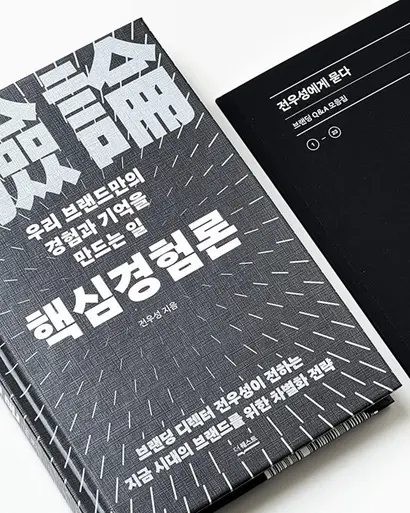
What makes this book special is its lack of greed. It doesn't list countless branding methodologies or techniques. Instead, it focuses on a single keyword: Core Experience. Around that word, it repeatedly asks, reflects, extracts, and finally organizes it into a single, sensible sentence. The explanations are clear and the examples are concrete. It shows real-world moments before delving into complex theories, making readers naturally reflect on their own brands.
The book consists of four parts. The first part re-examines the necessity of branding. It carefully highlights how easily brands lose their way when marketing is focused solely on efficiency, and how the criteria for consumer choice have changed. The second part centers on the concept of 'core experience' and explains how it becomes the root of a brand. By dividing it into functional and emotional experiences, it shows how actual brands have defined and built upon these concepts.
The third part demonstrates how core experience can be practically applied through fictional brands. Various categories appear, such as living goods, kitchenware, perfume, and beer. Each brand shows how they discover their own core experience and translate it into identity and strategy. It feels like reading a series of short stories. Concepts that felt unfamiliar in one scene become familiar in the next, making you want to apply them yourself. The final part is a quiet piece of advice for those working in branding. It talks about the attitude and mindset of the people who build and maintain a brand.
This book is not just a strategy guide for branding. It is a book that encourages us to look at brands from the level of memory. There is always something ineffable flowing between the consumer and the brand. Branding is the work of designing and creating that 'something.' It is not merely about polishing sentences; it is about melting the essence of a brand into an experience. This book points toward the direction of that experience.
And that direction is always simple and quiet. It reduces the complex and holds onto the essence. The single impression and the single memory that a brand must leave for the consumer—that is the brand's core experience. After reading it, you might find yourself thinking of one. A brand that has stayed in your memory for a long time. That scene of the brand that makes your heart move slightly when you hear its name. This book shows exactly how to create those kinds of moments.
It is not a loud or rushed book, but one that is deep and long-lasting. If you are building a brand or simply love brands, it is worth reading slowly. On any page, you will quietly find something worth taking away.