

[비즈한국] As online content creation using generative artificial intelligence (AI), such as ChatGPT, emerges as a popular side hustle, the problem of "mass-produced blogs" is intensifying. While search engines like Naver035420 and Google manage their platforms independently, they are currently unable to sufficiently filter out inaccurate information or "abusive" behavior. AI-automated writing programs, which promise "guaranteed monthly earnings of 300,000 won," are also being sold for hundreds of thousands of won. As the use of AI becomes increasingly common, experts argue that a response strategy for the proliferation of low-quality content is necessary.
"Non-existent" hotels recommended: Lying blogs run rampant
While searching for ocean-view accommodations in Busan on Naver for an upcoming trip, a person surnamed Bae (31) repeatedly found strange posts. Upon clicking on a post promising recommendations for private hotels, they found only vague descriptions like "an accommodation boasting a great room condition at a kind price" and "it features not only neat rooms but also convenient transportation and nearby restaurants," while omitting the actual name and location of the lodging.
Other blogs appearing at the top of search results were no different. "Even the photos of the hotel interiors and ocean views were just unnatural AI-generated images," Bae said. "They were all different blogs, but there was no difference in the content. It was absurd to see recommendation posts filled only with obvious advice like 'compare locations carefully when using public transportation.'"

If you search for keywords related to Busan travel on Naver, you can easily find blog reviews based on false information. One blog account explicitly named recommended accommodations in posts such as "Jeonpo-dong Vintage Guesthouse," "Songjeong Surfing Guesthouse," and "Nampo-dong Retro Hotel." Although the posts mentioned, as if the author had actually visited, that "the owners whispered that if I mentioned a referral when booking, they would provide extra services," these are all fake accommodations that do not exist in reality.
At present, portal sanctions are not determined solely by the use of AI. A Naver representative stated, "We impose sanctions when content falls under categories of abuse such as advertisements, spam, flooding, or macros. There are technical difficulties in identifying whether a post was written using AI at the platform level," and added, "We are adjusting our algorithms to prioritize user-experienced or well-sourced content, and are also advancing our AI to improve our detection capabilities."
Software that enables "Blogging side hustles with just a click" is trading actively
Related products promoting "blogging side hustles" are also being traded actively. Automated writing programs utilizing ChatGPT are sold for between 100,000 and 600,000 won for products that can be used for six months or more. These programs automatically search for the latest posts matching a topic, generate images and text, and even handle the posting process once the essential keywords are entered. While mainly traded on small and medium-sized online commerce platforms, they are also listed on Naver Smart Store.
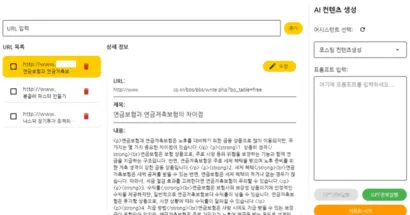
While automated advertising programs have previously been used in communities like Naver Cafes, AI-integrated programs are different. With simple command inputs, they can automatically handle the entire posting process, from writing and applying blog layouts and color themes to generating free images, AI-based thumbnails, and tags, making mass production of posts possible. These products, which claim that the entire process from editing to uploading "takes less than 1 minute," promote themselves with slogans like "Guaranteed automated monthly income of $300 or more" and "Possesses Naver Cafe/Band automation programs." There are even dedicated programs based on Naver Map data or newspaper articles.
While the basic framework—creating posts by combining key terms to attract visitors, attaching ads, or leading them to phishing sites—remains the same as in the past, the difference is that these programs can create posts that are indistinguishable from human-written ones if not looked at carefully. It is also easy to be deceived due to the "hallucination phenomenon" unique to AI, where it convincingly presents information that is not factual or does not exist.
One program (Program A), sold for around 390,000 won, also supports search engine optimization (SEO) and AdSense approval—a process for generating advertising revenue—to ensure effective exposure on Naver and Google. For Program B, customer service staff provide direct guidance to buyers on how to set up and use the software.

Internet "pollution" is inevitable... How to prevent misuse?
Some products even mock portal sanctions, using them as a differentiation strategy for their software. The seller of Program A stated, "You can bypass the 'I'm not a robot' check with auto-CAPTCHA. Quick exposure is possible through Naver and Google's automatic indexing." "reCAPTCHA," which triggers the "I'm not a robot" checkbox, is a technology used by Google to catch fake users or malicious software. It is one of the methods used to censor posts generated by automated programs like macros.
However, among actual users, there is a sentiment that these tricks will eventually be caught. One blog operator who previously used an automated posting program to manage a Tistory blog ended up having their account permanently restricted by Kakao035720. "AI is very skilled at lying," they said. "Many bloggers focus on quantity over quality because they can make a profit as long as they get visitors, but for advertisers and portals, fake posts are a nuisance. It might be a short-term revenue source, but it won't last long."
There are calls for appropriate sanctions to prevent the misuse of AI. In the United States, where the adoption of AI was earlier, there is growing criticism that Google search quality is declining significantly as the number of AI-utilized blogs increases.
Jeon Chang-bae, Chairman of the International AI Ethics Association (IAAE), noted, "At a time when the prioritization is on AI activation, search engines—which are also the entities providing AI services—are in a position where they 'know about it but are not actively blocking it.'" He points out that if this continues, it will eventually lead to a gradual decline in content quality. "Recent research results show that the quality of information is declining as AI-processed information is repeatedly re-processed," Jeon said. "Improvements in user awareness and technical filtering must go hand-in-hand."