

[비즈한국] The Homeplus crisis has triggered a wave of social criticism directed at the private equity firm MBK Partners. Responsibility is also increasingly being placed on Chairman Kim Byung-Ju, who leads the firm. While Chairman Kim has attempted to appease public opinion by offering to contribute his personal wealth, the "eat-and-run" controversy surrounding MBK is unlikely to subside easily.
Character
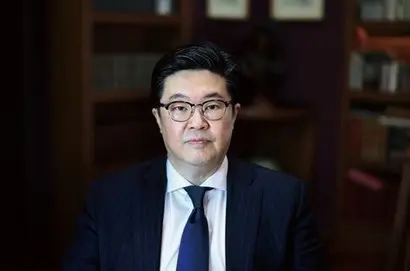
Chairman Kim Byung-Ju was born on October 8, 1963, in Gimhae, South Gyeongsang Province. He moved to the United States at the age of 10 to begin his studies. He majored in English Literature at Haverford College, worked at Goldman Sachs for two years starting in 1986, and then attended Harvard Business School to earn his MBA. As a U.S. citizen, his English name is Michael ByungJu Kim.
During his MBA studies, he married Park Kyung-ah, the fourth daughter of the late Park Tae-joon, the founding chairman of POSCO005490. Ms. Park had previously married Chun Jae-yong, the second son of former President Chun Doo-hwan, in 1987, but they divorced in 1990. Chairman Kim has two sons. His eldest son, who majored in art, briefly worked at Goldman Sachs but is currently known to be pursuing a career as an artist. His second son studied at the University of Chicago. During his childhood, he attracted attention for playing in a Korean Little League baseball team.
Having majored in English literature, Chairman Kim has a deep interest in literature, even dreaming of becoming a playwright. In 2020, he published an autobiographical novel titled "Offerings." The novel tells the story of "Dae-jun," a Korean-American protagonist who, putting aside his father's wish for him to become a scholar, begins working at an investment bank on Wall Street in New York. It is known that Chairman Kim spent over 20 years writing this novel.
He is rarely involved in external activities, to the point of being called a "recluse executive." Because he is selective about who he meets, he was once criticized for "acting like a chaebol." He has been a great fan of baseball since childhood.
Career
He began his career at the U.S. investment bank Goldman Sachs. After working at their New York headquarters and Hong Kong branch, he moved to the global investment firm Salomon Smith Barney. In 1999, he joined the world-renowned private equity firm Carlyle Group and served as the representative of its Korea office. He gained significant market attention by leading the acquisition of KorAm Bank in 2000. In 2005, he founded the private equity firm MBK Partners. The name MBK is derived from the Chairman's English name (Michael ByungJu Kim). He established the MBK Scholarship Foundation in 2007 and has served as its chairman since.

Capability
In the M&A market, Chairman Kim’s nickname is the "Midas Touch." Over the 20 years since establishing MBK Partners, he has successfully closed major domestic M&A deals including KorAm Capital, Coway, Doosan Machine Tools, Nepa, and Lotte Card. As a result, MBK Partners has grown into the largest private equity firm in East Asia, and Chairman Kim topped Forbes' 2023 list of the 50 richest people in Korea. At the time, his net worth was estimated at approximately $9.7 billion (about 12.8 trillion won).
He also consistently engages in scholarship and charitable work. In 2007, he used his own funds to establish the MBK Scholarship Foundation and has provided scholarships to students from financially struggling families every year. In 2010, he donated $20 million (about 22.8 billion won) to Harvard University, the largest donation by an Asian person in the university's history. In 2021, he contributed 30 billion won for the construction of the Seoul Municipal Kim Byung-Ju Library in Seodaemun-gu, Seoul. In 2022, he donated $10 million (about 14.5 billion won) to the Metropolitan Museum of Art in New York, and in 2024, he donated $25 million (about 36.2 billion won) to his alma mater, Haverford College in the U.S.
Critical
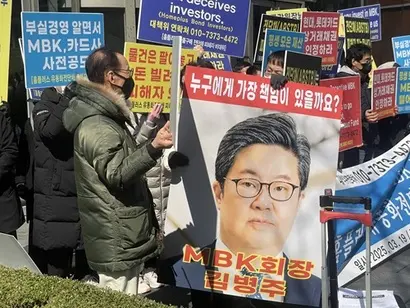
There is fierce criticism surrounding MBK Partners' management style, with many labeling them as "corporate raiders." Private equity firms acquire undervalued companies, boost their value, and sell them for profit. In this process, MBK Partners has been accused of focusing solely on short-term gains while neglecting the strengthening of a company's competitiveness, leading to criticisms that they "ruin companies" and engage in "eat-and-run management."
Public opinion regarding MBK Partners and Chairman Kim has worsened rapidly, particularly due to the recent Homeplus situation. In 2015, MBK Partners acquired Homeplus for approximately 7.2 trillion won, the highest price in the history of domestic M&A. The process involved excessive borrowing, and the subsequent sale of assets to repay debts diminished the company's competitiveness. Eventually, Homeplus was forced to enter corporate rehabilitation procedures. 100,000 employees (including direct hires and contractors) and over 8,000 tenant businesses are now facing a survival crisis, and the potential for losses for investors is growing. Political circles have even criticized MBK Partners as a "vicious private equity firm."
The controversy deepened because MBK Partners maintained a high-dividend policy even while their acquired companies were experiencing management difficulties. For instance, despite the worsening performance of Nepa, which was acquired in 2013, MBK Partners continued to implement a high-dividend policy and received a total of 83.3 billion won in dividends by 2021.

Challenges
Voices demanding a sincere apology from Chairman Kim for the management failures are growing louder. However, Chairman Kim has not appeared in public even as criticism against MBK Partners has escalated. Only MBK Partners Vice Chairman Kim Kwang-il and Homeplus CEO Jo Joo-yeon attended the press conference held at the Homeplus headquarters in Gangseo-gu, Seoul, on the 14th. When Chairman Kim was selected as a witness for a pending issues hearing held by the National Assembly's National Policy Committee on the 18th, he did not attend, citing an overseas business trip.
Recently, appearing to be conscious of public opinion, Chairman Kim promised to contribute his personal wealth to pay off debts owed to small business owners. As it is highly unusual for a private equity firm head to decide to use personal funds for an invested company, the industry assesses that Chairman Kim likely felt a sense of crisis due to the rapidly deteriorating social atmosphere. However, he has not yet disclosed the specific scale of the contribution. Political circles are pressuring Chairman Kim to contribute at least 1.5 trillion to 2 trillion won. Whether Chairman Kim can resolve the Homeplus crisis through this contribution and deflect the arrows of criticism aimed at MBK Partners remains to be seen.