

[비즈한국] Shared electric scooters, once hailed as eco-friendly transportation, are now on the verge of being forced out. As citizen complaints regarding illegal parking and safety risks have flooded in, local governments are moving to tighten regulations and expand "no-ride" zones for shared e-scooters. Industry insiders express frustration, arguing that the lack of realistic regulations and policies is causing them to lose both safety and future business opportunities.
Banning and cracking down... From innovation to a public nuisance
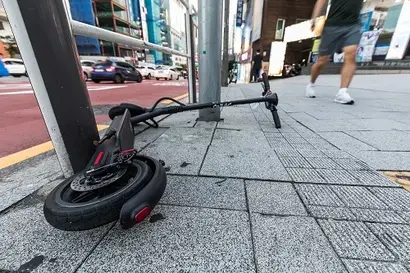
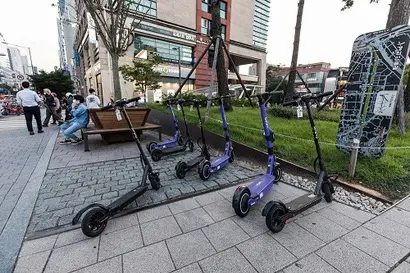
First introduced in Korea in 2018 as a form of innovative mobility, shared e-scooters have now become a nuisance on the streets. As users abandon devices on sidewalks after their rides, illegal parking problems have escalated, and accidents are on the rise due to failure to follow safety regulations. Local governments are facing a barrage of complaints from citizens demanding the removal of shared e-scooters.
In response, local governments have been expanding regulations. The Seoul Metropolitan Government has begun designating certain areas as "scooter-free zones" and initiating crackdowns. In December of last year, Seoul designated the "Academy Street" in Seocho-gu and the Hongdae Red Road as "e-scooter prohibited zones," and starting in April, a fine of 20,000 won is imposed for riding an e-scooter in these sections.
A Seoul city official explained, "We selected densely populated areas and high-accident areas as pilot operation zones. We are currently designing safety signs and will begin enforcement once they are installed. We may designate additional areas with high numbers of complaints as prohibited zones based on future analysis by each district."
Towing measures for illegally parked e-scooters are also being strengthened. Local governments including Suwon in Gyeonggi-do, Yeonsu-gu in Incheon, Seo-gu in Gwangju, Gijang-gun in Busan, Jeonju in Jeonbuk, and Asan in Chungnam are towing illegally parked shared scooters when reported and charging the companies towing fees.
Incheon's Yeonsu-gu stated that they received over 1,000 citizen reports within just 20 days of implementing the crackdown. Suwon, Gyeonggi-do, also recorded approximately 940 reports (for both shared scooters and shared bicycles) from the 4th to the 20th. A Suwon city official noted, "There were many complaints from citizens about significant obstruction to pedestrian traffic. Our policy is to tow if the company does not take action at the site within 3 hours of a report. There have been a total of 6 cases that led to towing after a report. However, companies generally tend to clear them within the grace period."
Companies operating shared e-scooter businesses are sighing in despair. Some firms are giving up operations due to the burden of towing costs. In Incheon, one company decided to pull out of the market after the city began its towing crackdown. Company B also ceased operations in Suwon this year after running its service until last year. TMAP Mobility, which had launched shared e-scooter services in partnership with companies like Swing and G-Scooter since late 2021, will also terminate its service as of the 26th.
An industry representative pointed out, "The grievances caused by the illegal parking issue are immense. Domestic users have zero sense of responsibility regarding returning the devices. Because it is not their own property, they don't think about parking shared scooters properly. Privately owned e-scooters don't have this problem because the owners themselves are fined. The systemic problem is the major issue."
Another industry insider remarked, "The burden of towing fees is significant. Because of this, it is difficult to expand the PM (Personal Mobility) business in the domestic market any further. In the case of electric bicycles, they aren't towed even if parked illegally. The regulations are targeted solely at e-scooters. We consider this unfair regulation."
Experts: "Re-examine realistic regulations," "Cooperation from companies is also necessary"
The industry is voicing dissatisfaction with the local governments' moves to restrict shared e-scooter operations. They point out that the process of considering efficient and safe operational methods has been omitted. Kim Pil-soo, a professor of Automotive Engineering at Daelim University who serves as the head of the Korea PM Industry Association, said, "Several global PM companies have already withdrawn from Korea. Our country is becoming a wasteland for PM. It is frustrating to see local governments banning the use of shared e-scooters. About 2,800 people die in car accidents every year, but that doesn't mean we ban driving cars, does it? Blindly banning operation due to accidents and inconveniences caused by the lack of proper regulations is a foolish policy."
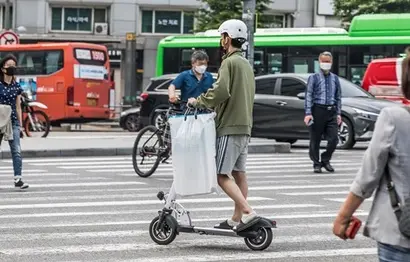
E-scooters are classified as motorized bicycles and are treated as automobiles under the Road Traffic Act. They can only be used by those with a driver's license and are prohibited from riding on sidewalks. Experts emphasize that various problems arise because of efforts to squeeze e-scooters into the existing system, and that a separate system and related laws for PM must be established.
Professor Kim remarked, "They tell you to ride e-scooters on the road, but anyone who has ridden one knows that is realistically difficult. Currently, all PM-related systems and laws are like this. They are not realistic. Various types of personal transportation will continue to emerge, and are we going to insist on managing every single device by forcing them into the 'motorized bicycle' category as we do now? Since PM is a new form of transportation, it needs new systems and related laws that suit it. There is a need to create new chapters related to PM in the Road Traffic Act or the Motor Vehicle Management Act."
Cooperation from PM companies is also necessary to prevent accidents. Currently, the maximum speed of shared e-scooters is 25 km/h. Experts recommend lowering the speed of shared e-scooters to 17–18 km/h for accident prevention.
Strengthening education for middle and high school students is also urgent. Professor Kim said, "We need to introduce a method where we go directly to schools to provide safety education to students, have them take a test, and issue certificates on the spot. We must continue training through repeated education to ensure students can use them safely."
The Seoul Metropolitan Government began e-scooter education for middle and high schools last year. Since it is currently only available to schools that apply, the number of sessions is not high. Last year, the number of e-scooter training sessions conducted by Seoul was 43 (for 16,950 students). A Seoul official explained, "We were doing some PM-related education before, but we started in earnest last year. We are trying to expand the number of trainees and schools."
Professor Kim argued, "For PM, a new mode of transportation, to succeed, we must catch two rabbits: safety and future business. However, our country has lost both. Because e-scooters require standing, they are structurally one of the most unstable devices. Therefore, institutional mechanisms are needed to operate this unstable means of transport safely. We need to stop these piecemeal regulations and re-examine proper regulations that fit the PM industry."