

[비즈한국] A passage in Ovid's 'Metamorphoses' goes as follows.
While all other animals bow their heads and look at the earth, God gave only to man a face lifted upward, commanding him to raise his face toward the stars and look at the sky.
I fully resonate with this expression. It is often said that the benefits humanity gained from walking upright were the freedom of two hands and the ability to use tools. However, a more important development is that thanks to our straightened spines, we could look up at the night sky much more comfortably than other animals. This allowed us to become beings who live while mindful of the night sky.
When does the fruit before our eyes ripen? When will wild beasts attack? We began to find answers to our survival struggles in the night sky. By following the paths shown by the sun, the moon, and the stars, humanity was able to avoid threats and wait for abundance. Astronomy truly began about 200,000 years ago, at the very moment when humanity's spine straightened.
What is even more amazing is that we are still gazing at the same starlight that reflected in the eyes of our distant ancestors who first stood upright and lifted their heads 200,000 years ago.
On May 27, 1933, a massive exposition opened in Chicago, Illinois. It was the first time an event of this scale had been held in Chicago in exactly 40 years since the World's Columbian Exposition of 1893. Although the United States was struggling in the deep quagmire of the Great Depression at the time, the hope for a future promised by science and technology was still alive. People dreamed of a brilliant century of progress, hoping to briefly forget the dark shadows of reality.
The opening ceremony of the 1933 exposition began with an innovative lighting ceremony. Rather than simply flipping a switch to turn on the lights, they realized the ingenious idea of using starlight to illuminate the fair. Edwin Frost, the director of the Yerkes Observatory, looked up at the night sky while pondering how to commemorate the event returning after 40 years. A clever idea crossed his mind. If there is a star exactly 40 light-years away from Earth, the light that departed at the moment the 1893 Columbian Exposition was held would just be reaching Earth now. If we use that starlight to turn on the lights of the fair, wouldn't it be a special moment where the past and present are united as one?
Astronomers searched for a star to play that role. It was Arcturus, the brightest star in the constellation Boötes. At the time, astronomers knew the distance to Arcturus to be 40 light-years. Above all, it was easily visible in the night sky of May when the exposition was held. They thought that if any beings lived near that star, the sight of Earth they would be seeing right now would be the scene of the 1893 Columbian Exposition in full swing.
The 1930s was a period of rapid development in photovoltaic technology. This technology, which converts light into electricity, was already widely used in astronomy to increase the sensitivity of telescopes. To ensure the opening ceremony went perfectly, four observatories collaborated: the Yerkes Observatory where Frost worked, as well as the University of Illinois Observatory, Harvard College Observatory, and Allegheny Observatory. This was a preparation in case the sky was cloudy at any one location.
On the evening of May 27, 1933, the sun set and the opening ceremony began. Rufus C. Dawes, who was in charge of the exposition, declared in a majestic voice before a crowd of over 30,000 people.
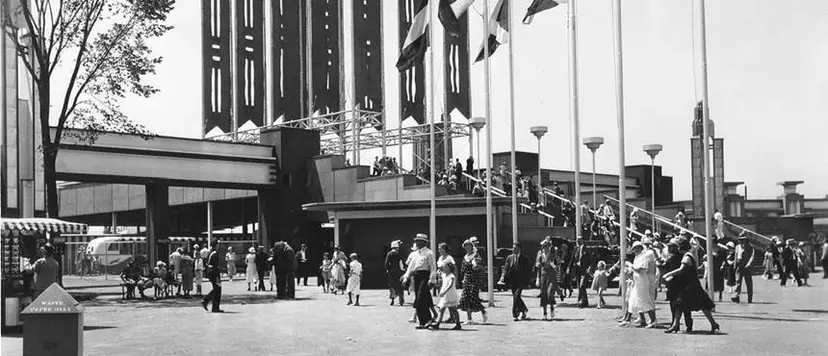
“We recall the moment of the great 1893 Columbian Exposition. To experience its brilliant beauty once again, we are here to welcome the light that set out 40 years ago. This beam of light from Arcturus will illuminate our grounds and become the mysterious power that moves the machines of the exposition.”
His words reminded one of a high priest of an ancient civilization performing a sacred ritual before a crowd, promising the mysterious power of the heavens. On the podium, he reached out toward the crowd, proclaiming that the power of the universe would connect with this moment. Beside the stage stood giant speakers and an electric display board. Below it hung a map of the eastern United States with the locations of the four observatories marked. The stars in the night sky seemed to be watching this ceremony.
Finally, at 9:15 PM, four telescopes aimed at Arcturus simultaneously. As the starlight gathered through the telescopes hit the photovoltaic cells, current was generated. This current flowed through telegraph wires to the lighting of the fairgrounds, and in a fleeting moment, the space that had been submerged in darkness was filled with dazzling light. The crowd cheered. From that day on, the lighting ceremony was held in the same way every night of the fair, and people were captivated by the magical moment created by starlight.
The 1893 Columbian Exposition might have been an unwelcome moment for astronomers. This is because, starting from that day, humanity emerged from the darkness of the night sky and entered a new world brightly lit by artificial light. The lights of tens of thousands of bulbs that filled the fairgrounds stretched into the night sky, and the faint starlight gradually disappeared. In a sense, humanity had plucked the stars from the night sky to set up streetlights.
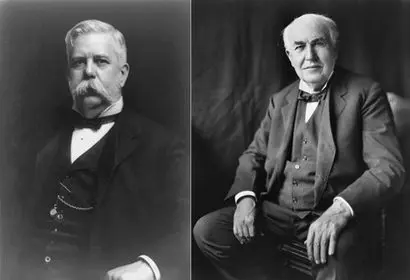
In ancient legend, Prometheus handed the fire of the gods to humans. In return, Zeus gave him a terrible punishment, chaining him to a giant rock and having an eagle gnaw on his liver every day. In 1893, the Chicago fairgrounds became heated once again with the competition of humans who had brought down celestial fire. Two rivals, George Westinghouse and Thomas Edison, were at the center of it. The two men, who had fought to install their own utility poles across the United States, were just as fierce at the site of the Columbian Exposition.
At the time, direct current (DC) electricity was widely used in the U.S., and Edison held a monopoly on it. However, Westinghouse saw the potential of alternating current (AC) proposed by Nikola Tesla and presented a more efficient and affordable power system. Westinghouse eventually won the contract for the electricity supply of the Columbian Exposition. The fight reached extreme levels, with Westinghouse and Edison even going so far as to build a brutal electric chair to experiment on and discredit their opponent. In later years, this conflict between the two would be called the 'War of Currents'.
The inventors put on high-power showmanship to demonstrate their technology. Tesla wrapped coils around his body and sent 20,000 volts of electricity through it. It was a spectacular sight, as if lightning from the sky were engulfing his body. He was unharmed. Tesla wanted to prove firsthand that alternating current was not dangerous.
Meanwhile, Edison built a massive monument to science and technology. He connected thousands of incandescent bulbs atop a 25-meter-high tower. The weight alone reached 0.5 tons. And he wrapped the bulbs in 5,000 prisms. The light emitted from the bulbs spread into brilliant rainbow colors, adorning the fairgrounds. Through this flashy performance, Edison tried to show off that direct current, which his company General Electric was pushing, was still going strong.
However, the splendid exposition ended with an unexpected event. As the then-mayor of Chicago and promising politician Carter Harrison III was assassinated, the end of the festival was replaced by a sudden memorial service. At the end of the 19th century, three ambitious Prometheuses appeared to humanity: Westinghouse, Tesla, and Edison. They competed to light up the world with their own fire. Thanks to their inventions, humanity no longer feared the night, no longer lost their way in the dark, and no longer needed to turn off candles to go to sleep.
But at the same time, humanity stopped loving the night. The sensibility of looking at the pitch-black sky and feeling wonder even at the faint light of stars was overwhelmed by the artificial light before our eyes. The starlight buried in the light of the lamps no longer entered human eyes. The moment of the Columbian Exposition, which declared global power distribution, was also an astronomical turning point for an era. Now, humanity can no longer see the pure night sky without the help of a telescope.
It feels somewhat ironic that to recall the memory of the Columbian Exposition, which actually erased the Milky Way from the night sky, we gathered starlight 40 years later to light up the fair. Perhaps it was the final regret of a humanity that had covered the night sky with artificial light, confessing a longing for the lost starlight.
Who is the author Ji Woong-bae? He loves cats and the universe. After watching 'Galaxy Express 999' as a child, he dreamed of spreading the beauty of the universe. He currently researches the evolution of galaxies through interactions at the Yonsei University Galaxy Evolution Research Center and the Near-Field Cosmology Laboratory, and engages in various science communication activities including lectures and writing. He has written books such as 'The Someday Observatory', 'Thinking About the Universe All Day', and 'Stars, the Science of Light'.