

[비즈한국] The exodus of foreign investors from the domestic stock market continues. The foreign ownership ratio in terms of market capitalization has failed to recover to the 30% level since August 2024, and the total value of foreign holdings has shrunk from 738 trillion won at the end of 2023 to 666 trillion won as of January 2025. Feeling a sense of crisis, the government has pushed for a ‘Value-Up Program’ to resolve the Korea Discount, introducing the ‘Korea Value-Up Index’ comprised of 105 undervalued blue-chip stocks. Each week, we select one stock from the index to analyze its management status and strategies for enhancing corporate value, exploring whether it is a stock that can help prevent the ‘fall of the KOSPI.’

Defense industry stocks are currently considered some of the hottest themes in the stock market. This is because they are stocks that gain attention as global conditions become more unstable. One can gauge the popularity of defense stocks just by looking at the upward trend of Hanwha Aerospace, which ranked 6th among the components of the Korea Value-Up Index as of the 19th.
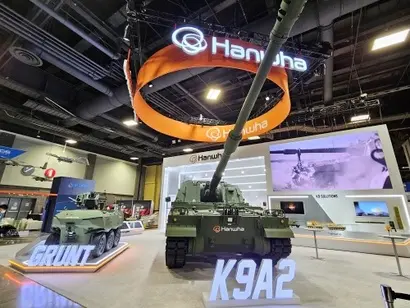
Hanwha Aerospace is a leading company in the aerospace, defense, marine, and space sectors. It produces and sells aircraft gas turbine engines, self-propelled howitzers, armored vehicles, marine products, and space launch vehicles. As Hanwha Group sought to strengthen its defense and petrochemical industries, it acquired Samsung Techwin from Samsung Group in 2014 and changed its name to Hanwha Aerospace in 2018. Between 2022 and 2023, Hanwha Aerospace absorbed and merged with Hanwha Defense and Hanwha Systems (defense division), integrating its defense affiliates.
Hanwha Aerospace's stock price has risen sharply this year. The stock, which was at 305,000 won on December 20, 2024, soared to 764,000 won by March 18. This means the stock price more than doubled in just three months. Over the same period, its market capitalization grew from 13.9023 trillion won to 34.824 trillion won. Consequently, as of the 18th, Hanwha Aerospace's one-year return reached a staggering 318.1%. Its six-month return is 159.7%, three-month return is 146.5%, and one-month return is 30.5%.
The rise of domestic defense stocks is underpinned by geopolitical crises and the strong performance of domestic defense companies. Last year saw strong export results for the domestic defense industry, and the outlook remains bright for this year due to unstable international conditions following the inauguration of U.S. President Trump. Moves by countries around the world to increase defense spending are also an opportunity for the defense industry.
Hanwha Aerospace also received a strong report card last year. In 2024, revenue was 11.2462 trillion won and operating profit was 1.7247 trillion won, an increase of 43% and 190%, respectively, compared to the previous year (7.8897 trillion won and 594.3 billion won). By sector, ground defense is driving the company's performance. In 2024, revenue from the ground defense sector reached 7.0056 trillion won. It was followed by Hanwha Systems272210 (2.8037 trillion won) and aerospace (2.045 trillion won). Ground defense also achieved overwhelming results in operating profit at 1.5659 trillion won, while the contributions from Hanwha Systems (219.3 billion won) and aerospace (-43.3 billion won) were minimal.
While investor returns are high due to the significant stock price appreciation, the lack of specific shareholder return policies is a regrettable point. Hanwha does not appear to be actively participating in the Value-Up program at the group level. Among Hanwha's listed affiliates, none have disclosed a Value-Up plan so far. As Celltrion068270 announced its plan to enhance corporate value on March 18, Samsung Electronics005930 and Hanwha Aerospace are the only ones left among the top 10 Korea Value-Up Index stocks that have not made a Value-Up disclosure.
The only place to catch a glimpse of its corporate value enhancement plans is in its sustainability report. In its 2024 sustainability report, Hanwha Aerospace explained its shareholder return policy, stating, “We are implementing an appropriate level of share buybacks or dividends. We have paid cash dividends over the past three years,” adding, “We will continue to provide shareholder returns by considering the company’s management situation and the dividend yields of peer companies in the KOSPI.” It did not specify any concrete targets or measures.
Hanwha Aerospace has not retired any treasury shares in the last four years (2021–2024) since retiring 480,000 shares in 2019 and 930,000 common shares in 2020.
However, the company is generating stock-boosting effects through dividend expansion, spin-offs, equity acquisitions, and investments. On February 24, Hanwha Aerospace announced a year-end dividend of 3,500 won per common share. The previous year’s dividend was 1,800 won per share, marking a 94.4% increase in just one year. Over the same period, the total dividend amount increased from 91 billion won to 159.1 billion won.
Last February, the stock hit an intraday high when it announced it would increase its stake in Hanwha Ocean042660 from 34.7% to 42.0% with the goal of creating business synergy. On April 5, 2024, it announced a plan to spin off its security business and industrial equipment business to form a new company, leading to the establishment of Hanwha Industrial Solutions on September 1. The stock price, which was in the 200,000 won range before the spin-off, soared well past the 300,000 won mark afterward.
In the brokerage industry, expectations for defense stocks remain high, with many firms raising their target stock prices in unison. Lee Seung-woong, an analyst at Yuanta Securities, predicted, “Given the high profitability of overseas exports, we will likely see similar margin rates in 2025 as in 2024,” adding, “Considering the continued performance of ground defense and synergies with Hanwha Ocean and Hanwha Systems in the marine business, there is sufficient room for the stock price to rise further.”