

[비즈한국] An investigation by Bizhankook has revealed that over the past 10 years, radioactive iodine has been detected in the Han River at levels averaging five times the normal amount on 13 separate occasions, yet the Ministry of Environment has never once initiated a formal investigation into the cause.
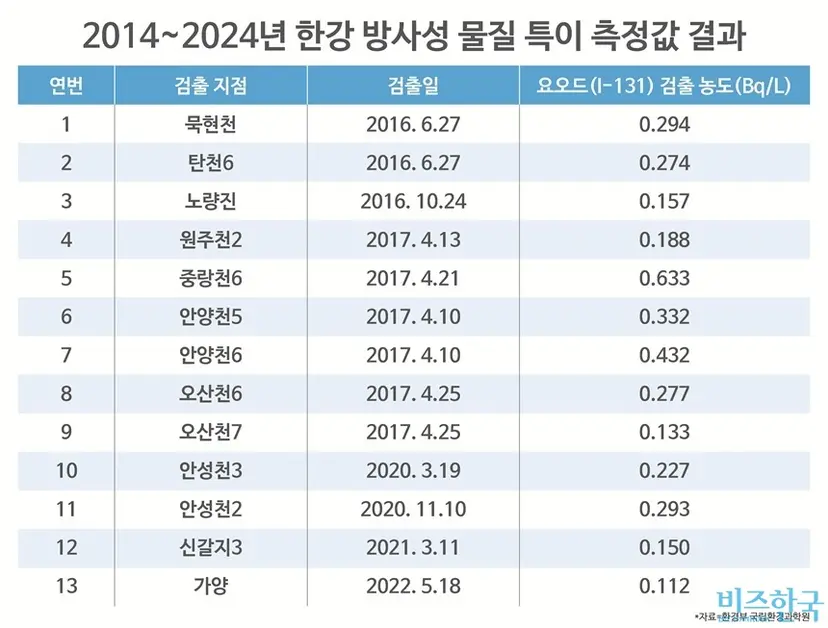
According to data on "reports of anomalous measurements in the public water body radioactive substance monitoring network" obtained by Bizhankook through a public information disclosure request, the Han River Water Environment Research Institute has reported 13 "anomalous measurements" of radioactive substances during regular monitoring of major streams and lakes in the Han River basin over the past decade.
An "anomalous measurement" of radioactive material refers to instances where the concentration exceeds five times the three-year average at a given location. When an anomalous value is detected, the research institution must complete an "anomalous measurement report" and submit the analysis to the Ministry of Environment and the National Institute of Environmental Research. All such anomalous instances involved radioactive iodine (I-131), with levels ranging from a minimum of 0.112 Bq (becquerel) to a maximum of 0.633 Bq per liter.
Bizhankook previously reported that radioactive iodine has been detected in the Han River every year since 2016. At the time, Professor Kim Ik-joong warned that exposure to iodine could cause thyroid cancer. Kim, a former professor at Dongguk University College of Medicine, stated, "The concentration of radioactive material is directly proportional to the risk. The regulatory thresholds are simply set to maintain some level of control; if we are talking about safety, it should be zero" (Related article: [Exclusive] Radioactive iodine detected in Han River for 8 consecutive years, measures are 'in the dark').
The issue lies in the content of these anomalous measurement reports. According to the 13 reports, while each research institution cited "surrounding environmental factors" as the cause, they added only that it was "presumed" without providing a clear explanation. The environmental factors pointed to by the institutions were mostly "discharged water"—meaning they presumed the radioactive iodine was released from sewage treatment plants. However, no investigation was conducted into how the radioactive iodine entered those sewage treatment plants in the first place.
Although the exact cause of the radioactive iodine detection has never been identified, every single report included a checkbox indicating that "no further investigation into the cause is necessary." Notably, in 2017, anomalous values were reported in five locations—two in Anyang Stream, two in Osan Stream, one in Wonju Stream, and one in Jungnang Stream—but no further investigation was conducted. The report for the Anyang Stream incident at the time simply stated it was "presumed to be caused by a nearby hospital." For the Wonju, Osan, and Jungnang streams, the reports merely stated that "the discharged water is presumed to be the cause."
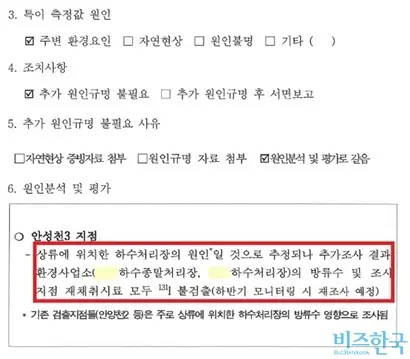
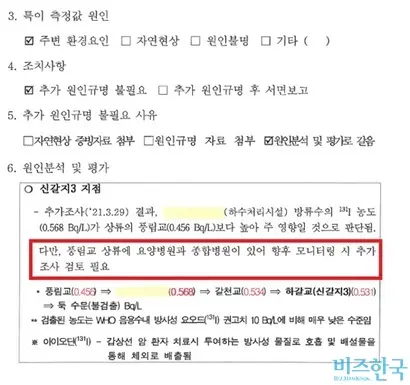
In 2020, iodine detected in the Anyang Stream was also "presumed to be caused by a sewage treatment plant located upstream," but subsequent re-analysis of the discharged water samples showed no iodine. Similarly, iodine detected at Singal Reservoir (part of the Yeongsan River system) in 2021 was noted as requiring further monitoring because of nursing hospitals and general hospitals located upstream, but it has been confirmed that no additional investigations were actually carried out.
Regarding the most recent anomalous measurement at Gayang (Gayang Bridge), it was presumed to be caused by the inflow of discharged water from a nearby water reclamation center.
An official from the National Institute of Environmental Research explained why they can only "presume" the causes of the anomalous measurements: "To find the exact cause, we would have to enter the sewage treatment plant and inspect it directly. However, since the water has already been discharged, we can only presume the source of the iodine detected in the stream."

Another problem is that there are no methods to take action beyond preparing a report once an anomalous value is found. Water quality standards for radioactive substances in streams have yet to be established. The Ministry of Environment claims to follow the World Health Organization (WHO) guidelines (10 Bq/L), but even if values exceeding this standard are measured, there is practically nothing that can be done.
Some suggest that because the half-life of radioactive iodine (the time it takes for a radioactive substance to reduce by half) is as short as 8 days, the cause should be tracked clearly. An official from an environmental group pointed out, "It is strange that radioactive iodine is detected continuously. It seems necessary to track the cause."
Lee Seung-joon, a professor of Applied Life Science at Kyungpook National University, criticized the situation: "Even if the analysis that it was released from a sewage treatment plant is correct, it should have been treated at the plant to begin with. The same applies to medical institutions. The fact that it is continuously detected means it is being discharged somewhere consistently. The biggest problem is ending the report with 'no further investigation necessary' and having no follow-up plan. We need measures to block future discharges. At the very least, we must identify and manage whether the radioactive iodine is coming from groundwater, sewage treatment plants, or medical institutions."