

[비즈한국] "My permanently owned copies have vanished into thin air." At the end of last month, the sudden closure of the small-to-medium webtoon platform Peanutoon caused widespread confusion among its users. Criticism poured in, calling the measure irresponsible, as the news of the business closure was announced unilaterally, and the company stated that it would neither retain users' paid "owned" content nor provide refunds for it.
The "ownership" right is a payment method that has long been established in the industry. It is distinct from short-term rental rights, which come with viewing limitations. However, unlike what the name suggests, it does not mean the content can be "kept" permanently. With the exception of a few platforms, very few explicitly specify compensation criteria for owned copies in their terms of service or policies. For this reason, there are calls to better protect user rights by accurately disclosing the nature of content usage rights.
Unilateral notice of platform closure, zero compensation 'no matter how much you spent'
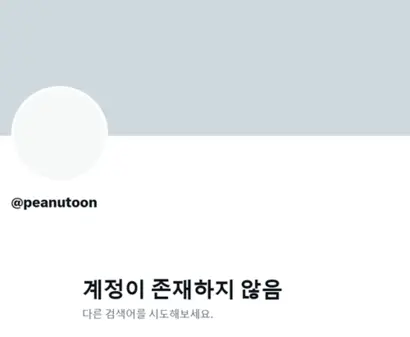
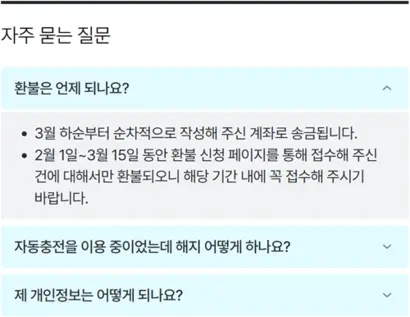
Peanutoon shut down on the 28th of last month, just about six weeks after announcing the business closure through its official website and social media. The charging and usage of in-platform currency (Peanuts), the serialization of works, and the viewing of owned works were all terminated at midnight on that day. Unused currency after recharging could be refunded if a separate application was submitted by March 15th. However, no compensation plan was presented for "owned" content purchases. Peanutoon clearly stated that "the separate storage and downloading of owned works is not possible."
Negative reactions from users are growing regarding the purchase of webtoons, web novels, and e-books. Contrary to previous perceptions, they are realizing that even "owned" copies are merely rights to view content for as long as the service remains operational. This incident has made users realize that no matter how much they purchased, if a platform closes, they lose not only their owned works but any claim to rights whatsoever.
Until the end of last year, right before its business closure, Peanutoon actively sought to acquire paid users through discount events. While the Peanutoon case is considered an exceptional instance occurring at a smaller platform with a low market share, the repercussions are expected to continue.
A legal expert noted, "Ownership rights currently exist in a legal blind spot. It is difficult for electronic publications to be recognized as having ownership under civil law," adding, "In similar situations, there are many cases where benefits are transferred to related companies or other businesses to ensure continuity, but this particular case seems to be an anomaly."
Expensive ownership rights, 'insufficient' guarantees in operational policies
What about other platforms? While some platforms clarify the concepts of rental vs. ownership rights and measures for paid services upon discontinuation through terms of service, policies, and customer center guidance, they remain insufficient regarding compensation for owned content and the disclosure of user rights upon service termination.
Major platforms such as Naver035420Webtoon, Kakao035720Webtoon, KakaoPage, Lezhin Comics, and Ridibooks stipulate in their terms of service that they may terminate services due to management reasons such as corporate division, merger, business transfer, closure, or revenue decline, and that in such cases, they will compensate paid users according to company policy. Most platforms promised full refunds for unused in-platform currency or usage rights. However, Naver Webtoon is the only one that provides a compensation method for purchased owned content through a channel accessible to users.
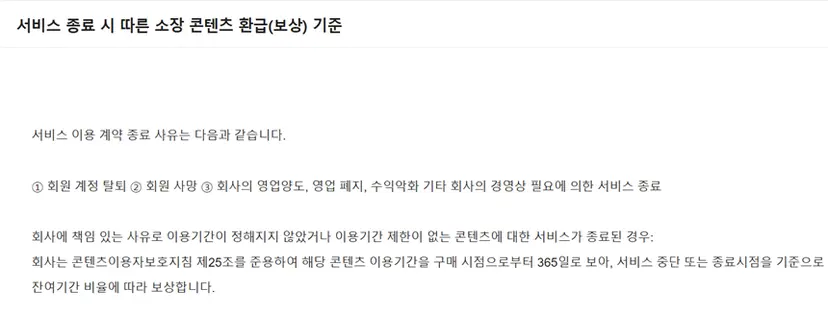
In its customer center's "Refund (Compensation) Criteria for Owned Content Upon Service Termination," Naver Webtoon states that if a service is terminated due to company reasons, "the usage period for the content is considered to be 365 days from the time of purchase, and compensation will be provided based on the remaining period as of the time of service suspension or termination." For instance, if you purchased content for 20,000 won on April 1, 2024, and the service terminated on March 31 of this year, you could receive a refund of approximately 1,640 won. However, if more than one year has passed since the purchase date as of the service termination date, no compensation is provided.
The industry claims it is difficult to codify rules for hypothetical business closures. Kakao Webtoon and KakaoPage state in Article 11 of their terms that in the event of user harm, compensation will be provided in accordance with the Content User Protection Guidelines and Consumer Dispute Resolution Standards. Ridibooks only explained the refund procedures for unused remaining cash when guiding users on service discontinuation. Toptoon also did not provide a separate compensation plan for ownership rights related to service closure, simply stating that "content available for download or streaming cannot be refunded as the value of the goods is significantly reduced upon use."
An industry official replied, "It is difficult to disclose how the compensation process will proceed." Another official sought to draw a line, stating, "Peanutoon is a very exceptional case," adding, "It is expected that the majority of platforms will provide appropriate compensation in accordance with government guidelines."
While there are differences between platforms, the limitation of compensation to a one-year period and the failure to properly explain the nature of ownership rights are cited as limitations. According to the Content User Protection Guidelines issued by the Ministry of Culture, Sports and Tourism, if the contract period is not fixed or is indefinite, users cannot effectively receive a refund if more than one year has passed since the usage date. Even this is merely a recommendation, not a mandatory requirement.
Voices among authors are calling for discussions on protecting user rights as the webtoon industry grows. The Cartoonist Association of Korea and the Korea Webtoon Writers Association have issued two statements and have announced that they will respond to user rights and author serialization rights at the association level. It is understood that the Author Countermeasures Committee within the Cartoonist Association is currently in communication with Peanutoon and affected authors.
Seo Beom-gang, chairman of the Korea Webtoon Industry Association, said, "Because even a corporation is not permanent, it may be difficult for a truly permanent ownership right to exist. If it is not ownership in the true sense, there is a need to clarify rights by subdividing concepts into short-term and long-term rentals." He added, "We could propose an agreement on service concepts and terminology, as well as pop-up windows that re-notify users of the nature of the product at the time of payment."